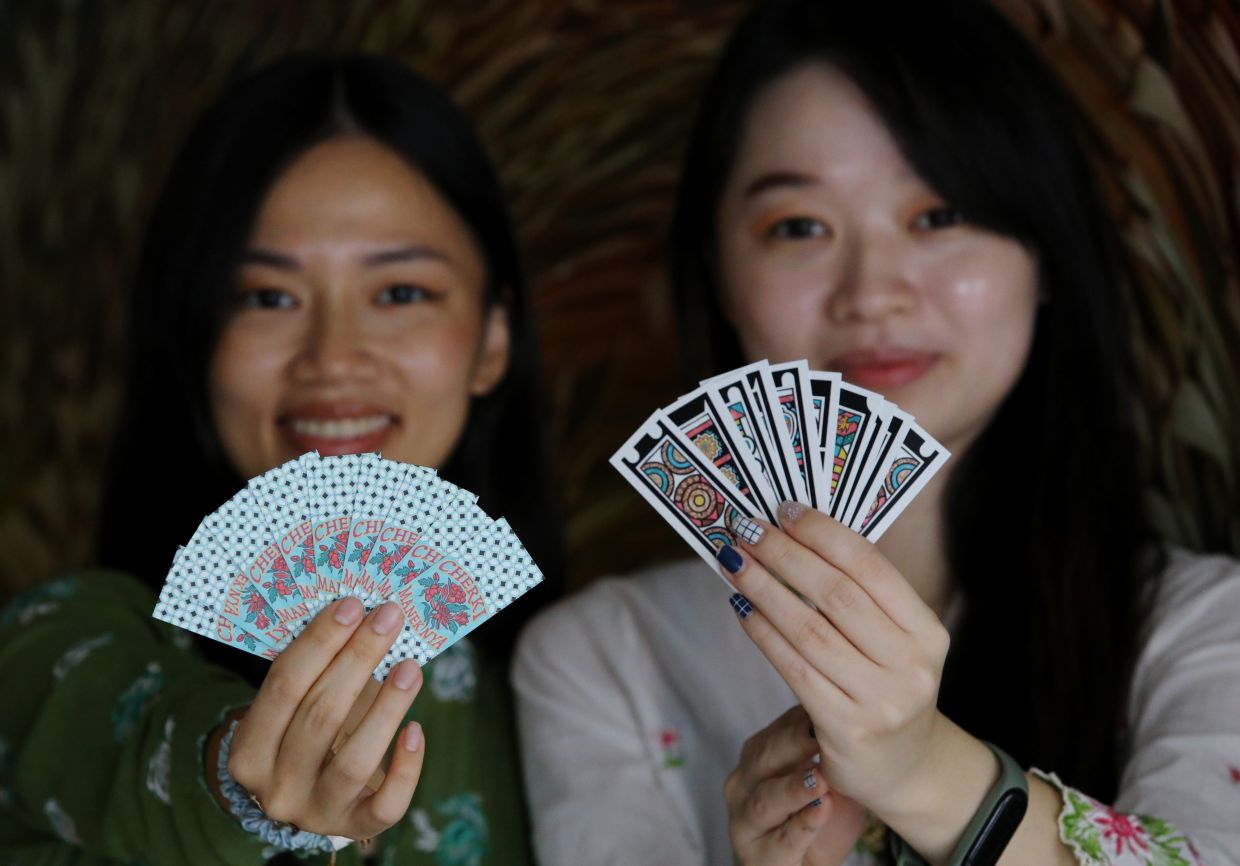
Malaysian Peranakan heritage encompasses far more than the beaded slippers, baju kebaya and iconic hand-painted tiles that populate heritage museums and tourist brochures. Among the lesser-known but equally significant elements of this rich cultural legacy lies Cherki, a card game that once graced household gatherings throughout Baba Nyonya communities but has largely faded from memory. Sisters Lee Swee Lin, 32, and Lee Swee May, 31, are determined to restore this overlooked tradition by introducing a redesigned version that marries contemporary visual aesthetics with authentic cultural symbolism.
The Melaka-born entrepreneurs, who operate a Kuala Lumpur-based enterprise specialising in Peranakan beaded footwear and decorative pieces, recognised a cultural void emerging within their own generation. Traditionally rendered in simple black-and-white designs, Cherki cards suffered from the dual challenge of declining familiarity and diminishing appeal to younger players accustomed to modern gaming aesthetics. The sisters recognised an opportunity to preserve a disappearing tradition by making it visually engaging while maintaining its essential character and historical authenticity.
Their inspiration stemmed deeply personal: their paternal grandmother Deo Yeok Kim, who passed away recently, served as the wellspring of their understanding of Peranakan culture. Growing up in their grandmother's Melaka household, the Lee sisters absorbed not merely games and craftsmanship but an entire philosophy of cultural transmission. Every element of their beading business—skills learned from their mother and grandmother—carries embedded meaning rooted in Peranakan traditions. Their decision to revive Cherki represented a natural extension of this lifelong engagement with heritage preservation.
The broader context of their initiative reflects a concerning trend within Malaysia's Peranakan communities. The Persatuan Peranakan Baba Nyonya Malaysia estimates the nation's Peranakan population at 10,000 to 15,000 individuals, with membership in the association currently standing at 3,000. Yet demographic research and cultural studies paint a troubling picture of disconnection. A 2022 academic study examining cultural transmission between original and new-generation Baba Nyonya descendants highlighted how younger community members face increasing exposure to global popular culture, digital entertainment and modern lifestyle pressures that compete with traditional practices for time and attention.
According to deputy president Lee Yuen Thien of the Peranakan association, contemporary challenges to cultural continuity extend beyond simple generational indifference. Career pressures, geographic dispersal away from ancestral heartlands in Melaka and Penang, mixed marriages, and shifting family dynamics have fundamentally altered how heritage knowledge circulates within communities. Many younger Peranakans, particularly those pursuing demanding professional careers, find cultural activities deprioritised amid competing demands on their time and energy. The informal mechanisms through which grandmothers once transmitted knowledge—watching, listening, participating in daily routines—have eroded significantly.
Cherki itself carries historical significance extending well beyond Southeast Asia. The card game, also known as Ceki, Chi Kee or Koa in various languages, traces its ancestry to China's Tang Dynasty, with written records from the 9th century documenting a "leaf game" that eventually spread westward along trading routes. By the 14th century, card games had reached Europe, while simultaneously becoming embedded in Southeast Asian cultures. In Malay, the cards were termed daun ceki—daun meaning "leaf"—a nomenclature adopted by Peranakan communities. The game mechanics parallel mahjong: two decks containing 60 cards featuring 30 distinct patterns repeated twice, divided into three suits representing coins, strings and myriads, with values from one to nine plus special cards designating flowers and high-value pieces.
The Lee sisters commenced their research and development process in 2024, enlisting a small design team equipped with digital tools including Procreate and Adobe Illustrator. Rather than merely colouring traditional designs, they pursued a more sophisticated approach: introducing vibrant hues and contemporary illustrations while embedding distinctly Peranakan symbols throughout the redesigned deck. Each value card incorporates culturally specific imagery—the kantan fragrant flower central to Nyonya cooking, chupu porcelain jars traditionally used for serving, kerongsang ornamental brooches securing the kebaya, and gelang bracelets worn by Nyonya women. The new deck retains the original 30 patterns but repeats them four times instead of twice, with the special cards rebranded as butterfly, dragon and phoenix—symbols of prosperity and cultural significance.
Concurrently, the sisters recognised that younger potential players often lacked familiarity with traditional rules. They developed clearer, more accessible instructions designed to lower barriers to entry without compromising the game's essential mechanics. This pedagogical consideration reflects contemporary understanding of cultural preservation: traditions need not remain frozen in time to retain authenticity. Instead, careful adaptation can enhance accessibility while honoring fundamental character. The revamped Cherki achieves what many heritage preservation efforts struggle to accomplish—making historical tradition feel immediately relevant and visually appealing to contemporary audiences.
Swee May articulated the underlying philosophy guiding their redesign: the objective was not creating a museum piece but developing a game people genuinely wanted to play with friends in present-day contexts. The modernised aesthetic—colour, contemporary illustration techniques, polished presentation—ensures Cherki competes effectively against digital gaming and contemporary entertainment options. Simultaneously, preservation of traditional Peranakan patterns and symbolism ensures that players engaging with the redesigned cards absorb cultural knowledge almost incidentally, experiencing heritage through gameplay rather than formal instruction.
Tan, manager of the Baba & Nyonya Heritage Museum Melaka, emphasises that cultural evolution need not equate to cultural dilution. Rather, allowing traditions to evolve with changing times while simultaneously increasing awareness among younger generations creates genuine prospects for continuity. Migration patterns, lifestyle shifts and intercommunal marriages have irreversibly transformed Peranakan communities; acknowledging these changes while creating new pathways for heritage engagement represents a more realistic preservation strategy than attempting to freeze culture in historical form.
The sisters' initiative addresses a fundamental challenge confronting minority communities across Southeast Asia: how to maintain cultural distinctiveness amid globalisation and rapid social change without alienating younger members who have internalized different aesthetic and entertainment preferences. By situating Cherki within contemporary design sensibilities while foregrounding its historical and cultural significance, the Lee sisters have created a model potentially applicable to other endangered cultural practices. Their work suggests that heritage preservation and modernisation need not exist in opposition; instead, thoughtfully executed adaptation can serve as a bridge reconnecting dispersed communities with ancestral traditions.
The success of their redesigned Cherki will ultimately depend on uptake within Peranakan communities and among broader Malaysian audiences intrigued by cultural heritage. However, their fundamental contribution transcends commercial success. By demonstrating that traditional games can be simultaneously visually contemporary and culturally authentic, the Lee sisters have challenged the assumption that heritage preservation requires aesthetic stagnation. They have created space for younger Peranakans to encounter their culture through a medium that feels immediately accessible rather than antiquated—a crucial distinction for communities seeking to transmit traditions across generational divides shaped by digital technology and globalised popular culture.

