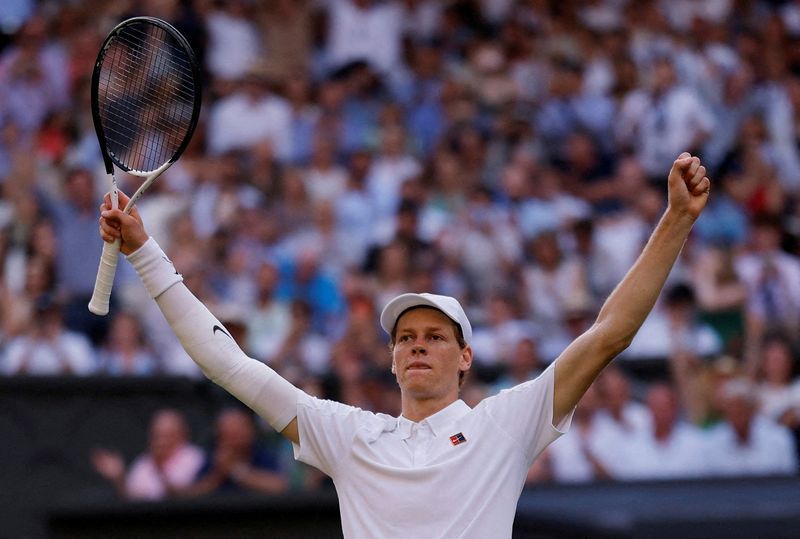
Jannik Sinner returns to Wimbledon as the defending champion, but the Italian's armour of dominance has been noticeably dented heading into this year's tournament. After an extraordinary run of form across the spring season, particularly on clay courts, the world number one collapsed in Paris last month, suffering a second-round exit that severed his 30-match winning streak dating back to February. As the All England Club prepares to host the grass-court Grand Slam from Monday, Sinner faces the dual challenge of restoring confidence in his game while proving he possesses the resilience to maintain his place atop the rankings when competition reaches its apex on the sport's fastest surface.
The 24-year-old's stumble at Roland Garros has raised uncomfortable questions about his durability through the rigours of back-to-back major tournaments. Leading up to the French Open, Sinner compressed an intense schedule with minimal downtime for recovery and dedicated training, a grinding approach that ultimately extracted a physical toll. Despite carrying the weight of expectation as defending champion at Wimbledon, the Italian has chosen to bypass traditional warm-up events, a decision that reflects both his need to rest and the risk of arriving under-tested. Seven-times Grand Slam champion Mats Wilander, assessing Sinner's prospects, suggested the setback in Paris stemmed purely from exhaustion rather than diminished capability, noting that the extended preparation period had left Sinner depleted just when he needed to perform.
Wilander's diagnosis offers qualified encouragement for Sinner's Wimbledon campaign. The veteran analyst believes recovery time should restore the Italian to peak condition, positioning him as the leading favourite despite the mental sting of early elimination at Roland Garros. However, Wilander's caveat proves equally significant: grass courts present their own particular challenges that extend beyond raw talent and current form. The surface's unpredictability and the speed of play place premiums on movement patterns and rhythm that sometimes favour players with different stylistic strengths. This uncertainty has created an opening for a constellation of challengers who scent vulnerability in Sinner's position and view the tournament as genuinely winnable.
Novak Djokovic emerges as perhaps the most formidable threat to Sinner's title retention, a conclusion underpinned both by historical record and current circumstances. The Serbian veteran possesses the precise return of serve and lateral movement that grass courts reward, attributes that complement his relentless competitive hunger. Djokovic will pursue an eighth Wimbledon crown, which would match Roger Federer's legendary haul and cement his grass-court legacy. More pressingly, at age 39, Djokovic hunts a 25th Grand Slam title to stand alone atop the all-time rankings, an achievement that becomes statistically more distant with each passing tournament. His early exit at the French Open, ordinarily a disappointment, conversely offers psychological advantage: Djokovic can mentally reset, strip away expectations, and approach Wimbledon as a genuine opportunity rather than a secondary objective.
Former American finalist Andy Roddick articulated this strategic reframing with insight, noting that Djokovic can credibly convince himself that grass represents his domain for this particular tournament. The Serb last captured Wimbledon four years ago, an interval that reinforces rather than undermines his candidacy given how few players maintain such longevity at the highest level. Roddick's observation captured the psychological calculus operating in Djokovic's favour: while he may no longer occupy his physical prime, the question becomes not whether he remains elite but whether elite suffices to triumph. In a field lacking the usual dominance of a player like Carlos Alcaraz, that mathematical simplification works substantially in Djokovic's favour.
Alexander Zverev, meanwhile, arrives at Wimbledon riding a wave of vindication after capturing his maiden Grand Slam title at Roland Garros. The German's long-overdue breakthrough fundamentally alters the tournament's competitive landscape, signalling that Zverev has finally converted raw physical attributes into sustained performance. Boris Becker, assessing Zverev's prospects with the authority of a six-times major winner, positioned the German as Wimbledon's leading favourite following Alcaraz's injury absence. Becker's reasoning centred on a simple truth: Zverev's exceptional serving ability, refined across his career, translates perfectly to grass-court demands. On a surface where a dominant serve can effectively neutralise opponents' return capabilities, Zverev possesses the foundational weapon to reach the semi-finals almost by default, thereafter facing opponents compromised by the grind of earlier rounds.
Zverev's transition from clay to grass represents his second consecutive Grand Slam campaign, a continuity that confers tactical familiarity even as surface requirements shift dramatically. The 29-year-old will adapt serving strategies and aggressive groundstroke patterns refined in Paris, elements that form the core of his game across all surfaces. What distinguishes grass is that these same attributes gain multiplicative advantage through the quicker court speed and lower bounce heights. Where clay demands patience and constructed points, grass rewards initiative and aggressive tennis that fits Zverev's natural inclinations. His Grand Slam breakthrough, psychologically, removes the question mark hovering over his ability to win majors, a burden that previously influenced his preparation and mental approach to such tournaments.
Carlos Alcaraz's enforced absence looms as perhaps the tournament's most consequential factor, reshaping the narrative entirely in favour of challengers. The Spanish prodigy had captured consecutive Wimbledon titles in 2023 and 2024, demonstrating the capacity to dominate grass courts with the same authority he exerted on clay. His injury removal creates a vacuum across the draw where previously only Sinner and Alcaraz possessed the all-surface mastery to consistently neutralise specialists. This absence fundamentally redistributes winning probability among contenders like Djokovic and Zverev, who now inhabit a flatter competitive landscape where particular strengths carry greater weight.
Beyond the triumvirate of Sinner, Djokovic, and Zverev, a secondary tier of contenders possesses sufficient weapons to disrupt any narrative. American Ben Shelton and fellow countrymen Taylor Fritz and Frances Tiafoe each bring aggressive serving and powerful groundstrokes that threaten fancied opponents in concentrated matches. Roland Garros runner-up Flavio Cobolli represents the emerging generation still hungry to announce themselves at tennis's highest level. This depth of competition across multiple tiers distinguishes Wimbledon 2024 as genuinely open, a departure from recent years when Alcaraz's presence effectively controlled outcomes. The tournament that begins Monday will test not merely who possesses the greatest talent but who has best prepared for grass's unique demands and who can sustain focus across multiple rounds when opportunity beckons throughout the draw.
For Malaysian and Southeast Asian tennis enthusiasts, this Wimbledon campaign offers compelling intrigue precisely because outcomes feel genuinely uncertain. Sinner's status as defending champion typically confers significant advantage, yet his recent vulnerability has erased the aura of invincibility that typically insulates major champions from defeat. Djokovic's twilight quest for tennis immortality provides a narrative framework that transcends sport, capturing how ambition and excellence persist across decades. Zverev's breakthrough carries different resonance, representing the validation that patience and persistence ultimately deliver. As the grass courts at the All England Club prepare for the fortnight ahead, Sinner must rediscover the form that secured last year's triumph while managing the psychological weight of recent failure, a challenge that may ultimately prove more demanding than any opponent awaiting across the net.

