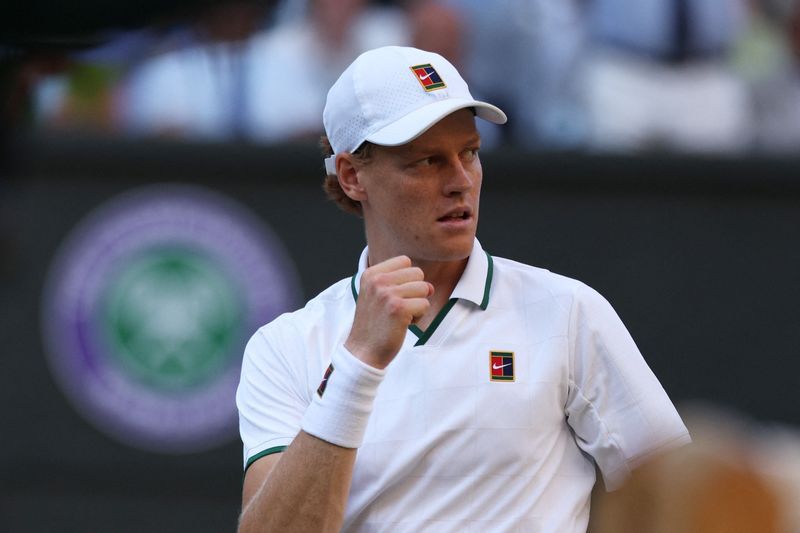
Italian tennis sensation Jannik Sinner has successfully defended his Wimbledon title, securing a hard-fought victory against Alexander Zverev in Sunday's final at the All England Club. The match saw Sinner triumph 6-7(7) 7-6(2) 6-3 6-4, claiming his fifth Grand Slam championship while simultaneously cementing his status among tennis's elite performers. This achievement positions Sinner in a select historical group—he becomes only the tenth man in professional tennis history to successfully retain the Wimbledon crown, an accomplishment that underscores his exceptional consistency on grass courts.
The 24-year-old Italian's dominance extends beyond this single tournament. His victory on Sunday represents his tenth consecutive win against Zverev, a streak that reflects the growing competitive gap between the two players despite Zverev's ranking as world number two. This particular advantage shapes the narrative around Sinner's emergence as a generational talent, though he remains one major title behind Carlos Alcaraz's seven Grand Slam championships. For Malaysian and Southeast Asian tennis fans, Sinner's sustained excellence at the sport's premier events offers compelling evidence of how emerging players can dethrone established champions through consistent preparation and performance under pressure.
The match itself was a gruelling affair that stretched beyond three hours, with both competitors displaying the intensity expected at a Grand Slam final. The opening set proved particularly competitive, with the two players locked in a prolonged battle that reached twelve games before reaching a tiebreak. Zverev demonstrated his capacity to perform at the highest level by executing a powerful forehand winner that secured the tiebreak and gave him the first set. The German player's aggressive approach during this phase suggested he possessed the weapons to challenge Sinner's title aspirations, and the Centre Court crowd responded to the elevated tennis on display.
However, Sinner's championship pedigree became evident in the second set, where he gradually seized the initiative. Although Zverev maintained his clean ball-striking, signs of frustration began surfacing as the set progressed. The tiebreak proved decisive, with Sinner demonstrating the composure required to convert the opportunity and level the match. This second-set recovery illustrated the mental resilience that distinguishes Grand Slam champions from merely accomplished players—the ability to respond to setbacks without allowing momentum to slip entirely away.
The third set witnessed a pivotal moment that altered the trajectory of the final. More than two and a half hours into the match, Zverev earned a break point opportunity, suggesting a potential shift towards the German. However, when Sinner executed a delicate drop shot, Zverev was caught off-guard, slipping and falling heavily onto the grass court. The second-seeded player struck his right knee in the tumble and remained on the court in obvious discomfort, clutching the affected area while the crowd fell silent in concern. Despite the injury, Zverev showed admirable determination by continuing to compete.
Yet the fall seemed to mark a turning point in Sinner's favour. Immediately after Zverev struggled to recover from his tumble, Sinner broke serve to establish a 5-3 lead, prompting the German to vent his frustration by slamming his racket to the court floor. By the time the third set concluded, Sinner had moved two sets ahead after nearly three hours of sustained competition. The physical and mental toll of the injury, combined with Sinner's improved positioning in the match, appeared to weigh heavily on Zverev's performance.
Sinner extended his advantage in the fourth set by breaking again for a 4-3 lead, capitalising on a brief dip in Zverev's play. From this point forward, the Italian's path to victory appeared increasingly certain. He held his service games with concentration and precision, refusing to allow Zverev opportunities to mount a comeback. The 24-year-old's composure in these closing stages reflected the experience of a player who has matured considerably within a short timeframe, transforming from promising prospect into major championship winner.
The conclusion came with characteristic emotion from Sinner, who collapsed to the grass surface in celebration upon clinching the victory. His post-match words to the crowd and himself revealed the weight he places on defending titles at Wimbledon. Speaking whilst holding the distinctive pineapple-topped Challenge Cup, Sinner acknowledged the enormity of returning to claim the title in consecutive years. He spoke of waking with nerves on Sunday mornings when facing finals, emphasising his refusal to take such opportunities for granted and expressing gratitude for the atmosphere created by spectators over the tournament's two-week duration.
For Southeast Asian tennis enthusiasts, Sinner's achievement carries broader implications. His rise represents a generational shift within professional tennis, where players from beyond the traditional European powerhouses are claiming major championships. The Italian's commitment to improving across all surfaces, combined with his mental fortitude in crucial moments, offers a template for emerging players throughout the region seeking to compete at the highest level. His trajectory also illustrates how sustained excellence requires more than raw talent—consistency, adaptation, and psychological strength prove equally vital.
Zverev's response to the loss demonstrated grace under difficult circumstances. The German acknowledged his multiple defeats to Sinner with self-deprecating humour, jokingly losing count of his nine-match losing streak against the Italian. In his post-match comments, Zverev recognised Sinner's current status as the world's dominant player while expressing the honour of having contested a Grand Slam final on Centre Court. This gracious acceptance of defeat, despite the obvious disappointment of a fourth Grand Slam final loss, reflected the professionalism expected of elite athletes.
The implications of this final extend throughout professional tennis. Sinner's successful defence of his title, coupled with his widening gap in head-to-head records against other top competitors, suggests that the Italian will remain a central figure in the sport's narrative for years to come. His pursuit of Alcaraz's seven majors appears increasingly plausible given his current trajectory and age. For regional fans and aspiring players, Sinner's consistent performance at the sport's most prestigious venues provides inspiration and a benchmark against which emerging talent can measure themselves as professional tennis continues to evolve.

