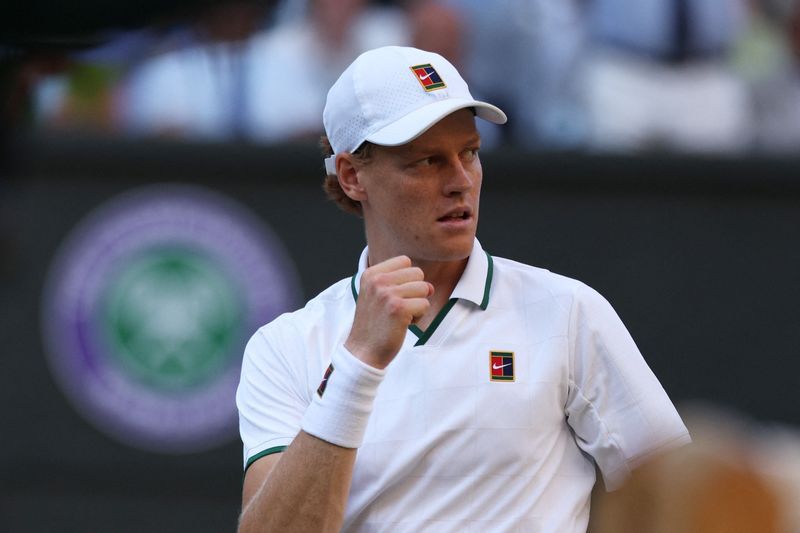
Jannik Sinner successfully defended his Wimbledon championship on Sunday, withstanding a determined assault from Alexander Zverev to claim his fifth Grand Slam title. The Italian top seed prevailed 6-7(7) 7-6(2) 6-3 6-4 in a match that stretched nearly four hours, cementing his place among the sport's elite defenders of the crown. Sinner's victory adds another significant achievement to a rapidly expanding resume that has established him as one of professional tennis's most formidable competitors.
The 24-year-old's triumph marked his tenth consecutive victory over Zverev, though the German world number two pushed him further than any previous encounter. Zverev arrived at the final riding momentum after capturing his maiden Grand Slam title at the French Open just weeks earlier, making his Wimbledon championship dream appear genuinely attainable. Despite his relative inexperience on grass, the 29-year-old German posed a legitimate threat to Sinner's dominance, seeking to become the first German man to claim the Wimbledon singles title since Michael Stich in 1991.
The opening set exemplified the intensity that would characterize the entire encounter. Contested over 65 minutes on a hot and breezy Centre Court, the set featured heavy-hitting from both baseline and serve. Zverev's forehand, historically a weakness during high-pressure moments throughout his career, functioned as a weapon rather than a liability. The German dropped only eight points on his opening serve and pushed Sinner to the tiebreak. There, Zverev ultimately secured the set after saving set point with an ace before striking a decisive forehand winner, snapping Sinner's remarkable streak of winning 14 consecutive sets against his rival.
Frustration visibly mounted on Sinner's face early in the second set as Zverev's serving appeared impenetrable. However, Sinner elevated his intensity dramatically in the second-set tiebreak, turning the match back in his favour through superior court positioning and aggressive shot selection. The sequence established a pattern that would define the remainder of the contest: Zverev capable of matching Sinner's power and precision, yet ultimately lacking the consistency required to sustain pressure across an entire set.
The decisive moment arrived approximately two hours and 42 minutes into the match, at 3-3 in the third set. Zverev earned his first break point opportunity, but as the Italian fashioned a delicate drop shot, the German slipped and fell awkwardly behind the baseline while attempting to change direction. Though Zverev claimed he remained uninjured, the tumble visibly affected his movement and mental fortitude. Sinner immediately held serve, then capitalized by breaking Zverev's delivery for the first time. The German's frustration boiled over as he launched his racket across the turf, a telling sign of mounting desperation.
While Zverev demonstrated resilience by regaining his composure in the fourth set, Sinner by then had entered a zone of absolute control. The Italian broke serve once more to establish a 4-3 advantage and sealed the victory with two spectacular rallies. The final point came after three hours and 46 minutes of relentless tennis, punctuated by thunderous serves and ferocious groundstroke exchanges from both players. Sinner cradled the distinctive pineapple-topped Challenge Cup, acknowledging the magnitude of successfully defending a major championship.
Sinner's achievement places him in rarefied company. By successfully defending his Wimbledon title, he became only the tenth man in the professional era to accomplish this demanding feat. For Malaysian and Southeast Asian tennis enthusiasts, Sinner's ascendancy represents a fascinating development in a sport historically dominated by European and American players. His emergence as a genuine three-surface competitor challenges the notion that Italian players struggle on grass, while his consistency across Roland Garros, Wimbledon, and hardcourt events suggests the beginning of a potentially dynasty-defining career phase.
The Italian's path to retaining his crown demonstrated remarkable mental resilience. He endured a second-round collapse at the French Open and narrowly avoided early elimination at Wimbledon against Miomir Kecmanovic, yet somehow rebuilt his form to peak precisely when it mattered most. His semi-final and final performances showcased championship tennis at its finest, with Sinner not surrendering a single service game across both matches. This defensive mastery proved the decisive factor against Zverev, whose service games, despite their formidability, lacked the impenetrability Sinner demonstrated.
Post-match, Sinner reflected on the profundity of competing at Wimbledon, describing it as possessing no equal among tennis venues. He emphasized the nervous energy accompanying a Sunday final and expressed gratitude for the opportunity, acknowledging the uncertainty surrounding future Wimbledon participation. This philosophical approach contrasts sharply with the invincibility often projected by tennis champions and hints at a maturity beyond Sinner's years. His willingness to credit Zverev's exceptional play, rather than dwelling on his own dominance, further distinguishes his demeanor among contemporary elite competitors.
For Zverev, the loss represented a fourth Grand Slam final defeat, yet his immediate future appears considerably brighter than his career's first three decades suggested. The 29-year-old accomplished what seemed impossible eighteen months earlier by capturing the French Open, followed immediately by a first Wimbledon final appearance. His performance against Sinner, despite falling short, demonstrated that he belongs among the sport's elite and possesses the capability to win additional major championships. Grass courts, long considered problematic for his game, proved manageable through his recent development and tactical adjustments.
Regionally, Sinner's sustained excellence carries implications for Asian tennis development. His youth, combined with his remarkable consistency across all surface types, establishes a template that young players throughout Southeast Asia might emulate. Malaysian readers, living in a tennis-passionate but achievement-limited region regarding Grand Slam titles, can recognize Sinner's journey as demonstrating how systematic development, proper coaching, and unwavering mental discipline eventually manifest in extraordinary results. His rise also illustrates how players from smaller tennis nations can overcome geographical and infrastructural disadvantages through talent and determination.
The match itself transcended tennis, becoming a compelling narrative of contrasting philosophies. Sinner represented controlled intensity and measured aggression, while Zverev embodied free-flowing power and risk-taking brilliance. Their contest reminded observers why Wimbledon remains sport's most coveted championship, where tradition, surface demands, and player excellence converge. Sinner's defence of his title ensures he will occupy considerable attention throughout the remainder of 2024, while Zverev's breakthrough major championship suggests the men's professional tour faces several years of compelling competition among a select group of genuine contenders. The final itself, oscillating wildly between triumph and disappointment across both players, encapsulated why grass-court tennis at the highest level continues captivating global audiences.

