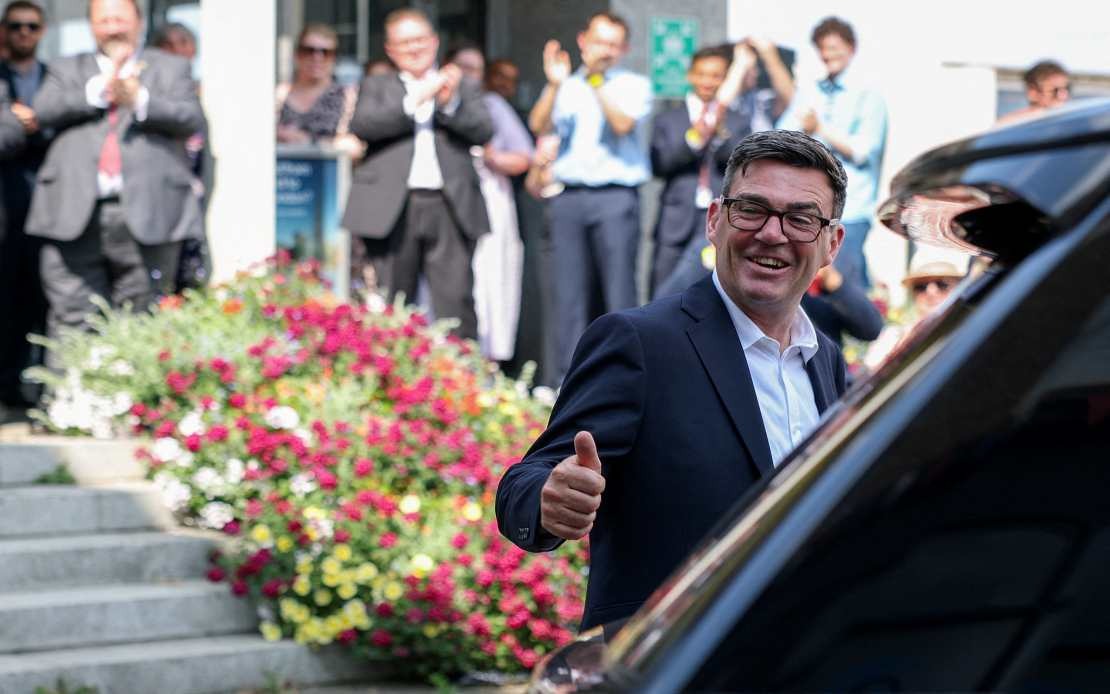
Lawrence Wong, Prime Minister of Singapore, has extended formal congratulations to Andy Burnham following his appointment as the United Kingdom's new prime minister this week. In a carefully crafted letter, Wong articulated Singapore's commitment to the bilateral relationship while casting an eye toward expanded cooperation during a period of significant geopolitical realignment. The timing of the message underscores the diplomatic importance Singapore places on maintaining strong ties with major Western powers, particularly as the global order undergoes substantial transformation.
Wong's message to Burnham struck a tone of measured optimism about the incoming British government's capacity to navigate complex international challenges. He extended wishes for Burnham's success in steering the United Kingdom through what Wong characterised as a time of "profound geopolitical and economic change," a diplomatic formulation that acknowledges the difficulties confronting Westminster while expressing confidence in the new administration's capacity to deliver stability for British citizens. This framing suggests Singapore views the transition as an opportunity rather than a source of concern, positioning the island nation as a reliable partner as Britain charts its course in the years ahead.
The core of Wong's message emphasised the deep institutional foundations underpinning Singapore-UK relations. He pointed to the Strategic Partnership framework as the bedrock of bilateral cooperation, a designation that reflects decades of accumulated trust and multifaceted engagement across numerous sectors. Singapore's characterisation of the relationship as "close and enduring" carries weight given the city-state's carefully calibrated approach to international relations, where such language is reserved for partnerships deemed genuinely substantive rather than ceremonial. The emphasis on relationship depth is particularly significant given Singapore's role as a global financial hub with interests spanning security, economics, and technology.
Wong identified specific areas where Singapore envisions expanded collaboration with the incoming British government. Innovation, science and technology, and defence emerged as the priority sectors, reflecting Singapore's strategic interests in maintaining technological edge and security partnerships. These domains are interconnected in contemporary geopolitics—technological advancement increasingly underpins military capability and economic competitiveness simultaneously. By highlighting these areas, Wong signalled that Singapore views Burnham's government as a credible partner for cooperation on issues central to the island nation's future development and regional security positioning.
A particularly noteworthy element of Wong's statement was his invocation of partnership resilience amid global uncertainty. He articulated the principle that trusted allies can achieve greater outcomes through collaborative effort even when international conditions prove unpredictable or volatile. This sentiment carries implicit reassurance for the British government, suggesting that Singapore—as a stable, prosperous, and strategically located nation—represents a reliable partner across economic cycles and geopolitical turbulence. For Southeast Asian observers, it underscores Singapore's philosophy of cultivating deep relationships with major powers as a means of advancing national interests through network effects rather than through singular alignment.
Singapore's emphasis on the United Kingdom's engagement with the Association of Southeast Asian Nations (ASEAN) and its role in regional security arrangements reveals the city-state's sophisticated understanding of British interests in Asia-Pacific affairs. Wong explicitly acknowledged the UK's status as an ASEAN Dialogue Partner—a formal designation that enables substantive engagement with the regional bloc—and highlighted British participation in the Five Power Defence Arrangements (FPDA), a security framework involving Singapore, Malaysia, and other Commonwealth nations. These references demonstrate that Singapore views UK involvement in Southeast Asian affairs as congruent with Singapore's own interests in maintaining a stable, rules-based regional order with involvement from major external powers.
Wong's message also contained an explicit forward-looking dimension anchored in upcoming institutional responsibilities. Singapore's assumption of the ASEAN Chairmanship and the United Kingdom's holding of the G20 Presidency in 2027 create a structural opportunity for coordinated leadership on global challenges. Wong framed these concurrent positions as enabling Singapore and the UK to collaborate on multilateral cooperation and address shared difficulties spanning both regional and global domains. This formulation suggests Wong views potential Burnham government as fundamentally committed to multilateralism—a crucial consideration for Singapore, whose security and prosperity depend substantially on effective international institutions and cooperative frameworks.
The diplomatic timing of Wong's message reflects established protocols whereby regional leaders acknowledge transitions in major-power governments with formal communications setting tone for the relationship period ahead. By extending congratulations promptly and articulating a constructive vision of future ties, Wong has positioned Singapore as a proactive partner rather than a passive respondent to British policy shifts. For Burnham and his incoming government, the message signals that Asian partners view Britain's regional engagement favorably and expect continued involvement in matters affecting Southeast Asia's strategic environment.
British Prime Minister Burnham's formal appointment came after Labour Party's electoral victory, with King Charles III inviting Burnham to form a government on Monday. This transition marked a significant shift in British politics and carries implications for how the new government will calibrate relationships with Indo-Pacific partners. Wong's message arrives at a moment when the new British administration will be formulating foreign policy priorities, making Singapore's emphatic expression of partnership value and collaborative possibility particularly timely. For Malaysia and other Southeast Asian nations, Singapore's diplomatic engagement with Burnham's government offers insights into how the region's most diplomatically nimble state is positioning itself within evolving great-power dynamics and institutional arrangements affecting Asia-Pacific stability and prosperity.

