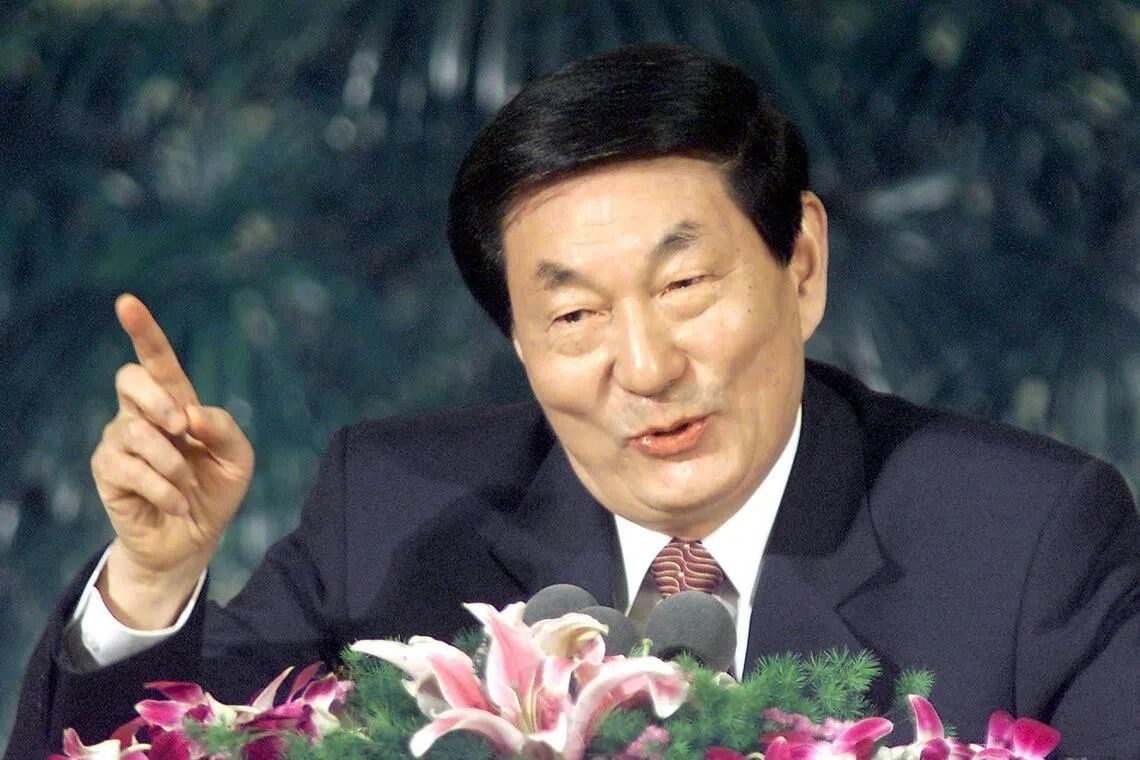
Prime Minister Lawrence Wong has extended formal condolences to Chinese Premier Li Qiang following the death of former premier Zhu Rongji, who passed away in Beijing on August 12 at the age of 97. Xinhua, China's official news agency, announced the loss just weeks before what would have been Zhu's 98th birthday. In his official letter dated August 13, Wong recognised Zhu's outsized influence on China's modern economic trajectory and his instrumental role in securing the nation's entry into the global trading system.
Zhu's tenure as premier spanned a transformative period in China's development, during which he championed the economic restructuring that would propel the nation toward becoming a major global power. Wong's tribute specifically highlighted Zhu's strategic leadership in navigating China's accession to the World Trade Organization in 2001, a milestone that fundamentally reshaped international commerce and cemented Beijing's integration into the rules-based trading order. The foresight and political determination required for such sweeping reforms were, in Wong's assessment, defining characteristics of Zhu's public service legacy.
The Singapore Prime Minister characterised Zhu as an enduring friend to the island nation, emphasising the former Chinese leader's extensive engagement with Singapore's past administrations. Wong noted that Zhu had maintained regular contact with Singapore's founding Prime Minister Lee Kuan Yew and his successor Goh Chok Tong throughout his career. These relationships reflected the broader strategic partnership that Singapore sought to cultivate with China, even as Beijing was undergoing profound domestic transformation during the 1990s and early 2000s.
A particularly significant moment in Singapore-China relations came in 1999, when Zhu became the inaugural Chinese leader to deliver the Singapore Lecture, an annual platform organised by the ISEAS – Yusof Ishak Institute that attracts prominent global statesmen and intellectual figures. In that address, Zhu articulated a vision of China's economic development as fundamentally beneficial not only to Beijing but to the broader Asia-Pacific region and the international community. His proposal for a free trade arrangement encompassing ASEAN and China was notably prescient, as it anticipated the deepening economic interdependencies that would come to define the region's trade landscape.
Wong observed that Zhu's strategic vision has proven substantially accurate in the intervening decades. The growing integration of China with Southeast Asian economies has indeed created a formidable economic bloc, with China now serving as a critical trading partner and investment source across the region. Singapore, in particular, has benefited substantially from this shift, leveraging its position as a financial hub and intermediary to facilitate commerce, finance flows, and technology transfer between China and the wider world. Wong's acknowledgment of this trajectory underscores how individual leaders' policy choices can echo across generations.
Beyond Zhu's role in shaping national policy, Wong recognised the practical institutional projects that Zhu championed to strengthen bilateral ties. The China-Singapore Suzhou Industrial Park stands as a tangible monument to this effort, representing a flagship government-to-government collaboration that embodied the potential for productive economic cooperation between the two nations. This project served not merely as a commercial venture but as a symbol of mutual confidence and shared developmental ambitions at a time when such partnerships were less common.
Additionally, Wong noted Zhu's encouragement of official exchanges and knowledge-sharing between Singapore and Shanghai during his tenure as the latter city's mayor. These interpersonal and bureaucratic connections, though less visible than major infrastructure projects, laid essential groundwork for the sustained dialogue and cooperation that would follow. The cultivation of human relationships and institutional channels proved as valuable as formal agreements in sustaining the partnership through periods of geopolitical tension or economic turbulence.
The Prime Minister's statement reflects Singapore's broader diplomatic approach toward China: acknowledging historical contributions to bilateral relations while maintaining the measured, institutionalised engagement that characterises Southeast Asian statecraft. For Malaysia and other regional nations, Zhu's legacy serves as a reminder that China's integration into global economic systems proceeded through deliberate policy choices and strategic partnerships with neighbouring countries, rather than occurring inevitably or automatically. Understanding these historical pathways illuminates how regional powers navigated China's rise and negotiated their own positions within an evolving regional order.
Zhu's passing marks the end of an era in Chinese politics—one in which economic pragmatism and carefully calibrated regional diplomacy played dominant roles. Wong's tribute suggests that from Singapore's vantage point, these qualities produced mutual benefits worth perpetuating. As ASEAN nations continue managing complex relationships with Beijing, the examples set by Zhu and Singapore's leaders during that formative period remain instructive. The institutional frameworks and trust mechanisms they established continue to facilitate dialogue even as political circumstances shift, demonstrating the enduring value of strategic foresight and sustained engagement in regional affairs.

