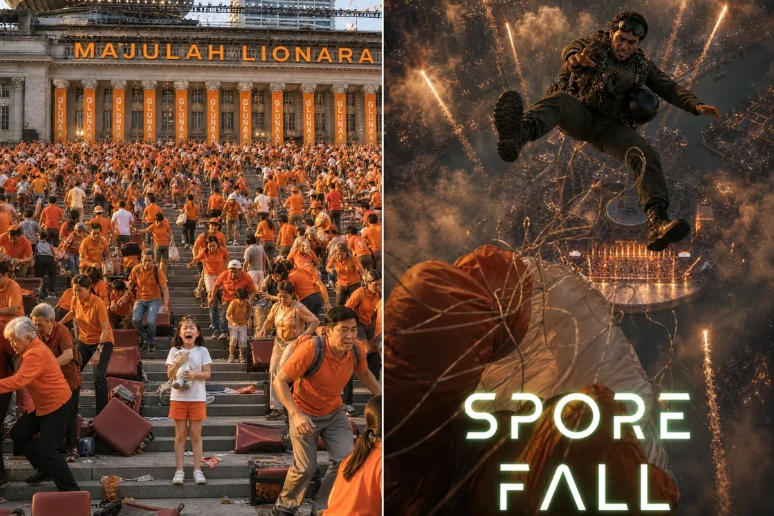
A Singapore-based creative studio has released a provocative four-minute film that reimagines one of the nation's most iconic celebrations as the backdrop for a zombie apocalypse scenario, deliberately inviting public scrutiny while defending the work as an affirmation of national strength. Edenstone, the production company behind the project, has prepared for waves of criticism by framing the dystopian vision not as cynicism but as a demonstration of faith in Singapore's capacity to withstand existential reimagining.
The short film, set in a fictional country called Lionara that visually mirrors Singapore, transforms the National Day Parade into a scene of chaos as a lethal spore pathogen unleashes zombie-like creatures upon crowds. Rather than obscuring its Singapore connections, the production prominently features recognisable landmarks including the Marina Bay skyline and the iconic Merlion, making the cultural displacement unmistakable to local audiences. This deliberate choice to ground science fiction horror in familiar national symbols represents a calculated creative decision that studio leadership anticipated would generate heated debate.
Studio founder Boh articulates the creative philosophy underpinning this approach in a way that reframes potential controversy as validation. The statement asserts that depicting a dystopian version of Singapore during its most patriotic occasion constitutes "the ultimate act of faith," suggesting that only nations confident in their foundational identity can afford to imagine themselves reimagined and reinvented. This argument inverts typical expectations about respectful national representation, proposing instead that creative courage and willingness to deconstruct cherished narratives signal genuine national confidence rather than disrespect.
The film's release arrives amid intense global scrutiny regarding artificial intelligence's role in creative industries and its potential to disrupt established production workflows and professional communities. Edenstone's project exemplifies how AI tools are being integrated into entertainment production beyond Hollywood's major studios, extending the debate to regional creators seeking to compete internationally. The timing and nature of the release suggest the studio is positioning itself at the forefront of this technological transition while simultaneously addressing mounting ethical concerns about automation and authenticity in creative work.
China has emerged as a significant testing ground for AI content regulation, with a viral AI-generated microdrama demonstrating both the technology's creative potential and the public's anxiety about distinguishing human from machine-generated work. In response, Chinese regulatory authorities have implemented comprehensive mandates requiring all AI-generated content to carry explicit labels and digital watermarks beginning September 1st, establishing what may become a template for regional governance of synthetic media. This regulatory momentum reflects governments' recognition that AI-assisted content creation requires transparent disclosure frameworks to protect audiences and maintain public trust in information sources.
The United States entertainment sector has also mobilised to establish protective boundaries, with major guilds including the Writers Guild of America and SAG-AFTRA negotiating strict contractual provisions governing AI deployment in production. These agreements focus on preserving employment pathways for human creators while preventing the use of AI to replicate or substitute for performers' and writers' labour without consent and compensation. The rapid development of these industry standards indicates that creative professionals worldwide recognise AI as a structural threat requiring negotiated protections rather than market-based solutions alone.
Edenstone's response to these ethical concerns provides a carefully calibrated defence of its approach. The studio contends that human creators retain complete authorship of narrative structure, scriptwriting, character development, emotional trajectories, and worldbuilding—the conceptual foundations of storytelling. AI tools, the argument proceeds, function as production accelerators deployed under strict human creative supervision, expanding the visual output capacity of the creative team without displacing human decision-making. This framework positions AI as a scaling technology rather than an autonomous creative agent, a distinction the studio emphasises repeatedly to address fears about technological displacement of artistic labour.
The distinction between using AI to accelerate execution of human-conceived ideas versus allowing algorithms to originate creative direction remains theoretically clear but practically ambiguous. As AI tools become more sophisticated in generating novel visual compositions, narrative suggestions, and character variations, the boundary between "acceleration" and "authorship" necessarily blurs. Edenstone's positioning suggests confidence that audiences and critics will accept this framing, though the studio's explicit preparation for polarised reactions indicates awareness that many will dispute this characterisation.
For Malaysian and Southeast Asian creative industries, Edenstone's venture carries significant implications regarding regional competitiveness in the global entertainment marketplace. The studio frames AI adoption explicitly as a means to help Singapore "compete on the global stage," suggesting that technological capacity represents an economic necessity rather than a mere creative choice. This framing may influence how other regional studios approach AI integration, potentially pressuring them to adopt similar tools to remain competitive or risk being outpaced by Singapore-based producers and international studios investing heavily in AI production capabilities.
The philosophical argument underpinning the film—that national confidence permits imaginative deconstruction of sacred symbols—resonates within Malaysian creative contexts as well, though local sensitivities around religious and national imagery may prove more restrictive. The studio's assertion that strong identities can withstand creative reimagining challenges conservative approaches to representation while acknowledging legitimate concerns about respect and appropriateness. Whether Malaysian creators might adopt similar strategies of respectful irreverence toward national symbols remains an open question that this Singapore precedent may partially inform.
Boh's insistence that "technology should serve the story, not the other way around" articulates the core tension animating current debates about AI in creative industries. This principle prioritises narrative vision and emotional authenticity as the directing force, with technological tools as subordinate instruments. If maintained consistently, this hierarchy would prevent AI from determining story direction, character motivation, or thematic emphasis—the deepest levels of creative authorship. Yet implementing this principle rigorously requires constant vigilance against the subtle ways algorithmic suggestions and generated options influence human creative choices through the accumulated weight of possibility and convenience.
The film's reception will likely reveal how audiences distinguish between these theoretical categories and what they actually perceive when engaging with AI-assisted work. Should the short film succeed in generating emotional engagement despite or because of its dystopian premise, it may validate Edenstone's argument about human creative primacy. Conversely, should viewers respond primarily by questioning the authenticity of the work or its ethical implications regarding Singapore's national identity, the studio's faith-based argument will face substantive challenge from audiences who experience AI-assisted creation not as acceleration but as fundamental alienation of creative authority.

