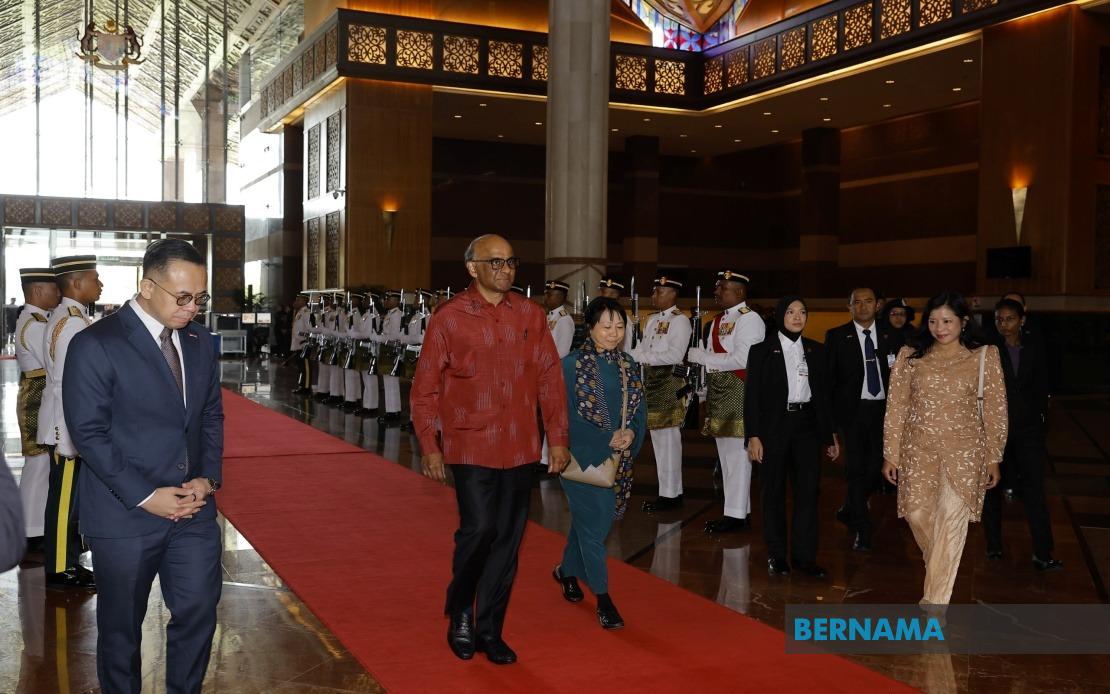
Singapore President Tharman Shanmugaratnam departed Malaysia on Monday afternoon, bringing to a close a three-day state visit that reinforced the deep institutional bonds between the city-state and its closest neighbour. The President, accompanied by his spouse Jane Ittogi and a high-level delegation, boarded a commercial flight from Kuala Lumpur International Airport Terminal 1 at 2.20 pm, marking the conclusion of a diplomatically significant engagement that highlighted the strategic importance both nations place on their relationship.
The departure ceremony at KLIA's Bunga Raya Complex reflected the formal nature of the visit, with a Guard of Honour mounted by officers and personnel from the First Battalion of the Royal Ranger Regiment. Malaysia's Minister of Entrepreneur and Cooperatives Development Steven Sim attended the farewell proceedings, underscoring the official character of Tharman's departure and Malaysia's respect for the visiting dignitary. The ceremonial aspects of international state visits, though often overlooked, serve as crucial diplomatic signalling mechanisms that reaffirm commitment to bilateral relationships in the eyes of both governments and their respective publics.
Tharman's visit commenced on Sunday at the formal invitation of His Majesty Sultan Ibrahim, King of Malaysia, representing the first major diplomatic engagement of its kind since the President assumed office as Singapore's ninth head of state in September 2023. The timing and nature of the visit carried particular significance, as it directly reciprocated Sultan Ibrahim's state visit to Singapore conducted on May 6 and 7, 2024. This reciprocal exchange of high-level visits demonstrates the mutual respect and commitment both nations maintain toward sustaining their relationship despite the historical complexities that have occasionally characterised their interactions.
The substantive elements of Tharman's itinerary encompassed meetings with Malaysia's most senior officials, beginning with a state welcoming ceremony on Monday followed by a formal audience with Sultan Ibrahim at Istana Negara. These ceremonial protocols are more than mere procedural formalities; they represent the constitutional and ceremonial frameworks through which Malaysia and Singapore conduct their most important diplomatic business. The audience with the Malaysian King provided an opportunity for the two heads of state to discuss matters of mutual concern and regional significance beyond the confines of ordinary ministerial channels.
Beyond the royal engagement, Tharman received a courtesy call from Prime Minister Datuk Seri Anwar Ibrahim, signalling the involvement of Malaysia's executive leadership in the bilateral discussions. The gathering included Foreign Minister Datuk Seri Mohamad Hasan, Investment, Trade and Industry Minister Datuk Seri Johari Abdul Ghani, and Minister Sim, indicating that the discussions likely touched upon trade, investment, and economic cooperation—the practical underpinnings of Singapore-Malaysia relations. These economic dimensions remain critical to both nations, as Singapore depends heavily on Malaysia for water, labour, and land connectivity, while Malaysia seeks Singapore's capital and technological expertise.
The visit extended beyond Kuala Lumpur's federal institutions when the Sultan of Selangor, Sultan Sharafuddin Idris Shah, granted an audience to Tharman at Istana Alam Shah. The inclusion of a state-level engagement demonstrates that Malaysia's approach to hosting the Singapore President encompassed not merely federal-level diplomacy but also recognition of subnational actors. Selangor, as Malaysia's most economically developed state and home to significant cross-border economic activities with Singapore, holds particular relevance in the bilateral relationship. This multi-level engagement strategy reflects the complexity of modern federalism and the recognition that state governments increasingly play roles in shaping regional economic and political outcomes.
For Malaysian readers and observers, this state visit carried implications extending beyond ceremonial niceties. Singapore remains Malaysia's closest economic partner in many sectors, serving as a crucial hub for Malaysian enterprises seeking regional and global market access. The strengthening of bilateral relations at the highest political levels creates favourable conditions for addressing practical issues that occasionally strain the relationship, including water agreements, security cooperation, and cross-border movement of goods and people. The regular exchange of high-level visits institutionalises dialogue channels that prove invaluable when disagreements emerge.
From a Southeast Asian perspective, the Singapore-Malaysia relationship functions as a bellwether for regional stability. Both nations are founding members of ASEAN, and their bilateral relationship influences the organisation's cohesion and effectiveness. Any significant deterioration in Singapore-Malaysia ties could reverberate across the entire region's diplomatic architecture. Conversely, displays of close cooperation, such as this state visit, reassure other regional powers that the cornerstone bilateral relationships within Southeast Asia remain solid despite occasional bilateral frictions.
The substantive outcomes and specific bilateral initiatives discussed during Tharman's visit have not yet been publicly detailed, but such visits typically generate joint statements outlining areas of cooperation, shared concerns, and commitments to future engagement. These documents, though often filled with diplomatic language, provide crucial guidance to officials implementing bilateral policies. The visit also serves to refresh personal relationships among senior political and bureaucratic leaders, relationships that prove invaluable when crises or urgent issues require rapid resolution without excessive formal procedure.
Looking forward, Tharman's successful state visit establishes a pattern of regular high-level engagement that Malaysian and Singapore officials will likely seek to maintain. The reciprocal nature of state visits—with Sultan Ibrahim having visited Singapore first—demonstrates a commitment to balanced engagement rather than hierarchical diplomacy. For Malaysian policymakers, maintaining this balanced relationship while managing occasional points of tension remains a central feature of regional strategy. The visit concluded on a positive note, having provided both nations' leadership with an opportunity to reaffirm shared values, discuss mutual concerns, and chart directions for bilateral cooperation in coming months.

