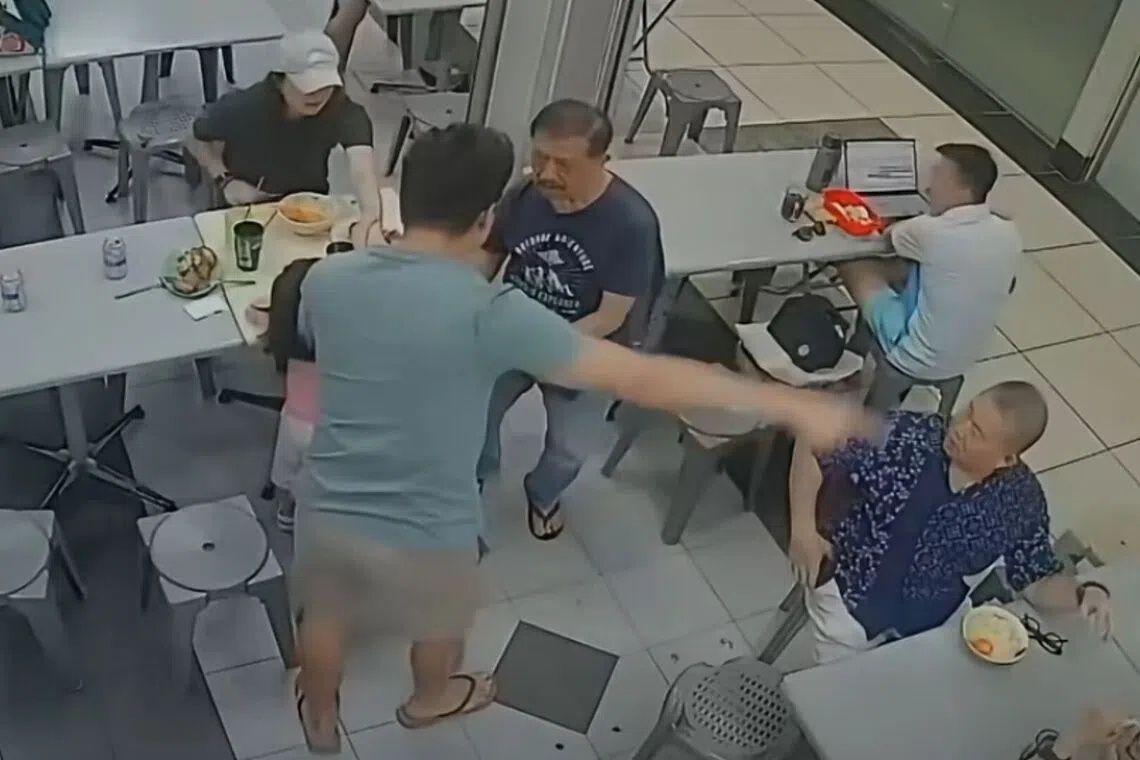
Singapore's police force is looking into a confrontation at a coffee shop in the East Coast area involving an elderly patron and another customer, with investigators now examining whether excessive force was used in response to an innocent gesture. The incident, which occurred in mid-August, was captured on security camera footage and subsequently shared online, prompting authorities to confirm they had received a report and opened a formal investigation into the matter.
The elderly man at the centre of the dispute was in his 70s and had been at the coffee shop helping out at a stall operated by his family. According to accounts provided by his son on Facebook, his father experienced mobility challenges and relied on the furniture around him to maintain balance as he moved through the venue. Despite his physical limitations, he remained an active presence at the family's stall, contributing to daily operations.
Security camera footage of the incident reveals the sequence of events in clinical detail. The elderly man is observed navigating through the crowded coffee shop by gripping the tables on either side to steady himself. As he passed by a table where a young girl was seated with adults, he reached out and gently touched the child's head in what appeared to be an affectionate, if somewhat uninvited, gesture. Such interactions, while sometimes viewed as paternalistic or presumptuous in modern contexts, are not uncommon in traditional Southeast Asian settings where elderly individuals may take familial liberties with younger people they encounter.
The situation escalated quickly when a woman at the same table, presumably a guardian or parent accompanying the girl, attempted to prevent further contact by brushing away his hand. This defensive action served as a flashpoint. A man who had been seated at the table—but had momentarily stepped away—rapidly returned upon witnessing the interaction. He initiated a verbal confrontation with the elderly patron, his tone and demeanor suggesting he perceived the head-patting as an inappropriate violation of his child or companion's personal space.
Within seconds of the verbal exchange beginning, the man proceeded to forcefully push the elderly customer to the ground. The physical assault was swift and severe enough to inflict injury. The elderly man's son subsequently reported that his father suffered from acute back pain in the aftermath of the fall, a particularly concerning development given the known vulnerabilities associated with age and bone density. The incident thus transformed from a minor social misstep into a matter of physical assault with potential long-term health implications.
The son's initial response to the incident was to appeal publicly for assistance in identifying the man responsible. His Facebook post, published on August 15 at 7:14 PM, outlined the sequence of events and requested that members of the online community help locate the individual. The post gained significant traction, reflecting broader public interest in street-level safety and the appropriate proportionality of responses to perceived infractions of personal boundaries.
Notably, the man who pushed the elderly customer subsequently approached him to apologise and offered him a drink, suggesting some measure of remorse or acknowledgment that his reaction may have been excessive. This gesture, however well-intentioned, could not undo the physical harm already inflicted. The offer of reconciliation through a beverage stands in sharp contrast to the violence of the preceding moment and raises questions about situational awareness and emotional regulation in public spaces.
Police confirmed on Sunday, August 16, that they had received the report and were actively investigating the circumstances surrounding the altercation. Their involvement signals that Singapore's authorities are treating the incident with appropriate seriousness, particularly given that it involved physical assault on an elderly and potentially vulnerable person. The investigation would likely examine whether the man's use of force was justified given the initial provocation, or whether the response constituted an unlawful and disproportionate assault.
The incident underscores broader tensions in densely populated urban environments regarding personal space, cultural norms, and the escalation of minor social conflicts into physical confrontations. In Singapore's multicultural context, assumptions about acceptable behaviour toward strangers vary significantly across different demographic and cultural groups. What one person views as harmless affection toward a child may be perceived by others as an invasion of privacy, yet most would argue that such disagreements should be resolved through words rather than violence.
By August 16, the son had posted again to thank members of the public for their expressions of concern and for sharing relevant information about the incident. However, he indicated that despite these efforts, the identity of the man involved remained unknown to him. This development suggests that while the incident generated substantial online engagement, concrete leads on identifying the perpetrator may have been limited or difficult to verify through social media channels alone.
The case raises important questions about self-defence versus excessive force, particularly in situations involving elderly individuals who may lack the physical capacity to pose a genuine threat. It also highlights how swift escalation from social friction to physical violence can occur in crowded public settings, and the role that perception and emotional reactions play in determining whether conflicts are resolved peacefully or devolve into assault. For Malaysian and other Southeast Asian readers, the incident serves as a reminder of how cultural assumptions about physical affection toward children and appropriate public behaviour can vary sharply, necessitating greater awareness and tolerance in increasingly diverse urban spaces.

