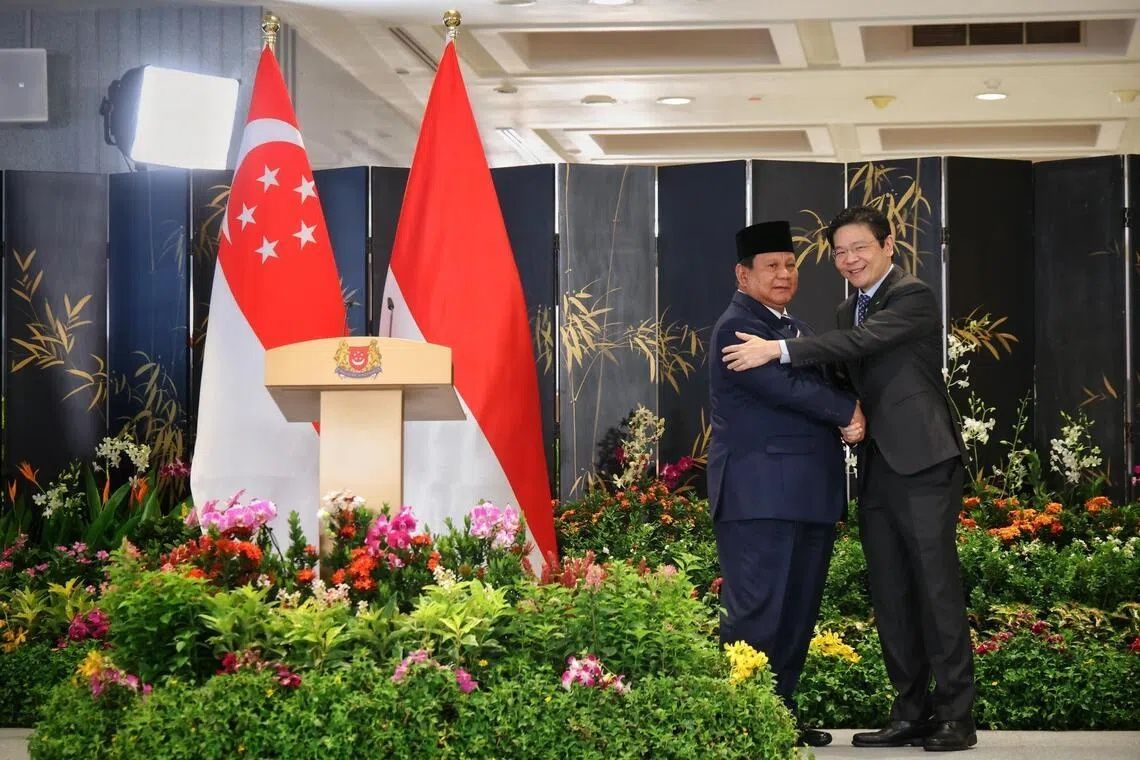
Prime Minister Lawrence Wong will travel to Jakarta on Monday, July 6, for a high-level strategic meeting with Indonesian President Prabowo Subianto at the Singapore-Indonesia Leaders' Retreat. The gathering represents the cornerstone of bilateral engagement between the two Southeast Asian neighbours, bringing together the most senior officials from both governments to chart the course of their relationship across multiple domains.
This will be the second retreat under the current leadership, with President Prabowo assuming the hosting duties in Jakarta. The previous edition took place in Singapore in June 2025, establishing a pattern of alternating venues that underscores the principle of equal partnership. The Prime Minister's Office described the retreat as an occasion to "reaffirm the deep and enduring bilateral ties between Singapore and Indonesia, and the commitment by both governments to deepening bilateral cooperation."
The agenda encompasses far more than ceremonial exchanges. Both leaders will review progress on bilateral projects initiated since their last meeting and receive detailed updates on the various initiatives underway between their administrations. Beyond project-specific discussions, Wong and Prabowo are expected to conduct a comprehensive exchange of perspectives on developments unfolding across the broader Asia-Pacific region and globally, allowing each government to better understand the other's strategic thinking and priorities.
The retreat is particularly significant given the expanding scope of Singapore-Indonesia cooperation in recent years. While traditional pillars such as trade, foreign investment, and defence have long anchored the relationship, both nations are now actively collaborating in emerging domains that reflect contemporary economic and environmental imperatives. These include the green economy transition, cross-border electricity trading arrangements, carbon capture and storage technology, artificial intelligence development, and digital connectivity infrastructure—all areas where Singapore and Indonesia possess complementary strengths and interests.
From an economic perspective, the relationship remains robust. Singapore maintained its position as Indonesia's leading source of foreign direct investment throughout 2025, channelling US$17.4 billion (S$22.4 billion) into Indonesian enterprises and projects. This substantial capital flow demonstrates the confidence that Singapore-based investors and multinational corporations headquartered there place in Indonesia's economy and growth trajectory, reinforcing the interdependence between the two nations.
The formal structure of the Leaders' Retreat distinguishes it as the paramount bilateral platform between Singapore and Indonesia. Unlike other diplomatic channels or working-level meetings, the retreat brings together the heads of government alongside senior cabinet ministers responsible for key portfolios, enabling holistic discussions that cut across sectoral boundaries. This comprehensive approach allows both sides to identify synergies and resolve issues that might otherwise remain compartmentalised within individual ministries.
Wong's delegation reflects the breadth of areas under review. Accompanying the Prime Minister will be Deputy Prime Minister Gan Kim Yong, whose commerce portfolio encompasses trade and industry matters central to bilateral economic ties. Coordinating Minister Chan Chun Sing, responsible for defence and public services coordination, will represent Singapore's security and governance interests. Foreign Minister Vivian Balakrishnan brings diplomatic expertise and regional perspective, while Minister Masagos Zulkifli and Minister Tan See Leng cover social development, manpower, and critical emerging sectors including energy and science and technology.
Historically, the retreat format has proven effective for Singapore and Indonesia to navigate their complex relationship. When the two nations last held a retreat in Indonesia in April 2024 at the Bogor Presidential Palace, then Prime Minister Lee Hsien Loong convened with then President Joko Widodo. Notably, both Wong and Prabowo were present at that meeting, with Wong serving as deputy prime minister and finance minister, while Prabowo attended as president-elect, positioning both as architects of the current trajectory of bilateral relations.
For Malaysia and other Southeast Asian observers, the Singapore-Indonesia retreat merits close attention. The two nations' ability to maintain strong institutional cooperation while managing geographical proximity and complex maritime boundaries offers lessons in regional statecraft. Additionally, their joint initiatives in areas such as green economy development and digital infrastructure carry implications for the entire region's economic competitiveness and climate transition efforts. Singapore's role as a financial and technology hub combined with Indonesia's vast resource base and market size creates dynamics that influence broader ASEAN economic integration.
The timing of this retreat also reflects Indonesia's reassertion of diplomatic leadership under President Prabowo. As Indonesia prepares to lead ASEAN in coming years and faces evolving geopolitical dynamics in the Indo-Pacific, strengthening ties with Singapore—a strategic partner with deep connections to global financial and technology networks—takes on heightened importance. Similarly, Singapore's engagement with Indonesia demonstrates its commitment to sustaining the bilateral relationships that remain central to its security and prosperity amid regional uncertainties.
In Wong's absence during the retreat, Coordinating Minister for National Security K. Shanmugam will assume the role of acting prime minister, ensuring continuity in Singapore's governance. This delegation of authority underscores the confidence in the institutional strength of Singapore's government and reflects the perceived importance of Wong's personal engagement with President Prabowo for advancing the bilateral agenda.
The retreat format, by bringing together decision-makers at the highest levels away from the formalities of capital-based diplomacy, creates space for candid discussion and strategic realignment where necessary. Such settings have historically proven valuable for resolving outstanding issues and identifying new opportunities before they become entrenched positions. For Singapore and Indonesia, where historical grievances and differing interests occasionally surface, the regular retreat provides a crucial mechanism for relationship maintenance and strategic recalibration.

