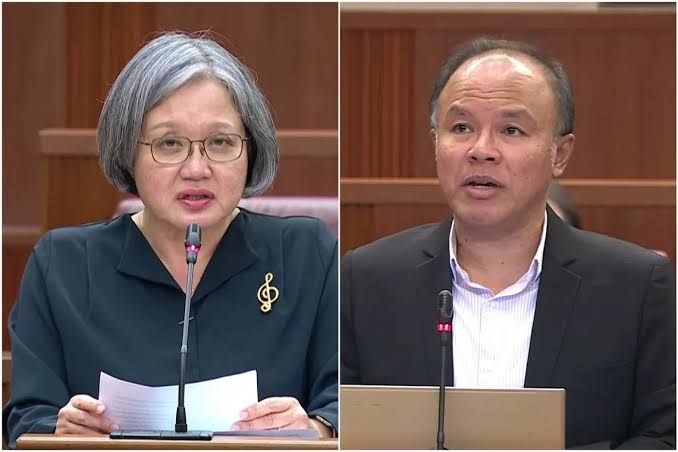
The Singapore Parliament has formally ended all further action against Workers' Party leaders Sylvia Lim and Faisal Manap regarding allegations that they misled a parliamentary committee, with Leader of the House Indranee Rajah confirming that the legal timeframe for imposing penalties has now elapsed. Delivered through a ministerial statement on July 7, this declaration effectively concludes a protracted political controversy that had dominated Singapore's parliamentary discourse for several years and marked one of the most significant integrity scandals to affect the opposition party since its election to Parliament.
The underlying dispute originated in 2021 when former Sengkang GRC Member of Parliament Raeesah Khan fabricated an anecdote about police conduct during a parliamentary speech. A subsequent Committee of Privileges investigation found that Workers' Party leader Pritam Singh had encouraged Khan to conceal the false account, while Lim and Faisal, both then representing Aljunied GRC, had attended a crucial meeting where the matter was discussed but subsequently provided misleading testimony to the inquiry. The committee determined that Pritam bore the greatest responsibility and referred him to public prosecutors for criminal proceedings, while Lim and Faisal were identified as playing subordinate roles, though still guilty of providing false information.
The criminal process against Pritam extended over several years, concluding only in December 2025 when the High Court upheld his conviction for lying to Parliament, having initially been convicted by the District Court in February 2025. This protracted legal journey created an unusual procedural difficulty: Parliament had deliberately postponed addressing the misconduct of Lim and Faisal pending completion of Pritam's case, intending to treat all three simultaneously once the criminal proceedings concluded. However, the timing proved consequential under the Parliament (Privileges, Immunities and Powers) Act, which constrains how long Parliament can pursue disciplinary action against its own members.
Indranee explained the technical constraint that rendered further action impossible. Section 22 of the parliamentary privileges legislation restricts Parliament's punitive authority to misconduct occurring either in the current parliamentary session or during the previous session of the preceding Parliament. The lapse of time between the initial conduct in 2021, occurring during the first session of the 14th Parliament, and the conclusion of Pritam's case in December 2025, which fell after the 15th Parliament had commenced following the 2025 general election, meant the new Parliament could no longer invoke disciplinary powers. In essence, the sequential nature of democratic elections and parliamentary sessions created a temporal barrier that rendered the formal penalty process unavailable, though Indranee emphasized this reflected legal constraints rather than any absence of misconduct.
The Leader of the House acknowledged that had the procedural timeline differed, she would have recommended a different course of action. Parliament had deliberately extended the benefit of doubt to Lim and Faisal while awaiting Pritam's criminal resolution, she noted, but this strategic patience inadvertently placed their conduct beyond the statute of limitations embedded in parliamentary privileges law. Indranee observed that in typical cases, Parliament resolves such matters swiftly within the same parliamentary session, but occasional circumstances necessitate carrying proceedings into subsequent sessions. Nevertheless, the law incorporates temporal constraints to establish finality and prevent indefinite postponement of parliamentary business, a principle she underscored while addressing why these specific provisions could not be overridden.
Despite the inability to impose formal penalties, Parliament retained alternative avenues for expressing institutional disapproval. Indranee indicated that the House could pass a motion formally signalling its disapproval of Lim and Faisal's conduct, though she noted such a step appeared redundant given that Parliament had already articulated its clear disapproval of dishonesty toward Parliament and its committees when it declared Pritam unsuitable as Leader of the Opposition in January. That earlier motion established Parliament's unequivocal position on the gravity of misleading legislative bodies, effectively communicating institutional censure without requiring additional formal action specific to the two junior figures in the controversy.
The High Court's December judgment upholding Pritam's conviction had independently validated the Committee of Privileges' original findings regarding Lim and Faisal's false testimony, Indranee observed. The court's determination essentially confirmed that both had indeed provided misleading information during the inquiry, even though only Pritam faced criminal consequences. This judicial confirmation of the committee's factual conclusions meant that while the legal pathway to parliamentary discipline had closed, the factual record establishing their misconduct had been reinforced through the criminal justice process, lending additional weight to the institutional record despite the inability to impose statutory penalties.
The controversy carries particular significance for Malaysian observers given the structural parallels between parliamentary systems in Singapore and Malaysia, particularly regarding how legislatures address misconduct by members and maintain institutional integrity. The case illustrates the complexities arising when parliamentary disciplinary processes intersect with criminal justice timelines, a challenge that any Westminster-influenced legislature might encounter. The question of how extensively Parliament should defer its own disciplinary authority pending criminal outcomes, balanced against principles of fairness and natural justice, represents a recurring tension within parliamentary governance that extends beyond Singapore's specific circumstances.
Lim responded to the ministerial statement by confirming she raised no objection to the conclusion, stating she had already presented her position regarding the relevant issues during the January parliamentary motion. She contended that references to her conduct in Pritam's appeal judgment relied upon prosecutorial evidence presented in court, where she had no opportunity to present a personal defence as she was not called as a witness in the criminal proceedings. This asymmetry—whereby court findings concerning her conduct were established through evidence she could not directly contest—underscores the peculiar position of Lim and Faisal, whose misconduct was determined through investigation and court processes where they possessed limited formal opportunity to present their side comprehensively.
The Workers' Party itself had addressed the matter internally during its general meeting on June 28, when party members voted to retain Pritam as leader despite his conviction, signalling the party's confidence in his continued leadership despite the serious breach of parliamentary conduct. That internal resolution preceded the parliamentary closure by approximately one week, allowing the party to resolve its own governance questions before Parliament formally ended the institutional matter. The timing reflected the party's determination to move beyond the controversy and refocus on substantive political work.
Indranee emphasized that observance of legal provisions, including temporal limitations within parliamentary privileges legislation, remained paramount regardless of sympathies regarding the underlying conduct. "Even though the Committee's findings have now been effectively confirmed by the High Court Judgement, the law, in this case the time bar provisions of PPIPA, must be observed," she stated, articulating the principle that institutional processes, however imperfect in their application to specific circumstances, must remain subordinate to governing legal frameworks. This declaration reflected the Parliament's commitment to operating within established constitutional parameters, even when those parameters produce outcomes that might seem incomplete or unsatisfying from certain perspectives.
The resolution of this extended episode marks a departure for Singapore's Parliament, which had maintained the matter in an active, pending status for approximately four years. The closure enables both the institution and the opposition party to redirect focus toward substantive parliamentary business and political competition, rather than remaining absorbed in historical misconduct proceedings. However, the case leaves broader questions regarding how parliamentary systems should structure their disciplinary timelines and procedural fairness guarantees when misconduct investigations extend across multiple parliamentary terms and electoral cycles—questions that will likely inform parliamentary practice discussions across Southeast Asia for years to come.

