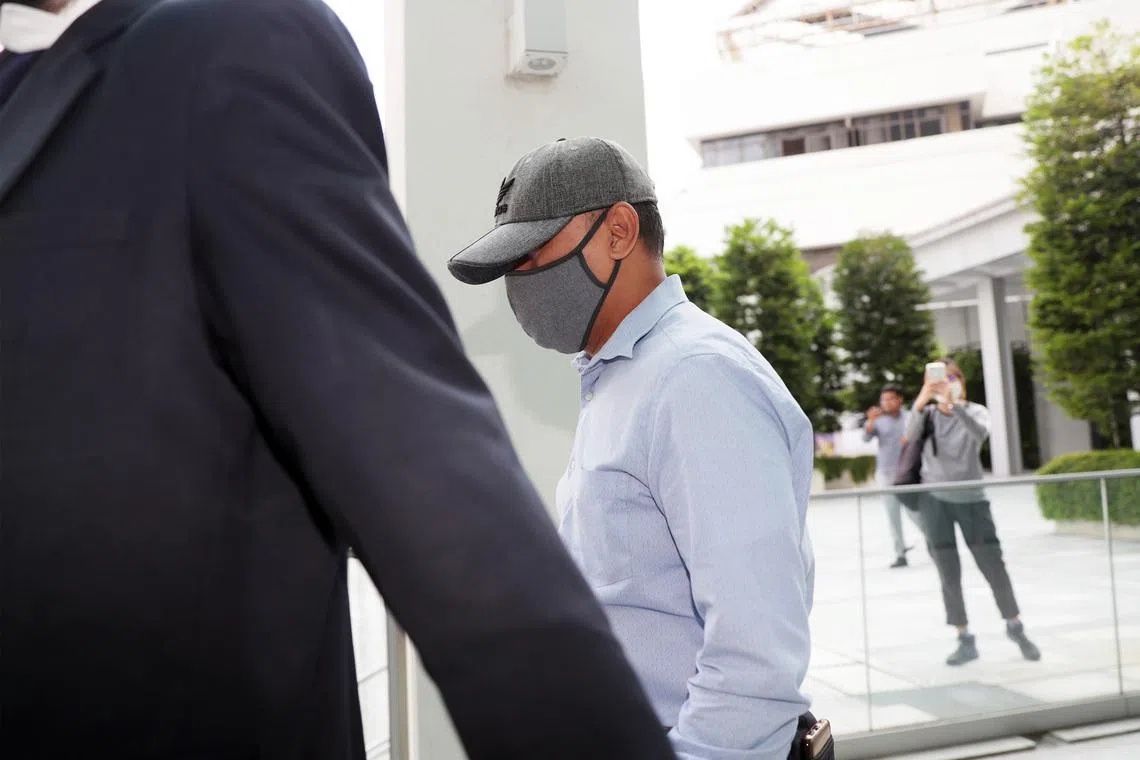
A former executive chairman of two Singapore mosques has been handed a 14-month jail sentence for abusing his position to illegally assist a friend's construction company in securing lucrative maintenance contracts. Abdul Rahim Mawasi, 59, exploited his role overseeing Darul Aman Mosque in Jalan Eunos and Sallim Mattar Mosque in MacPherson to provide pricing guidance that unfairly advantaged Zeal-Con Engineering, enabling the firm to win contracts totalling S$223,000. The conviction underscores the risks that arise when senior officials at religious and community institutions lack adequate oversight mechanisms, a concern that extends beyond Singapore to similar governance structures across Southeast Asia.
At the time of the offences, Abdul Rahim held dual positions as executive chairman of both mosques while simultaneously serving as a senior officer with the Islamic Religious Council of Singapore, having joined the council in 2005. His seniority and access to institutional decision-making processes proved instrumental in executing what prosecutors described as a carefully orchestrated scheme designed to circumvent competitive bidding procedures. The sophisticated nature of the arrangement—involving a shell company conversion, share transfers through family members, and deliberate concealment of financial interests—demonstrates how corruption at this level often involves layers of deception to evade detection.
The scheme originated in July 2018 when Abdul Rahim approached Mohd Mustaqim Kam, a construction industry executive he had known for over a decade, with an unusual business proposition. The two men agreed to establish a pilgrimage travel company with a novel arrangement: Abdul Rahim would contribute no initial capital, and instead would leverage his institutional position to direct construction contracts to Zeal-Con Engineering, the company where Kam held directorship. The profits generated from these contracts would subsequently become paid-up capital for their travel venture. This arrangement essentially transformed a public institution's resources into private equity for a commercial enterprise benefiting both men.
Darul Aman Mosque initiated the pattern in 2018 when it sought construction work for its yard area. Zeal-Con submitted an initial quotation of S$128,600 in August, but after Abdul Rahim provided crucial pricing intelligence to Kam, the company revised its bid downward to S$118,000 in September. This revised price undercut the closest competitor by S$7,500, positioning Zeal-Con as the lowest bidder. The court heard that management board members at the mosque remained entirely unaware that Abdul Rahim had conducted extensive discussions with Kam regarding bid strategy and had provided the price indicators that proved decisive in the tender outcome. On September 26, 2018, Zeal-Con secured the contract for the lower amount.
A parallel arrangement emerged at Sallim Mattar Mosque, where Abdul Rahim employed identical tactics. In September 2018, Zeal-Con quoted S$115,700 for renovation work encompassing the roof and reception areas. Following Abdul Rahim's intervention advising a price reduction, the company submitted a revised quote of S$105,000 the following year. Sallim Mattar Mosque subsequently issued contract awards linked to this lowered amount. The pattern of initial quotation followed by strategic downward revision—occurring at both institutions within a compressed timeframe—suggested coordinated action rather than genuine competitive pricing adjustments.
To obscure his financial interest in their joint venture, Abdul Rahim arranged for his son to hold shares in Amal Travel and Tour, the travel company eventually established through converted shell corporation assets. In November 2019, Kam allocated 25,000 shares worth S$1 each to Abdul Rahim's son, effectively transferring beneficial ownership to the family while maintaining plausible deniability. This arrangement allowed Abdul Rahim to claim non-involvement when questioned, though the prosecution successfully demonstrated through evidence that the share allocation represented disguised compensation for services rendered. Critically, Abdul Rahim failed to disclose his family's interest in the company to his employer, the Islamic Religious Council of Singapore, a material omission that itself constitutes a breach of fiduciary duty.
Abdul Rahim's accomplice, Kam, faced separate proceedings and received a six-month sentence in February 2025 for his role in orchestrating the scheme from the commercial sector side. While Kam initiated the partnership proposal, Abdul Rahim's institutional position and fiduciary responsibilities rendered his conduct more egregious from a legal perspective. The disparity in sentencing—14 months versus six months—reflects judicial recognition that public sector corruption, particularly involving religious institutions entrusted with community resources, warrants enhanced penalties. Deputy Public Prosecutor Bryan Wong emphasised during sentencing that Abdul Rahim had committed a serious public sector corruption offence for personal financial gain, regardless of whether the physical construction work itself was satisfactorily completed.
During trial proceedings, Abdul Rahim denied any involvement in Amal Travel and Tour through his legal representation by Satwant Singh Sarban Singh, maintaining he held no shares in the enterprise. However, the court found this defence unconvincing given evidence of strategic share transfers to his immediate family member and the suspicious timing of the company's establishment following the construction contract awards. The fact that Abdul Rahim did not personally hold shares proved irrelevant; ownership through family members constitutes an undisclosed conflict of interest and demonstrates deliberate concealment rather than genuine separation of interests.
The prosecution acknowledged that Darul Aman Mosque and Sallim Mattar Mosque did not sustain substantial financial losses, as Zeal-Con completed the contracted work satisfactorily. This technical point, however, does not diminish the severity of Abdul Rahim's conduct. Corruption prosecutions need not demonstrate actual damage to justify punishment; the abuse of institutional authority for private gain itself represents the harm society seeks to prevent. A mosque member expecting institutional resources to be allocated through fair and transparent processes has suffered a real injury to civic trust, even when the physical work performed meets acceptable standards.
The case carries broader implications for governance frameworks across Southeast Asian religious and community institutions, many of which operate with similar structural vulnerabilities. Senior officials at temples, mosques, churches, and community centres often exercise significant discretionary authority over contract awards with minimal external scrutiny, creating environments where corruption flourishes. Malaysia's own mosque management structures and waqf administration systems warrant examination to ensure comparable safeguards exist. The Abdul Rahim case demonstrates how personal relationships, when combined with institutional authority and inadequate transparency mechanisms, enable individuals to systematically redirect community resources toward private commercial interests.
Abdul Rahim's bail has been set at S$30,000, and he was due to commence his sentence on July 10. His conviction came after a full trial in April, indicating the prosecution overcame substantial defence arguments and presented compelling circumstantial and documentary evidence. The case represents one of Singapore's more sophisticated institutional corruption investigations, requiring financial forensics, timeline reconstruction, and detailed examination of pricing deliberations spanning multiple organisations. For regional observers, the prosecution's success in unravelling the scheme despite layers of concealment—including family intermediaries and shell company structures—offers instructive lessons in detecting complex corruption patterns within religious and community sector institutions.

