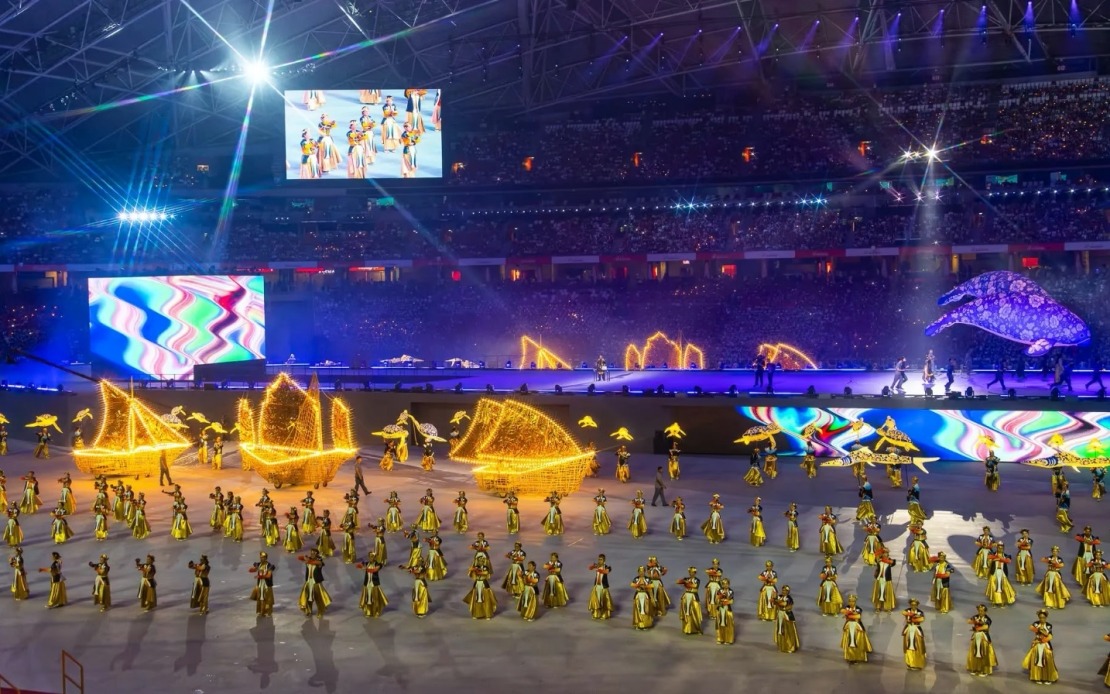
Singapore's 61st National Day celebrations unfolded on Sunday with a landmark moment for the island nation: the National Day Parade returned to the National Stadium for the first time in a decade. The sprawling ceremony, orchestrated under the banner "Majulah Singapura, Go Beyond!", brought together President Tharman Shanmugaratnam, Prime Minister Lawrence Wong, and senior Cabinet members alongside around 42,000 members of the public who packed the stadium in the traditional red and white colours. The event marked not merely a resumption of a beloved tradition, but a reimagined iteration that extended far beyond the confines of the iconic venue.
One of the most striking innovations this year involved a geographical expansion of the celebration's ceremonial core. For the first time in the republic's history spanning more than six decades, the Presidential Gun Salute and State Flag Flypast took place at Kallang Basin rather than exclusively within the stadium walls. This deliberate geographic shift demonstrated how Singapore's planners sought to democratise access to the pageantry, ensuring that thousands of additional spectators positioned throughout the broader Kallang precinct could experience the ceremonial elements firsthand. Four 25-pounder Howitzer guns, each mounted on a Mobility 3rd Generation raft, traversed the basin's waters in a striking military display that brought the experience into immediate proximity of far larger crowds than would have been possible in previous iterations.
The traditional 21-gun salute formed the backdrop to this expanded presentation. A total of 151 personnel drawn from the 23rd Battalion of the Singapore Artillery and the 35th Battalion of Singapore Combat Engineers executed the coordinated firing sequence, demonstrating the logistical coordination required to stage such a ceremony across multiple locations simultaneously. The ceremonial dimension commenced around 6 pm and unfolded under the thematic banner "Go Beyond Self", a concept that would prove central to understanding the philosophical direction the celebration intended to convey to Singapore's diverse population.
The parade itself comprised 32 distinct contingents encompassing more than 2,000 active participants, each representing different facets of Singapore's institutional and community structure. Six Guard of Honour contingents, drawn from the Singapore Army, Republic of Singapore Navy, Republic of Singapore Air Force, the newly established Digital and Intelligence Service, Singapore Police Force, and Singapore Civil Defence Force, escorted the SAF Colours Party in a formation involving 72 total participants. Beyond these formal contingents, the parade incorporated ten separate units from uniformed youth organisations and sixteen additional supporting contingents, creating a comprehensive representation of Singapore's security apparatus and youth development ecosystem.
Beyond the strictly military and ceremonial dimensions, the parade's cultural and entertainment components reached unprecedented scale. The show segment, directly aligned with the overarching "Go Beyond" theme, mobilised 36 featured artistes and more than 2,600 performers in a production designed to narrate contemporary Singapore's authentic lived experiences. Rather than presenting an abstract vision of national identity, the production centred on storytelling rooted in genuine Singaporean narratives, woven throughout with technological innovations that reflected the nation's forward-looking orientation and ambitions in an increasingly digital world. The accompanying musical composition provided emotional continuity throughout the performance, creating a cohesive artistic statement that transcended individual performance elements.
Particularly noteworthy was the deliberate inclusion of performers from underrepresented communities, signalling an important evolution in how Singapore's national celebrations conceptualise inclusive belonging. The show featured seven dancers representing diverse backgrounds, including notably an autistic dancer and a performer with Down syndrome. This intentional casting choice carried profound symbolic weight, articulating a national vision wherein every individual, irrespective of background, ability status, or other differentiating characteristics, possesses the capacity to meaningfully contribute to Singapore's collective future. Such representation in a high-visibility national ceremony sends powerful messaging about societal values and institutional commitments to inclusivity.
For Malaysia and other Southeast Asian nations observing Singapore's National Day evolution, several dimensions warrant consideration. Singapore's approach to modernising traditional ceremonies while maintaining their symbolic resonance offers instructive models for other regional celebrations. The expansion of the parade beyond a single venue to incorporate broader geographic and demographic reach reflects sophisticated thinking about public engagement and accessibility in an era when citizens increasingly expect governmental events to account for varied attendance capabilities and preferences. The emphasis on authentic storytelling rather than abstract nationalist rhetoric, combined with technological integration, presents a template that other nations might adapt to their own contexts and values.
The return of the parade to the National Stadium after a decade's absence also carries implications regarding post-pandemic recovery of large-scale public gatherings in the region. Singapore's confidence in mounting such an extensive event involving tens of thousands of participants, multiple venues, and complex logistical coordination signals broader regional comfort with reverting to pre-pandemic patterns of collective celebration and civic engagement. This confidence likely reflects both epidemiological assessments and psychological readiness to resume larger-scale public activities that define national identity expression.
The 2026 celebration also demonstrated Singapore's continued investment in ceremonial pageantry as a tool for nation-building and social cohesion. In an era sometimes characterised as one of declining civic engagement and fractionalised public discourse, Singapore's elaborate National Day productions serve as deliberate counterbalance, creating shared moments of national experience that cross generational, ethnic, and socioeconomic boundaries. The scale of participation, both as performers and spectators, underscores the continued relevance of such ceremonies in forging collective identity and shared purpose.
Looking forward, the innovations introduced in this year's celebration appear likely to establish new templates for future observances. The successful integration of expanded geographic venues suggests that Singapore's National Day celebration has entered a new phase of evolution, moving away from singular venue-centred formats toward distributed, network-based celebrations that can accommodate larger populations while maintaining ceremonial coherence and symbolic power. The demonstrated commitment to inclusive representation in both formal contingents and cultural performances indicates institutional recognition that contemporary national celebrations must authentically reflect the demographic and social reality of the communities they purport to represent.

