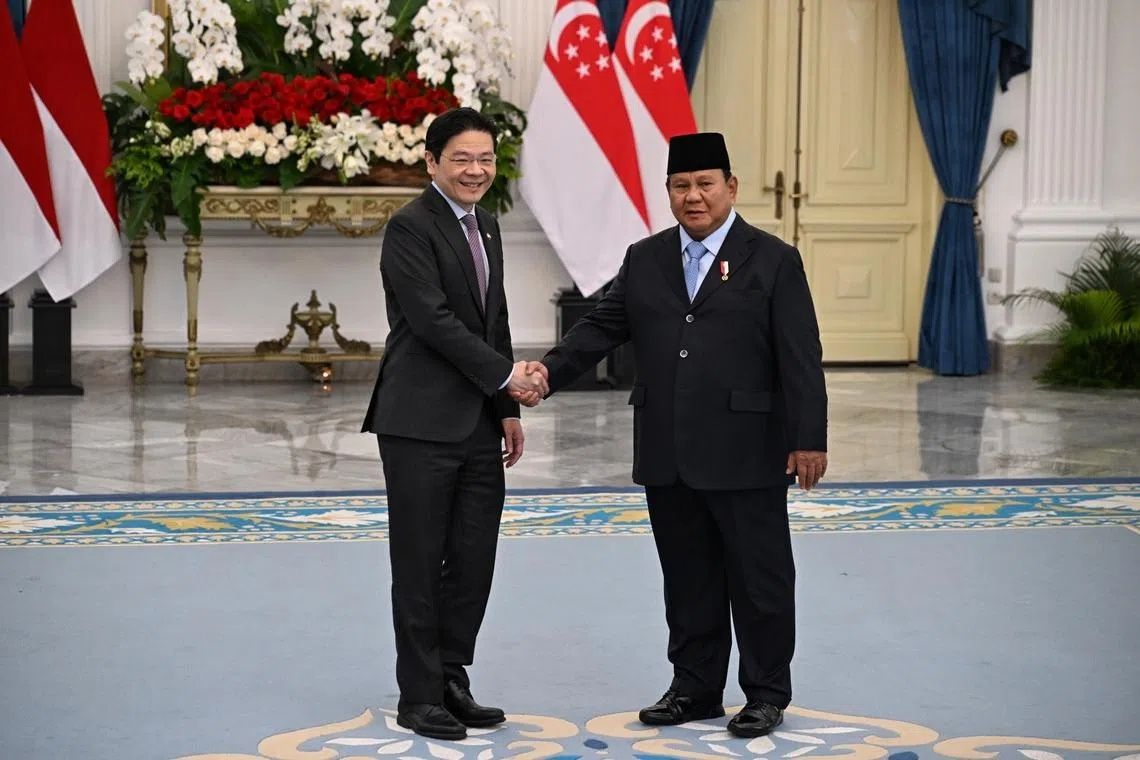
Singapore and Indonesia have reaffirmed their shared commitment to preserving the Strait of Malacca as an open and accessible maritime corridor, positioning the waterway's security as a cornerstone of their deepening bilateral relationship and regional stability efforts. The pledge emerged from talks between Prime Minister Lawrence Wong and President Prabowo Subianto at their annual Leaders' Retreat on July 6, underscoring how both nations view freedom of navigation through this critical chokepoint as inseparable from their economic and strategic futures.
The Strait of Malacca represents one of the world's most vital trade arteries, funnelling a substantial portion of global commerce and energy resources between the Indian Ocean and the South China Sea. Its geopolitical significance has only intensified as regional tensions mount and maritime challenges from piracy to environmental threats demand coordinated responses. For Malaysia and the broader Southeast Asian region, the security and accessibility of this passage directly affects everything from supply chain stability to energy security to inflation in consumer goods.
President Prabowo articulated Indonesia's position with particular clarity, noting that as direct neighbours sharing the strait's boundaries, both nations possessed overlapping interests in maintaining unfettered passage for all users. He emphasised Indonesia's intention to work closely with Malaysia and Thailand to ensure compliance with the United Nations Convention on the Law of the Sea, guaranteeing that the waterway would "always remain open to all, safe and accessible to anyone who requires access." This tripartite coordination mechanism reflects the understanding that the strait's security cannot be managed by any single country but requires institutional frameworks binding the littoral states together.
PM Wong connected the Strait of Malacca's importance to broader global supply chain vulnerabilities exposed by recent geopolitical shocks. He cited the Middle East tensions and their impact on the Strait of Hormuz as a cautionary example, highlighting how blockades or disruptions to major shipping lanes can reverberate through global economies within days. For Singapore, a trading hub dependent on the smooth flow of regional commerce, and for Indonesia, an economy increasingly integrated into regional value chains, maintaining open sea lines of communication translates into tangible economic benefits and reduced inflationary pressures.
Beyond maritime security, the two leaders signalled a strategic expansion of their partnership into sectors expected to reshape both economies over the coming decade. Renewable energy cooperation emerged as particularly significant, with both nations recognising that regional energy security depends increasingly on interconnected power systems rather than isolated national grids. This pivot reflects a recognition that the traditional bilateral relationship—built primarily on trade, investment flows, and security cooperation—must evolve to address shared challenges in energy transition, digital transformation, and supply chain resilience that transcend borders.
Cross-border electricity trade represents perhaps the most concrete embodiment of this new strategic thinking. Indonesia's announcement that its sovereign investment fund Danantara would lead implementation efforts, in partnership with Singapore firms including Keppel Electric, Sembcorp Industries, and Singapore Energy Interconnections, signals serious intent to move beyond preliminary discussions into pilot projects and eventually full commercial operations. PM Wong positioned this initiative as a building block toward a wider ASEAN Power Grid, a vision that would fundamentally restructure how Southeast Asia manages its energy resources and could dramatically improve the region's ability to absorb renewable energy generation.
The electricity trade arrangements carry particular resonance for Malaysia, which sits geographically between both nations and could potentially benefit from similar interconnections, reducing its dependence on coal-fired generation and providing greater flexibility in managing its own energy transition. The success or failure of the Singapore-Indonesia pilot will likely set the template for how other ASEAN nations approach cross-border power trading, making this initiative strategically significant far beyond the bilateral relationship.
The retreat also addressed cybersecurity and digital infrastructure cooperation, domains where both nations recognise mutual vulnerability in an increasingly connected regional economy. Disruptions to critical digital systems affect financial markets, supply chains, and essential services across borders, creating incentives for shared standards, information-sharing protocols, and joint capacity-building initiatives. For Malaysian businesses and policymakers watching this cooperation unfold, it signals that digital security is becoming as important a component of bilateral relations as traditional maritime security concerns.
PM Wong's repeated emphasis on Singapore's confidence in Indonesia's economic trajectory carries particular weight given the island nation's historical role as a bellwether for investor sentiment in Southeast Asia. His references to specific investment hubs—the Batam, Bintan and Karimun region, and particularly the Kendal Industrial Park in central Java—reflect a deliberate strategy to highlight Indonesia's investment attractiveness at a time when supply chain diversification away from China is accelerating. The Kendal facility's reaching full capacity and planned 1,000-hectare expansion suggests that Indonesia is successfully attracting downstream industries and value-added manufacturing, not merely low-skill assembly operations.
This development holds indirect implications for Malaysia's own industrial competitiveness. As Indonesia attracts manufacturing investment through special economic zones and industrial parks, Malaysia faces pressure to differentiate its investment propositions by emphasising higher-value activities, advanced manufacturing capabilities, or specialised sectors where it maintains competitive advantages. The two nations' competition for Foreign Direct Investment, while real, also creates opportunities for complementary industrial ecosystems within the region.
The bilateral relationship's evolution toward marking 60 years of diplomatic relations in 2027 provides temporal context for understanding the accelerated pace of cooperation expansion. Both nations appear intent on transforming their partnership from a primarily transactional arrangement into a strategic alliance addressing shared vulnerabilities and opportunities in an increasingly uncertain geopolitical environment. The emphasis on maritime security sits alongside investments in renewable energy, digital infrastructure, and supply chain resilience because all these domains reflect how 21st-century threats to national prosperity transcend traditional security categories.
For Malaysian observers, this Singapore-Indonesia partnership recalibration holds several implications. It demonstrates that ASEAN's largest and most economically dynamic nations are building institutional depth and sectoral breadth in their bilateral relationships, potentially creating a new model for how regional partnerships should function. It also underscores that maritime security, long a technical issue managed by coast guards and navies, has become explicitly linked to economic prosperity and energy security in ways that demand political-level attention and resource commitment. Finally, it suggests that countries like Malaysia, positioned strategically in the Strait of Malacca and similarly dependent on regional stability, must similarly deepen their own strategic partnerships and prepare to participate in emerging cooperation frameworks around renewable energy, digital infrastructure, and supply chain resilience that are reshaping regional integration.

