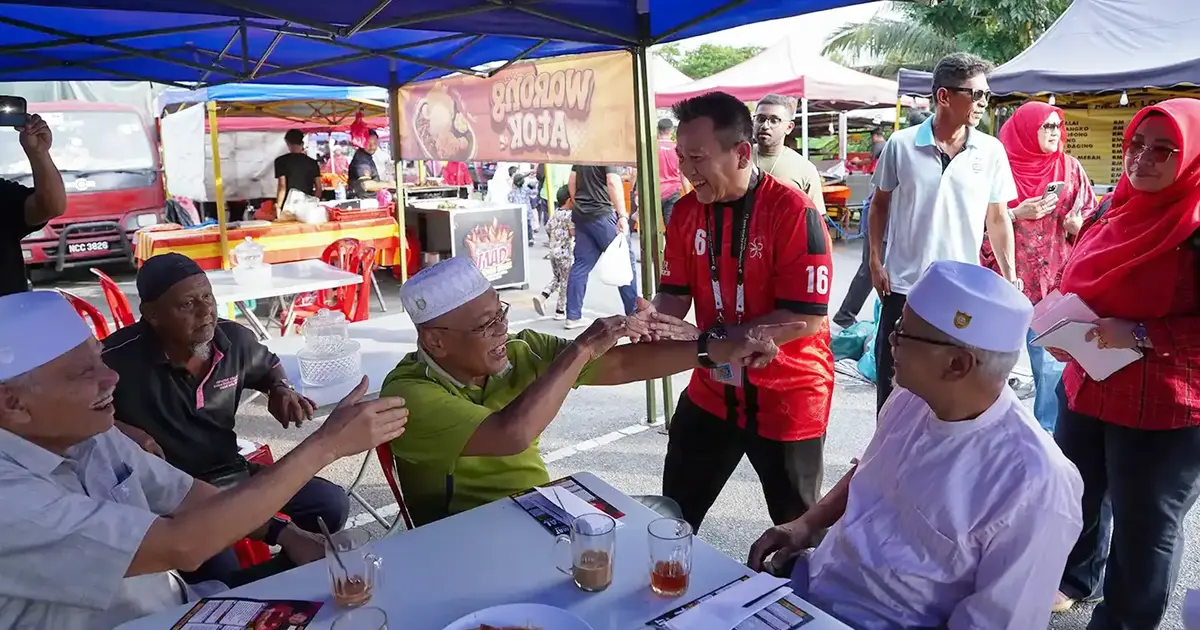
The Sikamat by-election is shaping up as a genuinely competitive three-cornered contest, according to Tun Faisal Ismail Aziz, who cautions that the entry of an independent Wawasan candidate may trigger voter defections from both Barisan Nasional and PAS. The observation comes amid signs that electorate frustration with the previous state administration has created an opening for alternative candidates beyond the traditional political establishment, fundamentally altering the dynamics of what might otherwise have been a predictable two-coalition showdown.
Tun Faisal's assessment reflects a broader reality in Malaysian electoral politics: when voters feel alienated from their customary political choices, even well-organised coalitions face unexpected challenges. The Sikamat contest demonstrates how voter sentiment, when sufficiently mobilised, can fragment traditional support bases and elevate previously marginal candidates into genuine contenders. This development carries particular weight in a state context where coalition politics has historically dominated local representation.
The announcement of Wawasan's candidacy in Sikamat has already set political observers speculating about which demographic segments may be most susceptible to switching their votes. Tun Faisal's implicit warning suggests that neither BN nor PAS can take their respective voter constituencies for granted, particularly among those segments that harbour dissatisfaction with recent governance and policy decisions at the state level. This dynamic mirrors similar patterns observed in recent Malaysian by-elections where independent and alternative candidates have successfully capitalised on voter apathy towards established parties.
For Barisan Nasional, the entry of Wawasan as an alternative candidate represents a potential drain of votes from urban-oriented voters and younger electors who may feel disconnected from the coalition's messaging. These constituencies have historically formed part of BN's supporting base but have shown increasing willingness to explore alternative political options when dissatisfaction with incumbent administration reaches critical levels. The loss of even modest numbers of such votes could prove decisive in a three-way contest where margins may be tight.
The PAS position presents an equally complicated picture. As an Islamist party that has positioned itself as a reform alternative, PAS may find that some of its potentially sympathetic voters view Wawasan as offering a similarly independent, reform-minded platform without the religious dimension that characterises PAS's political messaging. This could particularly impact younger and more secular-leaning voters within PAS's natural constituency who are drawn to the party's anti-establishment rhetoric but uncomfortable with its theological positioning.
The dissatisfaction with the previous state administration that Tun Faisal identifies appears to extend across multiple voter demographics and regions within Sikamat. This suggests that the grievances motivating voter discontent are not narrowly concentrated but reflect broader frustrations with governance performance, service delivery, or policy priorities. When such dissatisfaction becomes sufficiently widespread, it creates the conditions for unexpected political upsets and enables marginal candidates to punch above their weight.
Wawasan's positioning as an independent alternative candidate carries strategic advantages unavailable to coalition-affiliated parties. The organisation can present itself as unburdened by the baggage of either BN's establishment credentials or PAS's religious-based politics, appealing instead to voters seeking genuine alternatives to Malaysia's conventional party structures. In recent years, this positioning has proven increasingly attractive in specific electoral contexts, particularly among voters frustrated with what they perceive as inadequate responsiveness from traditional parties.
The three-way nature of the Sikamat contest introduces significant uncertainty into electoral forecasting and removes the predictability that typically characterises contests between two well-defined coalitions. Vote-splitting dynamics become critical, and the ultimate outcome may depend less on absolute support for any single candidate and more on how the anti-establishment vote fragments between competing alternatives. This unpredictability represents both risk and opportunity for each contending faction.
From a regional Southeast Asian perspective, the Sikamat by-election exemplifies a broader trend toward voter fragmentation and the declining dominance of traditional political parties in established democracies. Malaysia's experience parallels similar developments in Indonesia, the Philippines, and Thailand, where voters increasingly demonstrate willingness to support independent candidates and newer political movements when conventional parties fail to satisfy voter expectations regarding governance and accountability.
The implications extend beyond Sikamat itself. Should Wawasan perform unexpectedly strongly in this by-election, the success could embolden other independent candidates and non-traditional political organisations to contest future elections, further fragmenting Malaysia's political landscape. Conversely, if either BN or PAS successfully mobilise their core supporters despite the three-way contest, such resilience would demonstrate that traditional coalition politics retains sufficient organisational strength to weather challenges from independent alternatives.
Tun Faisal's public commentary appears designed to prepare BN and PAS supporters for a genuine contest rather than an assumed victory. By acknowledging the legitimacy of the three-way race and the genuine possibility of voter movement, he sets realistic expectations while potentially mobilising supporters through appeals to prevent their coalition losing to an alternative candidate. This framing transforms the election from a straightforward two-coalition competition into a broader battle for the political future of Sikamat and, by extension, the state itself.

