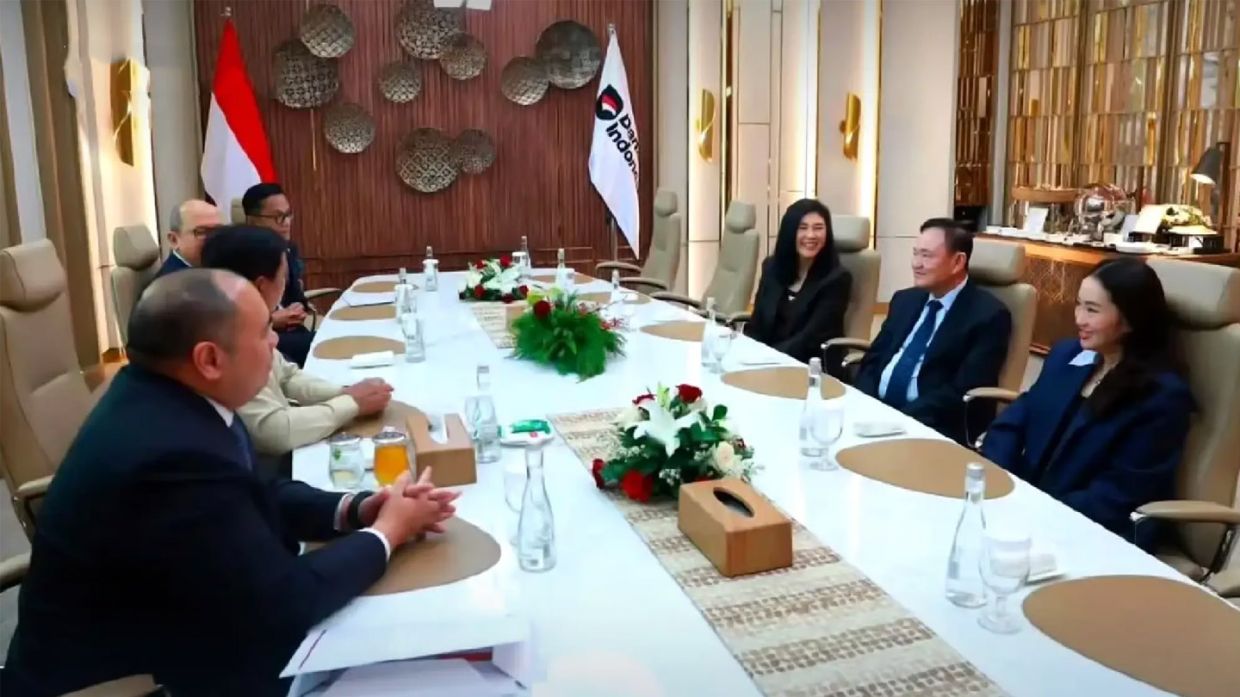
Three former Thai prime ministers from the Shinawatra family have held substantive talks with Indonesian President Prabowo Subianto at the state-owned investment firm Danantara in Jakarta, signalling deepening economic ties between Thailand's most influential political dynasty and Indonesia's newly installed leadership. The July 9 meeting between Thaksin Shinawatra, Yingluck Shinawatra, and Paetongtarn Shinawatra with Prabowo and senior Danantara executives explored investment pathways, asset management strategies, and mechanisms for driving long-term economic growth across the region.
Thaksin's involvement carries particular weight, as he serves on Danantara's advisory board—a position that underscores his continued influence in regional business circles despite decades of political turbulence in Thailand. The composition of the delegation, featuring a former prime minister (Thaksin), a former premier who remains internationally recognised (Yingluck), and the current Thai prime minister (Paetongtarn), presents a rare unified front for the family. This convergence suggests that beyond domestic politics, the Shinawatras maintain serious ambitions in regional economic architecture and are positioning themselves as conduits between Thai and Indonesian interests.
The meeting itself was characterised by Indonesian Cabinet Secretary Teddy Indra Wijaya as warm and informal, yet the presence of Danantara's top leadership—group chief executive officer Rosan Roeslani, chief operating officer Dony Oskaria, and chief investment officer Pandu Sjahrir—indicated formal substance. These officials oversee Indonesia's strategic national assets and long-term economic transformation agenda, suggesting the discussion ranged beyond courtesy exchanges into genuine policy considerations. The agenda focused on identifying investment prospects, refining approaches to capital allocation, and establishing frameworks for sustainable development that would benefit both nations.
Thaksin's advisory role at Danantara places him at the intersection of Indonesian state strategy and international capital flows. His appointment alongside other globally-recognised economic figures reflects Indonesia's intention to tap external expertise as it recalibrates its investment posture under Prabowo's presidency. For Thailand, particularly given Paetongtarn's recent ascension to the premiership, the engagement demonstrates the Shinawatra family's capacity to maintain prominence in cross-border business dealings irrespective of the domestic political landscape. The conversation likely touched on how Thai expertise and capital might support Indonesian infrastructure, resource management, or financial sector initiatives.
The timing of the encounter deserves scrutiny within Southeast Asia's shifting geopolitical context. Prabowo's administration has signalled a pivot toward strategic partnerships and infrastructure expansion, and Indonesia's willingness to engage prominent Thai economic actors reflects confidence in bilateral cooperation. For Malaysian observers, the meeting underscores how regional powerbrokers continue forging networks that shape investment flows, trade patterns, and economic influence across the Association of Southeast Asian Nations. Such high-level coordination between Thai and Indonesian actors can either complement or compete with Malaysia's own economic interests depending on where capital deployment is ultimately directed.
The Shinawatra family's international positioning has evolved considerably over the past two decades. Thaksin's 2006 ouster and subsequent life abroad, Yingluck's self-imposed exile following a 2017 conviction, and their eventual rehabilitation within Thailand's political establishment represent a complex narrative of resilience and adaptation. Their simultaneous engagement with Indonesian decision-makers signals that regardless of Thailand's domestic political cycles, the family retains credibility with major regional economies. This credibility stems partly from their commercial networks, partly from their proven administrative experience, and partly from the sheer longevity of their involvement in Thai and Southeast Asian affairs.
Danantara Indonesia itself warrants closer attention for regional investors and policymakers. Established as a sovereign wealth vehicle managing critical national assets, the institution concentrates enormous capital and strategic control. Its engagement with international advisors like Thaksin suggests Indonesia is serious about professionalising asset management and attracting sophisticated partners capable of optimising returns and facilitating cross-border collaboration. For Thai companies eyeing Indonesian opportunities—whether in infrastructure, renewable energy, telecommunications, or manufacturing—the Shinawatra family's advisory capacity at Danantara could facilitate introductions and build confidence.
The meeting also reflected broader patterns in Southeast Asian diplomacy. With formal multilateral arrangements often moving slowly, bilateral engagements between senior political figures and business leaders provide flexibility and momentum. The Indonesian government's explicit framing of such meetings as part of efforts to strengthen international cooperation and adapt to evolving global circumstances indicates that Prabowo's team views relationship-building as central to its economic agenda. By hosting the Shinawatra delegation, Prabowo positions Indonesia as an attractive hub for regional wealth, expertise, and opportunity.
The follow-up gathering at Prabowo's private residence further demonstrates the personal rapport between the parties. Such private meetings, described by the Cabinet Secretariat as cordial and warm, typically precede or accompany substantive business discussions and signal mutual respect and genuine interest in partnership. For the Shinawatras, access to Indonesia's top leadership and state investment machinery represents validation of their standing as serious players in regional economic affairs, not merely domestic Thai figures. For Prabowo, associating with successful regional entrepreneurs and former government leaders sends signals about Indonesia's openness to foreign expertise and investment.
Looking ahead, the implications extend beyond immediate bilateral transactions. If the Shinawatras successfully channel investment through Danantara or other Indonesian platforms, they deepen their footprint in Southeast Asia's largest economy. This could enhance their leverage in Thai politics, strengthen their business empire, and position them as gatekeepers for flows between Thailand and Indonesia. Meanwhile, for ASEAN as a whole, such high-level economic coordination between major member states suggests the region continues generating opportunities for connected actors despite periodic political turbulence.

