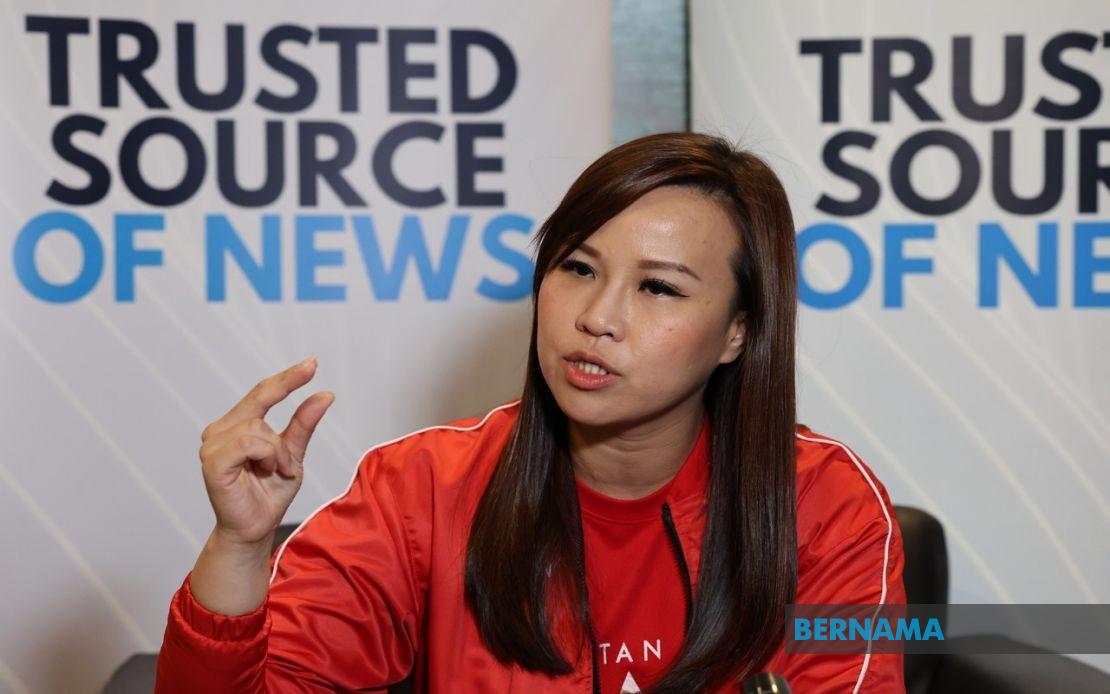
Sharon Teo Siew Hui is making her debut in electoral politics with a clear philosophical foundation. The 36-year-old Pakatan Harapan nominee for the Johor state seat of Permas credits her former boss, the late Datuk Seri Salahuddin Ayub, with shaping her approach to public service and laying the groundwork for her entry into formal politics. Having served as a special officer to Salahuddin, who held the ministerial portfolio of Domestic Trade and Cost of Living and earned widespread recognition as "Bapa Rahmah Malaysia," Teo has internalized lessons about humility, accessibility and commitment to constituents that transcend demographic boundaries — principles she now intends to apply should voters entrust her with the mandate.
Teo's political awakening traces directly to her professional relationship with Salahuddin. She initially offered voluntary support before joining Parti Amanah Negara in 2018, motivated by what she describes as her mentor's exemplary character and constituent-focused methodology. The late leader's dedication to serving people regardless of their racial or religious background resonated deeply with Teo, ultimately spurring her formal entry into the political sphere. She views Salahuddin's legacy not as a historical artifact but as a living blueprint for how elected representatives ought to conduct themselves, particularly in an era when public trust in institutions remains fragile across the region.
What distinguishes Teo's approach from conventional campaign rhetoric is her emphasis on the mechanics of problem-solving rather than merely the accumulation of grievances. Throughout her time assisting Salahuddin during multiple electoral cycles at both federal and state levels, she observed firsthand how elected representatives can transform constituent complaints into substantive resolution. She recalls instances where Salahuddin personally tracked the progress of public grievances well into the evening, sometimes dispatching messages near midnight to verify that residents' issues had been adequately addressed. This granular attention to follow-through represents, in her estimation, the crucial distinction between politicians who listen and those who genuinely deliver.
Incoming criticism about her status as a so-called parachute candidate, Teo has mounted a detailed rebuttal of the characterization. She has maintained consistent involvement with Amanah since joining in 2018, progressing from ordinary membership to Assistant Secretary of Amanah Johor and subsequently to leadership of Amanah Johor Wanita Muda (WARDA). Her historical presence in Permas, reinforced through repeated campaign appearances and community engagement alongside Salahuddin, provides tangible evidence of prior connection to the constituency rather than sudden insertion for electoral advantage. Importantly, she contends that the label misrepresents the nature of contemporary political recruitment and obscures the genuine relationships and organizational trajectory she has cultivated.
Initial canvassing during the opening phase of campaigning has fortified Teo's resolve and provided substantive intelligence regarding constituency priorities. The reception from voters across demographic segments has been encouraging, and the issues surfacing repeatedly from doorstep conversations paint a familiar portrait of localized frustration. Infrastructure deficiencies dominate the conversation — residents consistently cite potholes, deteriorating lanes behind commercial establishments, traffic congestion and the inadequacy of public facilities as pressing concerns demanding immediate attention. These are not abstract policy matters but tangible daily irritations affecting quality of life, and their prominence in constituent feedback underscores a perception that current representation has not adequately prioritized maintenance and improvement of municipal infrastructure.
Teo has explicitly committed to prioritizing younger voters, particularly first-time electors and school leavers who constitute a growing and increasingly digitally literate segment of the electorate. Rather than relying exclusively on traditional campaign methods, she intends to engage this cohort through social media platforms and esports initiatives, recognizing that meaningful communication with younger constituents requires meeting them within their preferred digital ecosystems. This strategic pivot acknowledges a fundamental demographic shift and represents a departure from conventional approaches that have sometimes struggled to resonate with voters under 30. The decision reflects broader recognition across Southeast Asia that sustainable political engagement with youth requires authenticity and presence in spaces where young people actually spend time.
Teo's proposed approach to her initial months in office, should she prevail, follows a methodical framework centered on data gathering and systematic prioritization. Her first 100 days would concentrate on comprehensive identification of constituency-specific challenges, aggregation of relevant information and construction of phased implementation strategies addressing the most urgent needs. She intends to establish PermasKu, envisioned as a centralized mechanism for managing public grievances with systematic tracking until resolution, directly mirroring the constituent service methodology she witnessed under Salahuddin. Concurrent with this institutional innovation, she commits to conducting an exhaustive infrastructure assessment spanning the entire constituency to establish an evidence-based hierarchy of priorities rather than relying on assumption or incomplete understanding.
Teo's commitment to grassroots engagement represents her third foundational priority, emphasizing direct interaction with residents across all neighborhoods to develop action plans grounded in actual community needs rather than outsider presumptions. This approach acknowledges that effective governance requires authentic dialogue and that representative democracy functions optimally when elected officials maintain regular contact with those they serve. The emphasis on moving beyond generic policy platforms toward neighborhood-specific solutions signals recognition that Permas, like many urban constituencies, encompasses diverse micro-communities with distinct requirements and circumstances.
The Permas contest has evolved into a four-way competitive struggle. Incumbent Baharudin Mohamed Taib, representing Barisan Nasional under the UMNO banner, secured victory in 2022 with a majority of 7,926 votes, establishing himself as the seat's current occupant despite the subsequent broader shifts in Malaysian politics. The Perikatan Nasional camp has fielded T. Vela, while Parti Bersama Malaysia, the newer political entity, has nominated Dr Zamil Najwah. The configuration reflects the fragmentation characterizing contemporary Johor politics following the 2022 general election and the internal realignments within major coalitions. Teo enters as an insurgent challenge to incumbent BN dominance in a context where voter sentiment has demonstrated responsiveness to fresh candidates and alternative visions.
For Malaysian observers, Teo's campaign illustrates a broader phenomenon within Southeast Asian politics — the emergence of politicians who combine formal organizational affiliation with attachment to specific mentors or exemplary figures from recent political history. Salahuddin's reputation for fiscal probity and constituent accessibility during his ministerial tenure provides Teo with substantial political capital and an appealing narrative framework. Her invocation of his legacy resonates because it taps into demonstrated public recognition of particular governance virtues, offering an alternative to abstract policy promises. However, her campaign also implicitly acknowledges the challenges facing Amanah, which has struggled to maintain political relevance in several states despite its reformist positioning within the PH coalition.
The Johor state election carries significance beyond the individual constituencies involved. Johor remains Malaysia's second-largest state by population and economic output, and its political orientation has shifted considerably over recent years. The state's electoral dynamics reveal tension between incumbent BN strength in certain areas and growing receptivity toward PH alternatives in urban constituencies like Permas. Teo's candidacy, grounded in principles of meritocratic service and constituent-focused governance, represents one expression of the reform impulse that continues to reshape Malaysian electoral competition, even as traditional party structures and alignments maintain substantial organizational advantages.

