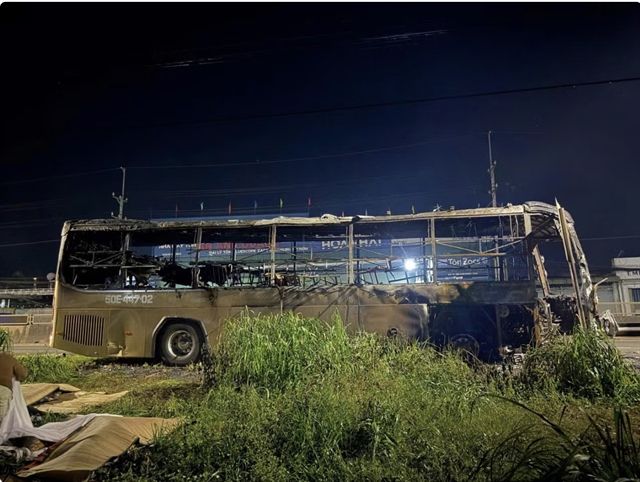
A catastrophic fire claimed seven lives aboard a sleeper bus in southern Vietnam's Dong Nai Province early on an unspecified date, marking the second deadly transportation disaster to strike the country in a single week. The overnight tragedy unfolded when the long-distance coach, piloted by 41-year-old Tran Thanh Hai from Khanh Hoa Province, collided with a roadside embankment along National Highway 1 at approximately 2:30am in Hung Thinh Commune. After the initial impact with the embankment, the driver attempted recovery manoeuvres but the vehicle struck a second earthen barrier before coming to rest, setting the stage for the catastrophic chain of events that would follow.
The circumstances immediately preceding the fire reveal the precarious nature of long-distance overnight travel in Southeast Asia, where fatigue, road conditions and vehicle design intersect dangerously. The bus had been en route from Dong Nai to Ho Chi Minh City, a journey that typically takes several hours through congested corridors that serve as vital economic arteries connecting southern Vietnam's industrial heartland to the capital. With 33 passengers and crew aboard, the vehicle represented a typical sleeper bus operation, where compact bunk-style seating maximises revenue but constrains passenger mobility during emergencies. The collision mechanics remain under investigation, but preliminary accounts suggest the driver lost vehicle control during the early morning hours when fatigue commonly impairs driver judgement.
The catastrophic spread of flames transformed the initial collision into a mass casualty incident within moments. Witnesses and emergency responders described how fire erupted from the front of the bus and propagated rapidly through the passenger compartment, suggesting fuel system rupture or ignition of electrical components. The rapid advancement of flames prevented orderly evacuation, trapping numerous occupants within the metal fuselage that became an inferno. Some passengers managed to escape before the flames consumed the entire structure, their survival attributable to proximity to exits and fortunate positioning when the fire ignited. Those unable to flee faced an impossible situation, surrounded by smoke, heat and compromised visibility within the narrow confines of a sleeper bus cabin.
Local community members demonstrated remarkable courage in attempting to contain the disaster before emergency services arrived. Residents from Hung Thinh Commune rushed to the burning vehicle armed with handheld fire extinguishers and improvised equipment, understanding instinctively that the minutes before professional firefighters arrived would determine survival rates. Their efforts, though valiant and immediately life-saving for some trapped passengers, proved inadequate against the velocity of the conflagration. The flames overwhelmed their modest resources, underlining the dangerous limitations of civilian response to vehicular fires of this magnitude. By the time professional emergency crews arrived following notification through emergency channels, the situation had deteriorated beyond salvage.
Once dispatched, firefighting units, rescue personnel and specialised equipment converged on the scene to manage both the blaze and the humanitarian crisis it had created. Coordinated efforts by emergency responders succeeded in extinguishing the fire and implementing rescue operations to extract victims and retrieve remains. Traffic diversions were implemented to facilitate emergency vehicle access and prevent secondary incidents in the chaos surrounding the disaster site. The professional response, while swift and effective in suppressing the flames, arrived too late to prevent the loss of seven lives. By the time the fire was brought under control and the charred remains of the bus could be examined, the vehicle had been reduced to an almost unrecognisable burnt-out shell.
The Hung Thinh Commune People's Committee formally confirmed seven fatalities through preliminary investigation, though the identification process and complete casualty accounting continued as authorities documented the incident. The injured, numbering at least 25 individuals based on passenger counts, received treatment at Thong Nhat General Hospital in Ho Chi Minh City. Medical personnel managed varying degrees of trauma, from life-threatening burn injuries and respiratory damage from smoke inhalation to crush wounds sustained during the chaos of evacuation. One individual assessed as suffering only minor injuries has since been discharged, though many others remained hospitalised undergoing treatment for serious harm.
The disaster scene has been sealed off for forensic examination and evidence collection, with authorities pursuing multiple investigative threads simultaneously. Determining the precise cause of the fire represents the primary focus, requiring analysis of fuel systems, electrical components and structural integrity. Identifying the seven deceased presents another critical task, involving dental records, DNA analysis and family verification processes. Understanding the exact sequence of events—whether driver error, mechanical failure, road conditions or a combination of factors precipitated the embankment collisions—remains ongoing. These investigations will inform discussions about sleeper bus safety standards, driver rest requirements and road infrastructure maintenance across Vietnam's transportation sector.
This tragedy must be understood within the context of Vietnam's broader transportation safety challenges, particularly the recurring danger associated with sleeper bus operations. The frequency of serious incidents involving these vehicles suggests systemic vulnerabilities that extend beyond individual accidents. Just seven days prior, on July 17, another sleeper bus returning from Thien Cam beach in Ha Tinh Province to Thai Nguyen in northern Vietnam veered off an expressway near Ha Noi and overturned catastrophically. That incident claimed five lives and injured dozens, establishing a disturbing pattern of deadly sleeper bus accidents within a remarkably short timeframe.
The clustering of these disasters within a single week raises urgent questions about vehicle maintenance standards, operator licensing requirements, passenger safety equipment and regulatory oversight across Vietnam's intercity coach industry. Sleeper buses offer economical transportation for lower-income travellers and represent a significant portion of Vietnam's domestic travel market, but their night-time operations, cramped passenger arrangements and cost pressures that may encourage extended driving hours without adequate rest periods create an inherently risky operating environment. The regulatory response to these recurring incidents will likely involve enhanced safety inspections, revised driver hour limitations and improved emergency equipment requirements.
For Malaysian readers and regional observers, these Vietnamese transportation disasters serve as sobering reminders of safety challenges that transcend national boundaries throughout Southeast Asia. Sleeper bus operations remain prevalent across the region, employed in Malaysia, Thailand, Cambodia and other countries where they fill crucial transportation roles despite inherent risks. The investigation findings from this Hung Thinh Commune fire and the preceding Ha Noi expressway incident may yield insights applicable to regional safety standards and best practices. The incidents underscore the importance of maintaining rigorous vehicle inspection regimes, enforcing driver rest requirements and equipping long-distance coaches with modern safety systems including fire suppression equipment and emergency exits designed for rapid evacuation under crisis conditions.

