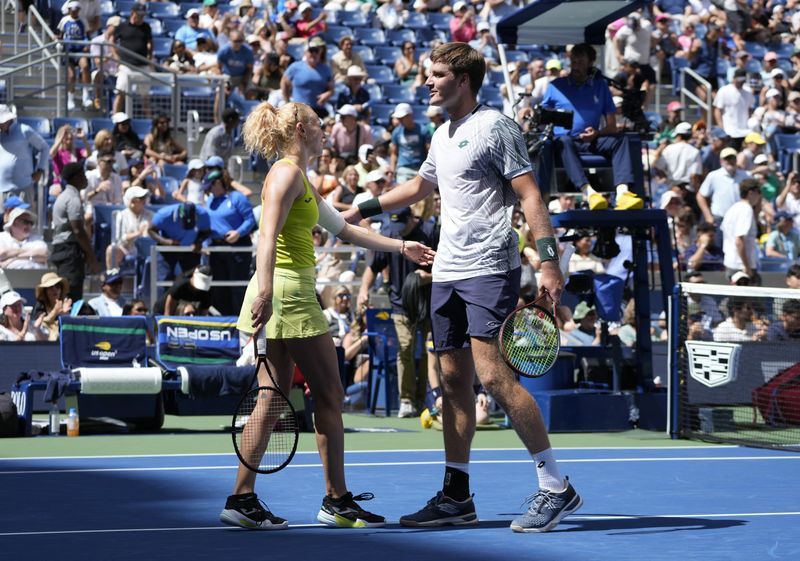
Serena Williams delivered a captivating homecoming to professional tennis at the US Open on Tuesday, teaming with young Spanish star Carlos Alcaraz to claim a commanding victory over Erin Routliffe and Lloyd Glasspool in the mixed doubles opening round. The 44-year-old icon, who last graced Arthur Ashe Stadium during her emotional retirement match in 2022, powered through to set up a quarter-final clash against Belinda Bencic and Flavio Cobolli later that evening. The crowd's rapturous reception underscored the resonance of her unexpected comeback announcement, which had electrified the tennis world just weeks earlier.
Williams' return to competition marked one of sport's most anticipated comebacks, with the 23-time Grand Slam champion cementing her legacy as arguably the greatest player in modern tennis history. Her reappearance on the sport's most iconic American stage generated electricity throughout the stadium, as fans who had witnessed her dominant career spanning decades witnessed another chapter unfold. The decision to launch her comeback through the mixed doubles format proved strategically astute, offering a lower-pressure environment whilst maintaining the spectacle and intensity that has always defined her matches.
The partnership between Williams and Alcaraz, separated by 21 years in age, displayed an easy chemistry that belied the unconventional pairing. The chemistry transcended the typical professional courtesy between doubles partners, with the two competitors frequently exchanging grins and animated encouragement throughout their 75-minute contest. Alcaraz, the world's seventh-ranked player and a seven-time Grand Slam winner in his own right, appeared energized by competing alongside the legendary American. The Spanish sensation had only recently returned to action following an injury layoff that sidelined him since April, yet showed no signs of rust during their successful outing.
Williams made an immediate impact from her opening shot, striking a backhand winner that drew thunderous applause from the packed arena. The moment symbolized her seamless transition back into elite competition, suggesting that her layoff from the sport had not diminished her formidable abilities. Later in the opening set, she struck a powerful 120 mph ace that elicited audible gasps from spectators, demonstrating the power and precision that had defined her playing career. Such moments highlighted why her return carries such profound significance for the sport and its global audience.
The mixed doubles format itself has undergone significant evolution at the US Open, entering its second year as a reimagined standalone event scheduled during the week preceding the singles draws. Tournament organizers deliberately repositioned the category to prominence by featuring elite singles competitors and scheduling matches in prime viewing slots, a departure from its previously marginal status on the professional circuit. This commercial recalibration has proven remarkably successful, generating sellout crowds and extending the spotlight to some of tennis's most recognizable personalities. However, the format's prominence has invited criticism from accomplished doubles specialists who contend that traditional pairings have been sidelined in favour of celebrity partnerships designed primarily for commercial appeal.
The Williams-Alcaraz victory contrasted sharply with the fortuitous exit of the tournament's top seeds, Novak Djokovic and Aryna Sabalenka. The formidable pairing suffered a stunning defeat at the hands of experienced doubles practitioners Henry Patten and Katerina Siniakova, whose 6-4 6-2 10-2 scoreline reflected a commanding performance. Siniakova sealed the upset with a precision ace down the sideline, delivering the decisive point in the abbreviated deciding tiebreak format employed in mixed doubles competition. Patten subsequently acknowledged the format's unforgiving nature, noting that a single poor service game could rapidly determine an entire set's outcome.
The tournament's defending champions, Italy's Sara Errani and Andrea Vavassori, also encountered unexpected resistance when they fell to the Russian combination of Mirra Andreeva and Andrey Rublev by a score of 6-4 6-1 11-9. The defending titlists' elimination highlighted the competitive depth and unpredictability now characteristic of the revitalized mixed doubles competition. Their conquerors will advance to face the winner of a subsequent fixture between Norwegian Casper Ruud paired with Diana Shnaider and Americans Jessica Pegula and Taylor Fritz.
Elsewhere in the draw, the married couple Gael Monfils and Elina Svitolina secured their passage through the semi-finals, joined by the Czech-Slovak pairing of Karolina Muchova and Jakub Mensik. These victories reflected the tournament's broader narrative of competitive balance and the capacity of diverse partnerships to mount credible title challenges. The semi-final configuration thus presented an intriguing mixture of celebrity pairings and established doubles experts competing for ultimate glory.
For Malaysian and Southeast Asian tennis enthusiasts, Williams' comeback carries particular resonance as a testament to the sport's capacity to inspire across generations and borders. Her return at age 44, competing against opponents young enough to be her children, challenges conventional narratives about athletic longevity and demonstrates the enduring appeal of competitive excellence. The mixed doubles innovation at the US Open also reflects global tennis governance's determination to broaden the sport's commercial appeal and accessibility to casual audiences, a strategic imperative as the sport navigates evolving media landscapes and audience preferences in Asia and beyond.
The tournament's second edition of the reimagined mixed doubles format has decisively validated the organizers' gamble on elevated status and celebrity partnerships. The combination of familiar champions like Williams returning to the stage, rising talents like Alcaraz gaining exposure, and established doubles professionals like Patten and Siniakova producing memorable upsets has created compelling entertainment that transcends traditional tennis demographics. As the competition advances toward its conclusion, the format appears positioned to become a permanent and prestigious fixture within the Grand Slam calendar, reshaping how professional tennis balances tradition with innovation.

