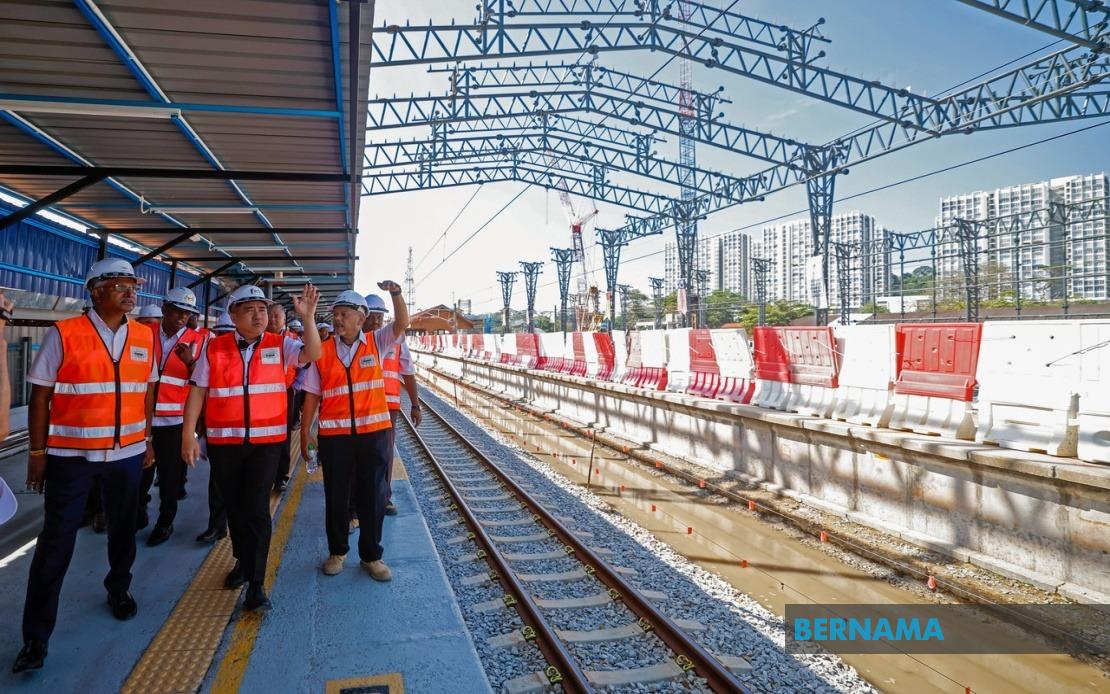
Transport Minister Anthony Loke has confirmed that the new Seremban Sentral railway station, designed to transform the city's transport infrastructure into a modern integrated hub, has progressed to 35 per cent completion and remains on schedule to open in March 2027. The RM100 million development represents one of the ministry's most ambitious undertakings, merging the heritage-listed Seremban KTMB Station, which has stood for over a century, with contemporary facilities to create an efficient, accessible transport interchange serving the region's growing passenger demands.
Loke, speaking during an inspection of the site in his capacity as both Transport Minister and Member of Parliament for Seremban, revealed that the project has overcome its initial bottlenecks. The most labour-intensive and technically demanding phases—deep piling work and relocation of underground utilities including electrical cables and wiring—have been substantially completed. These foundational activities, though time-consuming, were essential preparation that permits the construction momentum to accelerate significantly over the coming months. The minister attributed the earlier slower pace to the complexity of positioning piles at precise coordinates whilst simultaneously ensuring that existing subterranean infrastructure was safely and systematically repositioned away from the construction zone.
With these preliminary hurdles cleared, Loke indicated that the next phase will concentrate on structural and finishing work: installation of the roof structure, glazing systems, commercial spaces, and interior fittings. The project's architectural concept draws inspiration from Minangkabau design elements whilst adhering to green building principles, positioning the station as both a functional transport facility and a distinctive urban landmark. The integration of commercial zones within the station complex reflects a broader trend across Southeast Asian transport hubs toward creating mixed-use environments that generate revenue whilst enhancing the passenger experience.
Capacity projections underscore the station's strategic significance for Seremban's long-term development trajectory. Upon completion, the facility will accommodate approximately 30,000 passengers daily in its initial operational phase, with inherent design flexibility permitting expansion to 120,000 daily users as demand evolves. This scalability reflects the ministry's recognition that transport infrastructure must not merely address present requirements but anticipate growth over decades. Loke emphasised that the station's design provision of six platforms—with three initially constructed and three reserved for future development—embodies this forward-thinking approach, potentially serving the metropolitan area for thirty to fifty years before requiring substantial augmentation.
The station layout incorporates dual entry and exit points strategically positioned at the front along Jalan Tunku Antah and the rear to distribute passenger flows and reduce traffic congestion at any single access point. This thoughtful design reflects lessons learned from other regional transport hubs where bottlenecks at entry points have created operational inefficiencies. Upon completion and once the double-track railway upgrade concludes, Loke signalled the ministry's intention to increase frequency across Komuter and ETS services, leveraging improved infrastructure to attract greater ridership and support residential and commercial growth in Seremban.
Parallel to the main construction, the renovation of the heritage Seremban KTMB Station reached completion last month, comprising careful restoration work that modernised electrical systems and wiring whilst preserving the building's architectural and historical character. This conservation effort extends beyond aesthetic considerations; the ministry simultaneously implemented supplementary drainage infrastructure to address chronic flooding issues that have historically disrupted station operations during monsoon periods. A new sewerage system now directs stormwater directly into Sungai Temiang, bypassing the station precinct entirely and preventing accumulated rainwater from inundating platforms and tracks during heavy downpours—a practical solution to an operational vulnerability that had compromised service reliability.
The Seremban Sentral project forms part of a broader integrated development strategy encompassing the Transit-Oriented Development (TOD) Seremban Sentral complex planned immediately behind the main station. This coordinated approach to mixed-use development centred around transport infrastructure aligns with regional best practices and government policy objectives to create walkable, vibrant urban precincts that reduce dependency on private vehicles. Loke characterised the completed station as a transformational asset for Seremban, elevating its status as a regional transport hub and contributing to the town's economic and social vitality.
Progress on the complementary Klang Valley Double Track Phase 2 (KVDT2) infrastructure project, which supports enhanced rail services across the Klang Valley region, has reached 55.8 per cent. To expedite construction activities, the ministry has implemented temporary reductions in afternoon Komuter service frequency to permit accelerated work following the closure of one track for construction purposes. This trade-off between short-term service adjustments and long-term infrastructure improvements reflects the practical compromises inherent in upgrading busy rail corridors serving millions of commuters across Malaysia's most densely populated region.
For Malaysian readers, particularly those in Negeri Sembilan and the broader Klang Valley, these developments carry significant implications for commuting patterns, property values, and economic development. The integration of heritage conservation with modern transport functionality at Seremban Sentral establishes a template for other Malaysian cities seeking to upgrade ageing rail infrastructure whilst respecting historical significance. The station's anticipated capacity to support regional population growth over the next half-century positions Seremban as an increasingly important node within Malaysia's transport network, potentially catalysing investment and residential expansion in the state. As the region continues to densify, reliable, modern transport hubs become critical competitive advantages in attracting businesses and talent, making projects like Seremban Sentral essential components of Malaysia's economic infrastructure development strategy.

