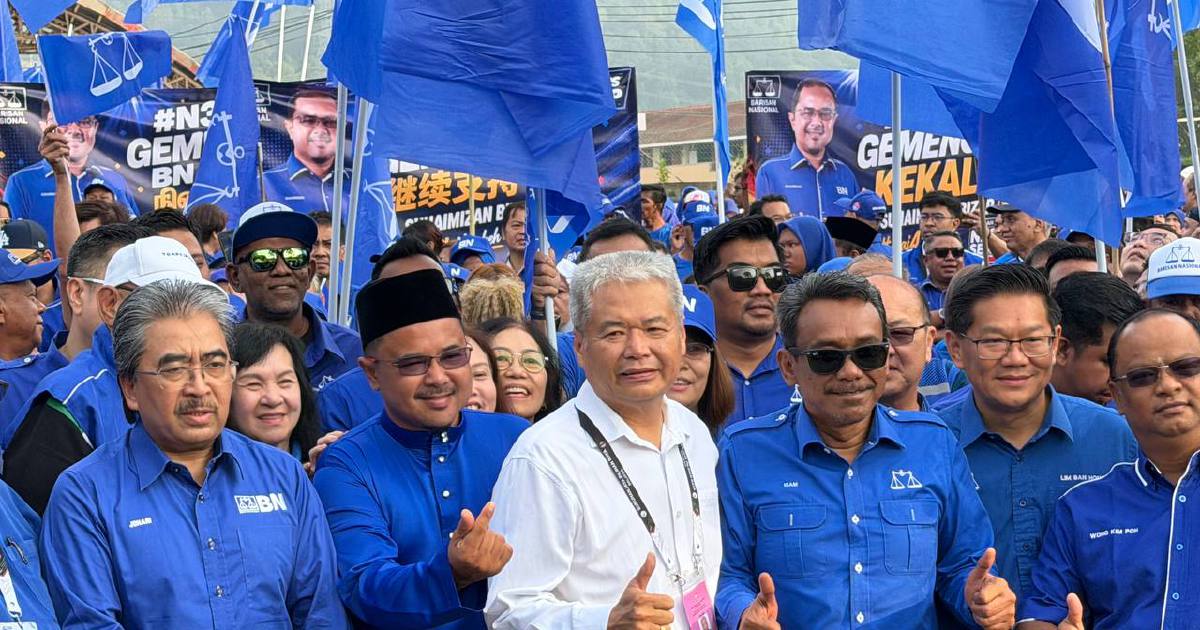
Umno's senior echelon made a show of strength in Negri Sembilan on nomination day, with vice-president Datuk Seri Johari Abdul Ghani and party treasurer Datuk Seri Tengku Adnan Tengku Mansor appearing at Dewan Perdana Tampin to stand beside Barisan Nasional's slate of candidates in the state election.
The dual appearance underscores the coalition's determination to project unity and organisational readiness as it competes for control of the Negri Sembilan state assembly. Both leaders occupy pivotal roles within Umno's hierarchy—Johari as the party's second-ranking official and Tengku Adnan as keeper of its finances—making their presence at the nomination centre a calculated signal to grassroots members and voters alike that the party establishment backs the chosen candidates unreservedly.
Negri Sembilan has emerged as a crucial battleground in peninsular politics. The state, which neighbours Selangor and sits within striking distance of Kuala Lumpur, carries symbolic weight beyond its parliamentary seats. Control of the state apparatus influences regional influence-peddling and sets the tone for neighbouring constituencies. For Barisan Nasional, which has faced erosion of its traditional dominance in successive elections, holding or recapturing ground here assumes heightened importance.
The nomination centre at Tampin, a town in the district of Tampin, served as the focal point for candidate registration and formal entry into the electoral contest. Such venues typically attract party machinery, media scrutiny, and grassroots observers keen to gauge enthusiasm and organisational preparedness. The presence of Johari and Tengku Adnan transformed the routine administrative process into a morale-building exercise, lending the proceedings an official sanction that reverberates through the party's membership networks.
Johari's involvement carries particular weight given his status as potential successor within Umno's power structure. His willingness to campaign at ground level demonstrates accessibility and commitment to electoral outcomes, qualities the party leadership emphasises to differentiate itself from rivals. Tengku Adnan's participation, meanwhile, signals that the party has allocated resources adequately for the contest and that financial backing matches the rhetorical commitment to victory.
Barisan Nasional's coalition architecture in Negri Sembilan typically involves Umno as the dominant partner, alongside MCA and MIC in proportional seat allocations. The appearance of Umno heavyweights implicitly reasserts the party's centrality to the coalition project and its continued relevance in peninsula-wide electoral mathematics. This messaging grows increasingly important as internal BN dynamics shift and component parties jostle for relevance.
The Negri Sembilan election assumes additional significance within Malaysia's broader political oscillation. The state has witnessed competitive contests in recent years, with opposition parties capitalising on voter dissatisfaction with governance or corruption perceptions. For Barisan Nasional, reversing negative electoral trends requires demonstrating competence, fresh faces, and renewed commitment to constituent concerns. The mobilisation of senior figures at nomination centres contributes to that narrative, even as policy platforms and candidate quality ultimately determine electoral outcomes.
From a Malaysian perspective, Negri Sembilan elections reflect microcosmic struggles playing out across peninsular constituencies. Voter concerns—from cost of living pressures to infrastructure development to educational provision—transcend state boundaries, yet state governments control significant levers over local implementation. The appearance of Umno's hierarchy in Tampin signals that senior leadership intends to remain actively engaged in prosecuting the case for Barisan Nasional's continued stewardship.
The nomination process itself marks the formal commencement of the electoral campaign. Candidates who successfully registered at Dewan Perdana Tampin enter the official campaigning period with legal certainty regarding their eligibility. The gathering of party notables during this juncture—traditionally a low-key administrative matter—has evolved into an opportunity for parties to broadcast their enthusiasm and organisational reach to supporters and observers. Johari and Tengku Adnan's appearance at the centre transformed a procedural event into a media moment, generating coverage that amplifies the party's message beyond those physically present.
For Southeast Asian observers tracking Malaysia's political evolution, state elections in Negri Sembilan illustrate how coalition politics, party factionalism, and voter realignment reshape governance across the region. Barisan Nasional's sustained efforts to recalibrate its appeal and reassert electoral competitiveness offer lessons—both positive and cautionary—for neighbouring democracies navigating comparable tensions between established parties and emerging political alternatives.
The Negri Sembilan contest, whilst not commanding the national headlines generated by federal elections, determines the composition of state government and shapes regional power distributions within Umno's broader machinery. The mobilisation of senior leadership at nomination centres signals that Barisan Nasional intends to contest the election seriously and comprehensively, deploying its institutional advantages and organisational apparatus to secure electoral legitimacy and validate its continued claim to govern.

