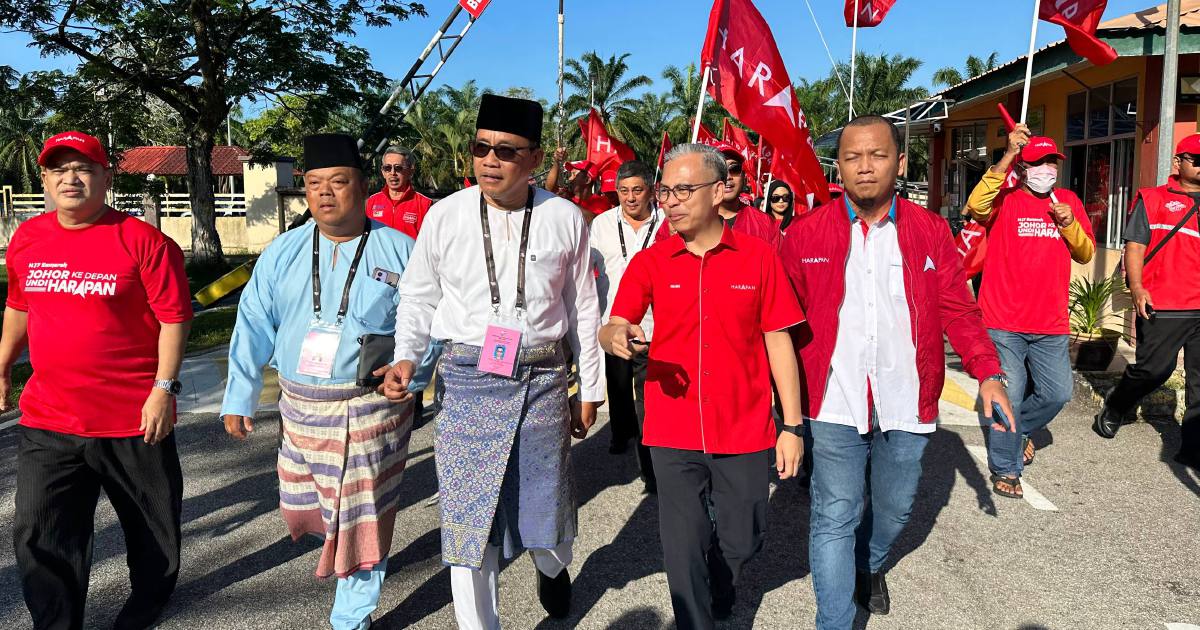
The Semerah constituency is bracing for a closely-watched contest that will likely pit Barisan Nasional against Pakatan Harapan once again, as nomination day activities at Dewan Mahkota, Maktab Rendah Sains Mara in Batu Pahat revealed the familiar political choreography that has come to define the state's electoral landscape. The venue thrummed with energy as supporters gathered to witness their respective candidates lodge their nomination papers, with chants of "Reformasi" and Islamic prayers punctuating the proceedings—a telling backdrop that underscored the ideological and political divisions underpinning the contest.
The contest in Semerah represents a microcosm of broader dynamics playing out across Johor, where the state's two dominant political coalitions are locked in an intensifying struggle for control. The seat has emerged as strategically significant within the constellation of marginal constituencies that will ultimately determine the composition of the state assembly. Understanding what unfolds here carries implications not only for Johor's direction but also for how national political momentum may shift in the lead-up to the next general election.
Rematches between the same candidates across successive electoral cycles are becoming increasingly common in Malaysian politics, reflecting both the calculus of party strategists who see value in name recognition and the structural entrenchment of opposition between established coalitions. The decision by both BN and PH to field candidates who have previously contested the seat suggests confidence in their respective political machinery and a belief that victory remains within reach despite previous setbacks. This continuity also means voters will be making judgments based on accumulated impressions of candidates' performance and track records rather than encountering entirely fresh faces.
For Barisan Nasional, fielding a returning candidate in Semerah fits a broader strategy of consolidating traditional support bases while attempting to recover ground lost to Pakatan Harapan in recent state-level contests. The coalition has undertaken significant reorganisation following the 2022 general election, and fielding candidates with prior electoral experience in constituencies like Semerah allows the party machinery to function from established infrastructure and networks rather than starting from scratch.
Pakatan Harapan's decision to field its own previous candidate reflects the coalition's confidence that it can retain support among voters who may have swung toward the opposition in recent years. The opposition coalition has made substantial inroads in urban and semi-urban areas of Johor through its emphasis on reform narratives and anti-corruption messaging. A rematch provides PH with the opportunity to consolidate these gains and demonstrate that its previous electoral performance was not a flash in the pan but rather evidence of durable political realignment.
The religious invocations and "Reformasi" chants that characterised nomination day proceedings underscore how contemporary Malaysian electoral contests increasingly incorporate symbolism drawn from both religious conviction and reform ideologies. These elements serve to energise supporters and frame the election as a contest between fundamentally different visions of the state's future rather than simply a choice between competing administrative teams. Such framing has proven effective in mobilising voters and driving turnout, particularly among younger demographic cohorts.
Semerah's electoral trajectory offers lessons for understanding Johor's political evolution. The constituency sits within the Batu Pahat district, an area that encompasses both rural and urban voters whose preferences have proven volatile in recent elections. This mix of voter types means that campaigns must address concerns ranging from rural development and agricultural support to urban infrastructure and cost of living pressures. Candidates who can convincingly articulate responses to this diverse set of concerns will likely find themselves advantaged in the contest.
The nomination day gathering also reflects how electoral competition in Malaysia continues to revolve around established political parties and coalitions rather than independent candidates or entirely new political movements. Despite periodic calls for political reform and fresh approaches, the structural dominance of BN and PH means that meaningful electoral competition occurs primarily within and between these two camps. This duopolistic structure has both strengths and weaknesses—it provides clarity for voters and stability for governing processes, but it may also limit exposure to alternative policy approaches and perspectives.
For Malaysian observers tracking Johor's political direction, the Semerah rematch carries significance because the state remains a crucial testing ground for national political trends. Johor's large and diverse electorate encompasses Malay-Muslim, Chinese, Indian, and other communities, making it broadly representative of Malaysian society. Electoral outcomes here often precede and predict shifts that later manifest at the national level. A strong showing by either BN or PH in constituencies like Semerah would provide valuable intelligence about the underlying trajectory of voter sentiment across the nation.
The intensity of feeling evident during nomination day proceedings—the chanting, the prayers, the passionate attendance—suggests that both campaigns will be hard-fought. Voters in Semerah can expect sustained engagement from both coalitions over the coming weeks as candidates and their supporters seek to persuade undecided voters and mobilise their respective bases. The outcome of this rematch will form one component of a larger electoral verdict on Johor's future political direction and may offer clues about the national political landscape beyond the state's borders.

