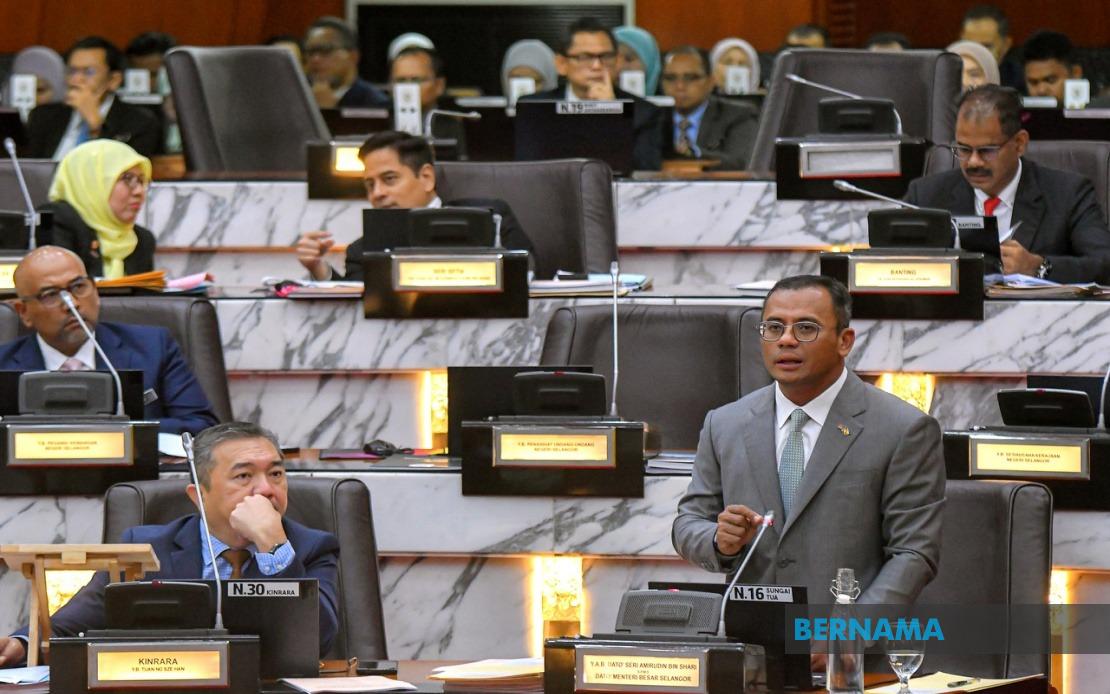
The Selangor government is moving to significantly expand its tertiary education support programme, planning to raise the number of Higher Education Institution Study Incentive (HPIPT) beneficiaries from the current 3,000 to 5,000 in 2027. Menteri Besar Datuk Seri Amirudin Shari announced the initiative during a recent sitting of the Selangor State Legislative Assembly, responding to concerns raised about escalating demand for the financial aid scheme among state residents pursuing higher education.
The decision reflects mounting pressure on the scheme's limited capacity. According to Amirudin, the state has consistently received more than 5,000 applications annually for the past two years, indicating that current recipient numbers fall significantly short of eligible demand. This substantial gap between applications and available places has prompted the state administration to reassess the programme's scope, particularly given Selangor's comparatively stronger revenue position relative to other Malaysian states.
The HPIPT functions as a fundamental support mechanism for Selangor's students, providing RM1,000 in financial assistance to those enrolled at accredited public and private higher education institutions. Beyond traditional university programmes, the scheme extends to students pursuing Level 4 Skills Certificates, diplomas, and bachelor's degrees, making it accessible across multiple educational pathways. This broad eligibility structure has contributed to the scheme's popularity among families seeking to reduce educational costs.
Amirudin emphasised that the expansion remains subject to a comprehensive fiscal review. The state government is currently evaluating whether financial capacity permits increasing recipients to somewhere between 5,000 and 6,000 annually. He noted that Selangor had previously operated the scheme at the 5,000-recipient level, suggesting that returning to this threshold represents a restoration rather than unprecedented expansion. The careful framing of this decision underscores the balance state authorities must maintain between expanding social programmes and maintaining long-term fiscal sustainability.
Beyond simply increasing recipient numbers, the state government is simultaneously examining procedural improvements to enhance the scheme's accessibility and fairness. Officials are reviewing the application timeline to ensure that students receive adequate opportunity to apply after they have received confirmation of university admission. Currently, the compressed application window following admission decisions may disadvantage some students who require additional time to organise their documentation or complete the submission process.
Particularly significant is Selangor's consideration of implementing biannual application cycles rather than the current single annual intake. This structural modification would accommodate students entering tertiary education at different points throughout the year, recognising that not all Malaysian students progress through higher education on the traditional September intake schedule. Such flexibility would be especially beneficial for mature-age students, those pursuing vocational qualifications that operate on alternative calendars, and international students with varying admission timelines.
The expansion initiative carries broader implications for Selangor's positioning as an education-friendly state within Malaysia. By demonstrating commitment to reducing financial barriers to tertiary education, the state government signals investment in human capital development and workforce preparation. This approach potentially appeals to middle and lower-middle-income households for whom education financing represents a significant family burden. In a competitive federalised system where state governments increasingly differentiate themselves through targeted social programmes, enhanced educational support serves as a tangible differentiator.
The timing of this expansion also reflects Malaysia's evolving tertiary education landscape. As private university participation has grown and tuition costs have escalated, state-level financial assistance has become increasingly important for ensuring equitable access. Selangor's initiative acknowledges that Federal-level student financing mechanisms, while substantial, may be insufficient to meet regional demand. This state-level supplementation thus functions as an essential complement to national higher education access efforts.
For students and families across Selangor, the planned expansion offers meaningful material benefit. Each additional 1,000 beneficiaries represents approximately 1,000 households gaining RM1,000 in direct educational support. While this amount does not fully cover university costs, it can meaningfully address portions of registration fees, accommodation, or essential course materials, thereby reducing reliance on private loans or family financial strain. The cumulative impact across several thousand families warrants consideration as a significant equity intervention.
The legislative question that prompted this announcement originated from Datuk Noorazley Yahya representing the Bukit Melawati constituency, reflecting how constituency-level concerns percolate through formal parliamentary channels to generate policy responses. This interaction demonstrates ongoing engagement between elected representatives and the executive regarding public service delivery and programme adequacy, a mechanism essential for responsive governance.
Implementation of the expanded programme will require corresponding budget allocation increases within Selangor's 2027 fiscal planning. If the state proceeds toward the maximum expansion of 6,000 recipients, this represents doubling current expenditure on the initiative, assuming stable per-capita benefit levels. These budgetary decisions will occur alongside competing demands for infrastructure, healthcare, and other state priorities, requiring careful prioritisation by the executive council.
Longer term, the success of an expanded HPIPT programme may influence policy discussions at the federal level regarding student financing frameworks. Should Selangor's expanded scheme demonstrate measurable positive outcomes for beneficiary students' academic achievement or completion rates, such evidence could inform national conversations about optimal levels of educational financing and the comparative effectiveness of state-targeted versus centralised approaches to tertiary education access.

