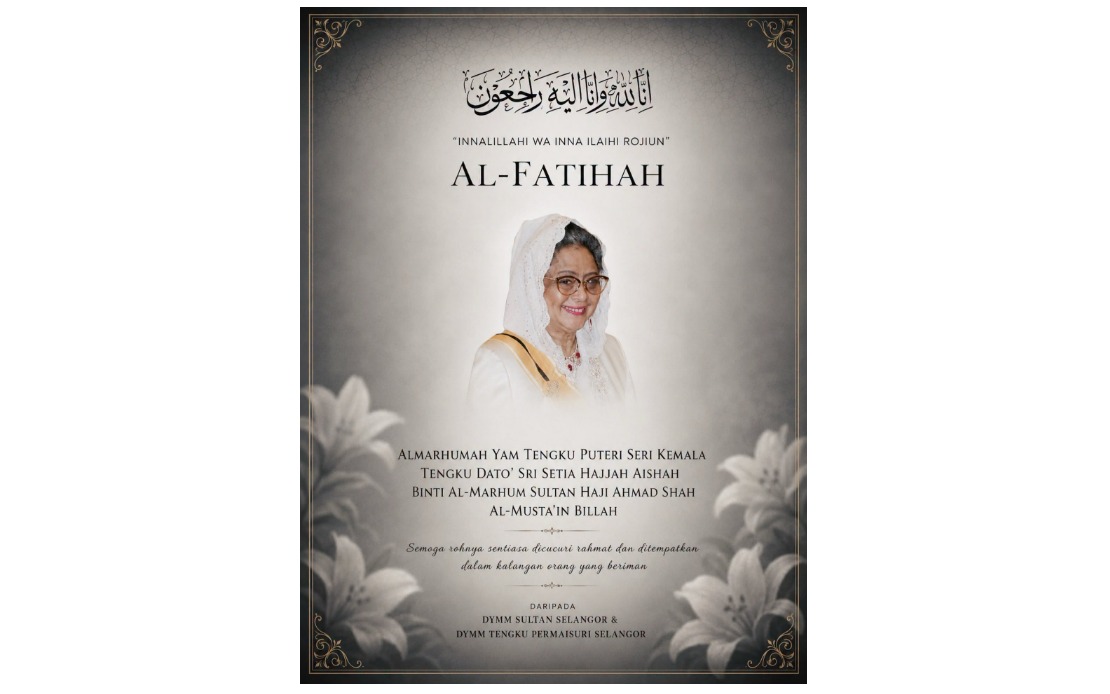
The royal leadership of Selangor has formally expressed deep condolences to His Majesty Sultan Abdullah Ri'ayatuddin Al-Mustafa Billah Shah, the Sultan of Pahang, following the passing of his elder sister. Tengku Puteri Seri Kemala Tengku Datuk Seri Aishah, whose death occurred on August 26, was remembered by Sultan Sharafuddin Idris Shah and Tengku Permaisuri Norashikin through an official statement released by the Selangor Royal Office in Shah Alam.
The gesture reflects the customary practice of inter-state royal solidarity in Malaysia, where members of the various sultanate families maintain close ceremonial and personal ties. Such expressions of sympathy between royal households underscore the interconnected nature of Malaysia's constitutional monarchy, which comprises nine hereditary rulers who collectively form the Conference of Rulers. The timing of the condolence message, released shortly after news of the Pahang princess's demise, demonstrates the immediate coordination that occurs among the royal establishments across different states.
Tengku Datuk Seri Aishah's death took place at a hospital in Kuala Lumpur at 9.15 pm on August 26. The Selangor royal couple's statement acknowledged both the loss to the Pahang royal family and its broader implications for Malaysia's royal institution. Their formal message conveyed sadness and sorrow while invoking Islamic funeral traditions, requesting divine mercy for the deceased's soul and expressing hope that she be numbered among the faithful.
The funeral arrangements for Tengku Datuk Seri Aishah reflected her prominent position within the Pahang royal family. Her remains were transported to the Pahang Royal Mausoleum in Pekan on August 27 for burial rites conducted with full ceremonial honours and in accordance with established royal customs. Such elaborate funeral procedures for senior members of the royal family serve not only as personal tributes but also as significant state occasions that reaffirm the respect and dignity accorded to the institution of hereditary monarchy in Malaysia.
Tengku Datuk Seri Aishah occupied a notable place in Pahang's royal lineage as the elder sister of the reigning sultan. Her relationship to Sultan Abdullah connected her to multiple generations of the state's leadership and governance. The Pahang sultanate itself holds particular significance within Malaysia's constitutional structure, as Pahang is one of the largest and historically most influential states on the peninsula. The death of prominent members of its royal family therefore carries weight beyond immediate family circles.
The condolence message from Selangor's royal household must be understood within the context of Malaysia's federal system, where state rulers maintain substantial ceremonial authority and symbolic importance. Sultan Sharafuddin, who himself leads one of the nation's economically significant states, would naturally extend formal recognition to his counterpart in Pahang during periods of personal and family grief. Such interactions form part of the intricate web of protocols and courtesies that characterize relations among Malaysia's royal establishments.
For the Pahang sultanate, the death of a senior family member represents both a personal loss and an occasion requiring careful management of state affairs. The royal mausoleum in Pekan, where Tengku Datuk Seri Aishah was laid to rest, serves as the repository of Pahang's royal ancestors and represents the continuity of the state's hereditary institution. Burial in this sacred location affirmed her status and ensured her remembered place in the state's historical record.
The receipt of condolences from neighbouring and fellow royal households forms an important part of the mourning process within Malaysia's royal circles. Such gestures, while ceremonial in nature, carry genuine significance as they represent the solidarity and mutual respect that bind together the various sultanates. For Sultan Abdullah, receiving expressions of sympathy from Sultan Sharafuddin and Tengku Permaisuri Norashikin would have provided reassurance of the broader institutional support available during a period of family loss.
The passing of Tengku Datuk Seri Aishah also serves as a reminder of the evolving nature of Malaysia's royal families and the succession questions that arise as senior members pass away. While her death does not directly affect the line of succession to the Pahang throne, it marks the transition of yet another generation within Malaysia's hereditary ruling families. Such transitions inevitably prompt broader discussions about the roles and responsibilities of royal families in contemporary Malaysian society and the balance between tradition and modernization that characterizes the institution.
As Malaysia continues to navigate its place in a rapidly changing Southeast Asian context, the stability provided by its constitutional monarchy remains a defining characteristic of the nation's political system. The coordination evident in the condolence messages exchanged among royal households reflects this institutional continuity. The death of Tengku Datuk Seri Aishah, while a personal tragedy for the Pahang royal family, becomes also a moment for the broader Malaysian royal institution to reaffirm its cohesion and shared commitment to ceremonial and constitutional values that have historically anchored the nation's governance structures.

