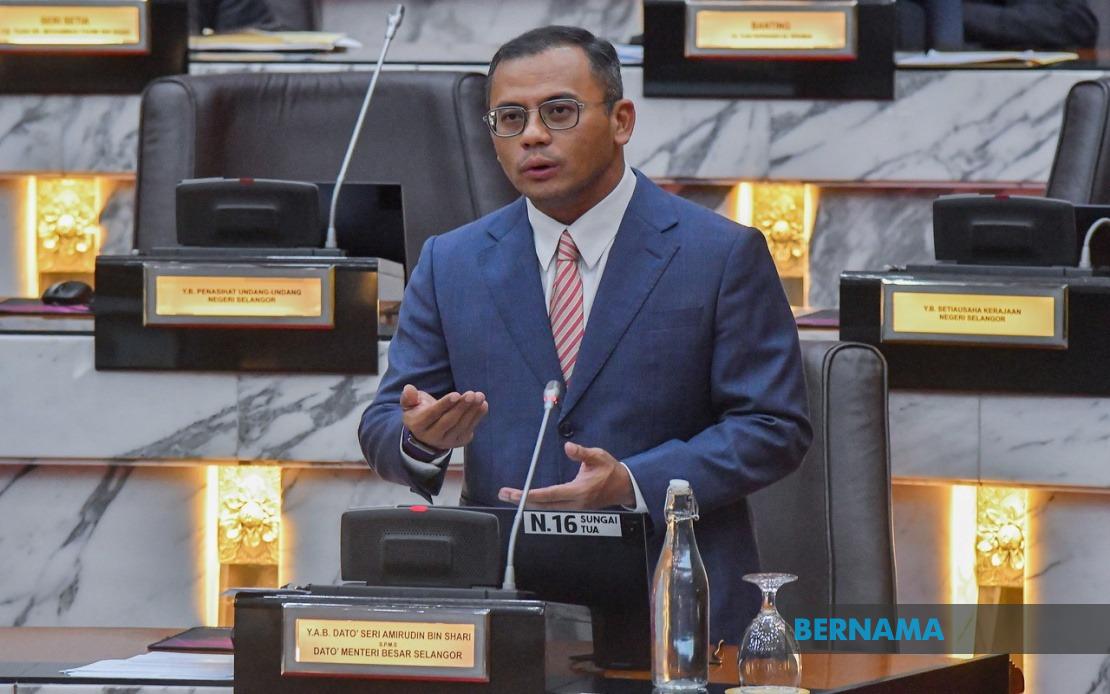
Selangor's Menteri Besar Datuk Seri Amirudin Shari has issued a direct instruction to all local authorities across the state to undertake a thorough review of public transport connectivity infrastructure, signalling growing official concern about the practical barriers preventing residents from effectively using the state's transit networks. Speaking in the State Legislative Assembly, Amirudin emphasized that the state government stands ready to commit supplementary financial resources to guarantee adequate facilities, particularly safer and more accessible pedestrian pathways that bridge the distance between residential areas and transit hubs.
The directive comes amid mounting public frustration documented on social media platforms, where residents have highlighted the genuine difficulty of reaching public transport facilities, especially the Selangor-launched LRT3 line. Rather than treating this as merely a responsive exercise, Amirudin framed the initiative as foundational to Selangor's broader mobility strategy, which aims to reduce private vehicle dependency and shift transportation behaviour towards sustainable public transit options. He stressed that infrastructure improvements must be pursued strategically, focusing on cost-effectiveness rather than expensive vanity projects that drain budgets without delivering tangible benefit to commuters.
Crucially, Amirudin criticized the reactive approach that characterizes current local authority responses, specifically calling out the pattern whereby these agencies only spring into action after complaints accumulate online. He urged Selangor's local authorities to demonstrate genuine proactivity by systematically engaging with their own councillors and relevant stakeholders before issues escalate into viral social media controversies. This reflects a deeper institutional concern: that local governance structures are becoming disconnected from emerging problems precisely because they rely on reactive crisis management rather than continuous dialogue with the communities they serve.
The review was prompted by remarks from Danial Al-Rashid Haron Aminar Rashid, a Petaling Jaya assemblyman representing Batu Tiga, who raised the specific case of inadequate connectivity surrounding LRT3 stations during the assembly's debate on the Selangor Resilience Strengthening Package. His interjection underscores how grassroots concerns about mobility infrastructure are now reaching the highest levels of state government, validating community grievances that had previously been confined to social media discussions.
To operationalize this directive, Amirudin appointed Ng Sze Han, the state's Investment, Trade and Mobility Committee chairman, to spearhead a comprehensive mapping exercise with all public transport operators in Selangor. This mapping initiative is designed to identify service coverage gaps and devise targeted interventions. The underlying premise is logical: without precise data about where commuters currently struggle to access transit, investments cannot be strategically directed toward maximum impact. The gap-mapping approach recognizes that connectivity problems are rarely uniform across the state—some areas face genuine service deserts, while others suffer from poor infrastructure connecting users to existing routes.
Amirudin also signalled the state government's willingness to deploy subsidies as a policy tool, but with important caveats about operator accountability. His comments suggest frustration with scenarios where public funds are deployed as subsidies yet operational inefficiencies persist unchanged. He explicitly warned that subsidies alone cannot solve connectivity challenges if public transport operators maintain inflexible schedules or poor coverage patterns. This represents a more assertive stance from the state government toward operators, suggesting that future subsidy disbursement may become conditional upon demonstrable improvements in service quality and coverage expansion.
For Malaysian observers tracking public transport development regionally, the Selangor initiative reflects growing recognition that transit infrastructure investment alone proves insufficient without parallel improvements to the human experience of reaching and using those systems. The emphasis on first-mile and last-mile connectivity—the journey from home to transit stop and from destination transit stop to final location—acknowledges that urban mobility is a chain, and weak links undermine the entire system. This principle, increasingly central to transport planning in developed cities globally, is gradually gaining traction within Malaysia's state governments.
The directive also carries implications for how state governments across Malaysia structure their engagement with constituents. By explicitly criticizing local authorities for ignoring council member input and waiting for social media uproar, Amirudin's comments suggest that institutional responsiveness to organized local concerns should supersede reactive response to viral complaints. This reflects broader governance challenges facing Malaysia's local authorities, which often operate with limited budgets, aging infrastructure, and constrained technical capacity—factors that can breed disconnection from community priorities.
Beyond Selangor, the connectivity challenge resonates across Malaysia's major metropolitan regions. Kuala Lumpur, Johor Bahru, and other growth centres face similar tensions between expanding transit infrastructure and ensuring that populations can physically reach these systems. The Selangor government's public commitment to addressing these gaps, backed by promised financial commitment and executive oversight from committee leadership, establishes benchmarks against which other state governments may be evaluated.
The appointment of Ng Sze Han to oversee operator engagement and service mapping also signals an important governance choice: treating public transport coordination as a strategic state function rather than deferring entirely to individual operator companies. By bringing operators into coordinated planning processes, the state government positions itself as an orchestrator of the entire system rather than merely funding specific infrastructure elements.
Looking ahead, the success of this initiative will depend heavily on whether local authorities actually implement the directive with substantive resource allocation and whether the operator mapping exercise translates into concrete service improvements. Public commitment from the Menteri Besar creates accountability—residents will monitor whether promised pedestrian improvements materialize and whether first-mile and last-mile gaps genuinely narrow. For a state government that has positioned sustainable mobility as a policy priority, delivery on this review will substantially influence public confidence in its broader development agenda.