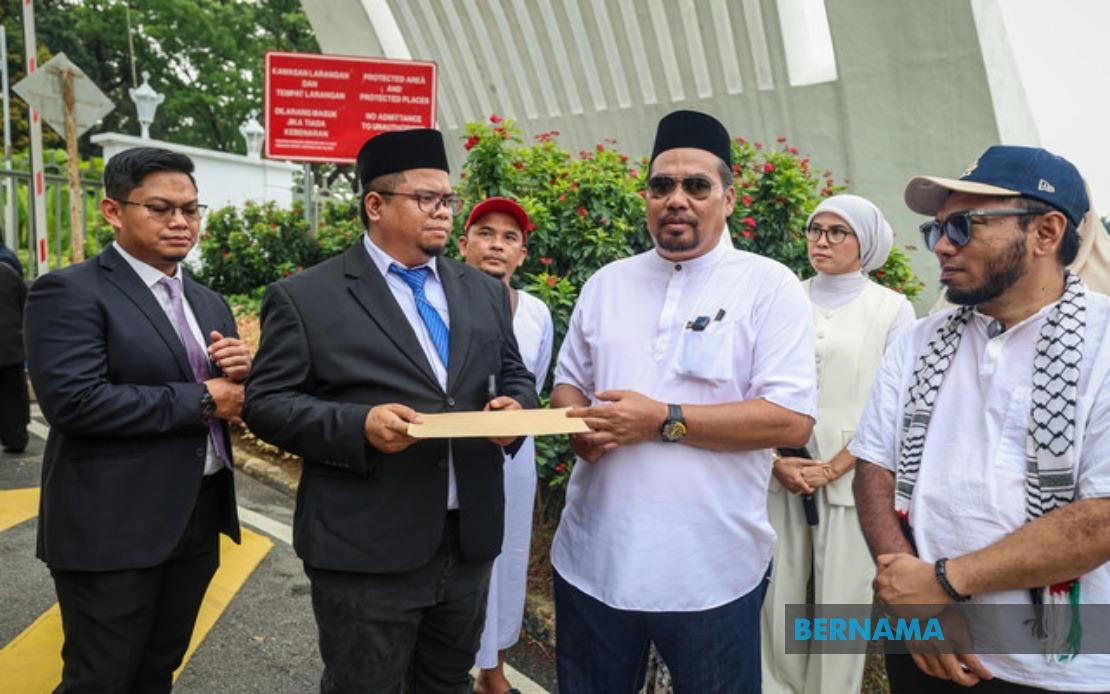
A prominent social media activist coalition has escalated pressure on the Malaysian government to pursue criminal and administrative action against individuals and entities implicated in the mismanagement of Lembaga Tabung Haji (TH), the Islamic pilgrimage fund that holds the savings of millions of Muslim Malaysians. Sekretariat Gerak Gempur Media Sosial Rakyat Malaysia (SEKPUR) delivered a formal memorandum to Parliament on August 11, calling for decisive measures in response to a comprehensive Royal Commission of Inquiry report that catalogued systemic failures within the institution over a seven-year period.
The submission occurred during a peaceful assembly at Parliament's main entrance, where group leaders met with Zairudin Hashim, press secretary to the Minister in the Prime Minister's Department (Religious Affairs), to ensure their petition reached Minister Senator Dr Zulkifli Hasan. The timing was deliberate, coinciding with a special parliamentary sitting convened to allow the minister to brief lawmakers on the RCI's findings and the government's roadmap for restoring TH's financial viability. This coordinated advocacy reflects growing public concern about the fund's governance and the fate of millions of depositors whose retirement savings remain at risk.
SEKPUR secretary Mohd Yani Alias articulated the group's unequivocal position during the handover, emphasising that accountability transcends partisan considerations and institutional loyalty. His remarks underscored a critical principle emerging from civil society: that the integrity of religious institutions serving the Muslim-Malay community cannot be compromised by political considerations or personal connections. The activist coalition's insistence that wrongdoers face prosecution regardless of their political affiliation or seniority signals a shift in how accountability for institutional failures is being framed in Malaysian public discourse, moving beyond traditional patterns where political protection has sometimes shielded prominent figures from consequences.
The memorandum's submission builds on the Yang di-Pertuan Agong's explicit directive that those culpable for TH's predicament must be held fully accountable through the justice system. This royal guidance lends significant moral and constitutional weight to civil society demands for prosecution, positioning them not as partisan attacks but as alignment with the Crown's stated expectations for governance standards. The invocation of the Agong's position demonstrates how activist groups are strategically anchoring their advocacy in the monarchy's recognised authority, a particularly potent approach within Malaysia's constitutional framework.
Beyond demanding prosecutions, SEKPUR's submission raises substantive concerns about TH's long-term financial sustainability and its capacity to provide competitive returns to depositors through hibah distributions. The fund's financial fragility represents more than an accounting problem; it threatens the retirement security of tens of thousands of Malaysians, many of whom made regular contributions throughout their working lives expecting reliable income during old age. The activist group's emphasis on this dimension highlights how institutional mismanagement translates into concrete harm to ordinary citizens, particularly those in lower-income brackets for whom TH savings represent crucial financial buffers.
The memorandum also highlighted the escalating cost of Hajj pilgrimage, a concern with immediate relevance to Malaysian Muslims planning to fulfil this central Islamic obligation. Rising pilgrimage expenses constrain access for lower and middle-income families, potentially creating a two-tier system where only the affluent can comfortably afford the journey. SEKPUR's inclusion of this issue acknowledges how TH's difficulties ripple across multiple dimensions of Muslim community welfare, from retirement security to religious observance. The group additionally demanded enhanced transparency in haj quota allocation, suggesting that traditional quota management processes may lack adequate public scrutiny.
The 211-page Royal Commission report, released publicly on July 29 after months of investigation, documented extensive weaknesses in TH's institutional architecture and operational procedures spanning 2014 to 2020. This period encompasses several changes in political administration and leadership structures, meaning responsibility is distributed across multiple parties and timeframes. The RCI's comprehensive scope and documented findings provide evidentiary foundation for the accountability demands now being articulated by civil society groups, transforming what might otherwise be dismissed as partisan criticism into substantiated indictment based on independent inquiry.
Among the RCI's 25 recommendations for systemic improvement, TH has reportedly implemented approximately 75 percent as of late July. While this implementation rate suggests responsiveness to the commission's findings, the remaining quarter of unimplemented recommendations deserves scrutiny. The delay in full implementation may reflect either resource constraints, institutional resistance to change, or deliberate foot-dragging by elements reluctant to embrace greater oversight. SEKPUR's advocacy implicitly questions whether administrative reforms, without concurrent prosecutions of those responsible for failures, constitute sufficient accountability.
The special parliamentary sitting where the minister briefed lawmakers on TH matters provided an official platform for addressing the institutional crisis, yet civil society intervention through SEKPUR's memorandum demonstrates that activist groups view parliamentary processes as insufficient guarantees of genuine accountability. This dynamic reflects broader tensions in Malaysian governance between institutional remedies and public demand for visible consequences for wrongdoing. The parallel submission of the activist memorandum signals that civil society expects more than bureaucratic assurances and will maintain pressure through street-level activism and media engagement.
For Malaysian depositors and potential Hajj pilgrims, SEKPUR's advocacy carries practical implications. Vocal demands for accountability may accelerate government action on outstanding cases, potentially leading to prosecutions that deter future misconduct. Conversely, should political considerations delay or water down accountability measures, the activist intervention establishes a public record of civil society demands, creating political vulnerability for officials perceived as protecting wrongdoers. The memorandum's submission thus represents both a tactical pressure point and a marker of public expectations that religious institutions managing community assets must be held to uncompromising standards of integrity and transparency.

