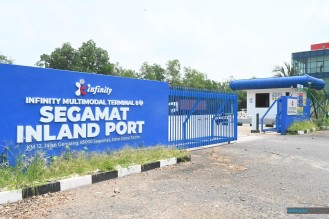
The Segamat Inland Port (SIP) in Johor is setting ambitious throughput targets as it charts a fresh chapter following its operational revival in late June. The facility's management has set its sights on handling over 6,000 twenty-foot equivalent units (TEUs) of containerised and bulk cargo by the end of 2026, marking a significant acceleration from its inaugural month when approximately 1,000 TEUs transited through the terminal. This restart represents a watershed moment for regional logistics infrastructure, transforming a previously dormant asset into a functioning transport corridor that could reshape cargo movement patterns across northern Johor, southern Pahang, southern Negeri Sembilan and Melaka.
SIP manager Samuel Ho outlined the strategic rationale underpinning the facility's reactivation, positioning it as integral to the government's broader Road to Rail initiative developed in partnership with Keretapi Tanah Melayu Bhd. The revival addresses longstanding inefficiencies in the region's logistics ecosystem and responds to mounting pressure on road networks carrying containerised traffic between major ports and inland distribution hubs. For nearly a decade and a half before June 2026, the facility remained largely inactive, its potential constrained by operational limitations that have now been substantially resolved through infrastructure modernisation.
The transformation reflects a calculated shift toward rail-based cargo movement, underpinned by compelling efficiency gains. Rail transport eliminates approximately 80 container truck journeys for each cargo train operation, a multiplication effect that extends far beyond simple arithmetic. This substitution addresses multiple systemic pressures simultaneously: reducing fuel consumption, lowering accident exposure, and diminishing the congestion externalities that plague Malaysia's heavily trafficked corridors. Safety considerations weighted heavily in the reactivation decision, acknowledging that road-based container transport carries inherent risks from accidents and schedule disruptions that rail networks largely circumvent.
Previously, SIP's rail infrastructure operated under severe scheduling constraints that rendered freight operations impractical. The single-track rail configuration forced cargo services to subordinate their dispatch timing to passenger train priorities, creating bottlenecks that discouraged freight operators from adopting the facility. This structural limitation has been fundamentally altered through completion of the double-tracking project extending to Johor, which now permits substantially more flexible scheduling arrangements. The improved rail configuration enables SIP to accommodate up to four cargo receiving and dispatch cycles weekly, compared to approximately one weekly trip under the previous single-track system, quadrupling the facility's operational frequency and responsiveness.
This enhanced scheduling capability creates new commercial opportunities for SIP to consolidate freight flows from Malaysia's major container ports. Port Klang, the Port of Tanjung Pelepas, and Johor Port in Pasir Gudang now have a functionally improved inland distribution channel that can absorb and redistribute containerised cargo more efficiently than traditional trucking arrangements. For logistics operators managing supply chains across the southern region, the revived inland port offers cost advantages and reliability improvements that should gradually shift modal preferences away from exclusively road-based transport.
The geographical context proves equally significant for understanding SIP's strategic importance. Northern Johor encompasses industrialising districts including Batu Pahat and Kluang that are progressively attracting manufacturing and warehousing investment but have historically suffered from logistics disadvantages relative to more proximate port access. SIP positions itself as a gateway for rail-based cargo movement serving these emerging industrial concentrations, potentially catalysing further manufacturing relocation and warehouse development in surrounding areas. By reducing logistics costs and improving supply chain reliability for companies operating in these districts, the facility can function as an economic development instrument, attracting factories and distribution centres that might otherwise locate in areas with superior port connectivity.
Currently, SIP operates across 20.23 hectares in its initial development phase, situated adjacent to Segamat Railway Station. The overall project encompasses three distinct development phases, with the first phase already generating employment for over 200 local residents. This job creation represents immediate economic impact, though far more substantial employment generation should materialise as subsequent development phases progress and operational volumes expand toward their potential. The logistics and security sectors will likely capture the majority of employment opportunities, reflecting the facility's cargo-handling orientation and security requirements associated with containerised trade.
Academic collaboration underpins SIP's operational development strategy, extending beyond purely commercial considerations. The facility has established partnership arrangements with Universiti Tun Hussein Onn Malaysia (UTHM) to facilitate knowledge transfer regarding rail-based inland port management practices. These collaborative initiatives encompass fieldwork exposure for students and structured research projects examining operational efficiency, logistics optimisation, and transport system performance. Such academic engagement serves multiple functions: it develops local expertise in specialised logistics management, establishes knowledge networks that enhance operational decision-making, and builds intellectual capacity within Malaysia's transport and logistics sectors.
SIP's operational history provides important context for understanding the significance of its reactivation. The facility was originally established and commenced operations in 1997 but struggled to generate sufficient cargo volumes to justify ongoing investment, ultimately entering extended dormancy. This earlier failure underscores the infrastructure's vulnerability to operational inefficiencies and modal competition from road transport. The 2026 reactivation, officiated by Transport Minister Anthony Loke Siew Fook, represents a deliberate institutional and strategic pivot that directly addresses the previous operational shortcomings through improved rail infrastructure, enhanced scheduling flexibility, and explicit positioning within the government's modal shift objectives.
The anticipated reduction in road traffic represents perhaps the most tangible impact for ordinary Malaysians navigating southern Malaysian highways. SIP is projected to eliminate approximately 18,000 monthly lorry movements encompassing container trucks and trailers from regional road networks. This substantial volume reduction carries cascading benefits: measurable congestion alleviation, improved road safety through reduced heavy vehicle traffic, diminished logistics costs that can flow through supply chains to consumers, and more efficient utilisation of the nation's rail network. For commuters and logistics operators competing for road capacity, particularly on corridors between ports and inland industrial zones, the modal shift represents meaningful relief from congestion and associated delays.
The facility's evolution must be understood within Malaysia's broader logistics infrastructure modernisation agenda. Rail-based inland ports represent a relatively nascent logistics concept within Southeast Asian supply chains, reflecting global trends toward multimodal transport networks that reduce dependency on road infrastructure. SIP's successful operation could establish a template for similar facilities elsewhere in Malaysia, potentially replicating the model in other regions where road congestion constrains logistics efficiency. The success metrics now emerging from Segamat will likely influence transport planning decisions and infrastructure investment priorities throughout the region.
Looking toward the year-end target of 6,000 TEUs, SIP's management confronts the practical challenge of converting existing capacity into sustained commercial utilisation. Market acceptance requires demonstration of reliable service, competitive pricing relative to alternative transport modes, and operational consistency that instils shipper confidence. The first month's 1,000 TEU achievement establishes a baseline, though scaling to 6,000 TEUs within months will require substantial uptake acceleration. Port authorities, shipping lines, and freight forwarders operating in the region must perceive genuine commercial advantage in routing cargo through Segamat rather than pursuing exclusively road-based distribution strategies.
The reactivation of Segamat Inland Port extends beyond logistics infrastructure modernisation to encompass broader questions about Malaysia's transport system integration and regional economic development. By reviving a dormant facility and repositioning it within the Road to Rail framework, policymakers are attempting to establish integrated transport networks that serve multiple objectives simultaneously: congestion management, environmental sustainability through fuel consumption reduction, improved road safety, economic development in peripheral industrial zones, and enhanced supply chain efficiency. For Malaysian logistics stakeholders and regional economies dependent upon efficient goods movement, the outcome of SIP's operational revival carries implications extending well beyond containerised cargo volumes.

