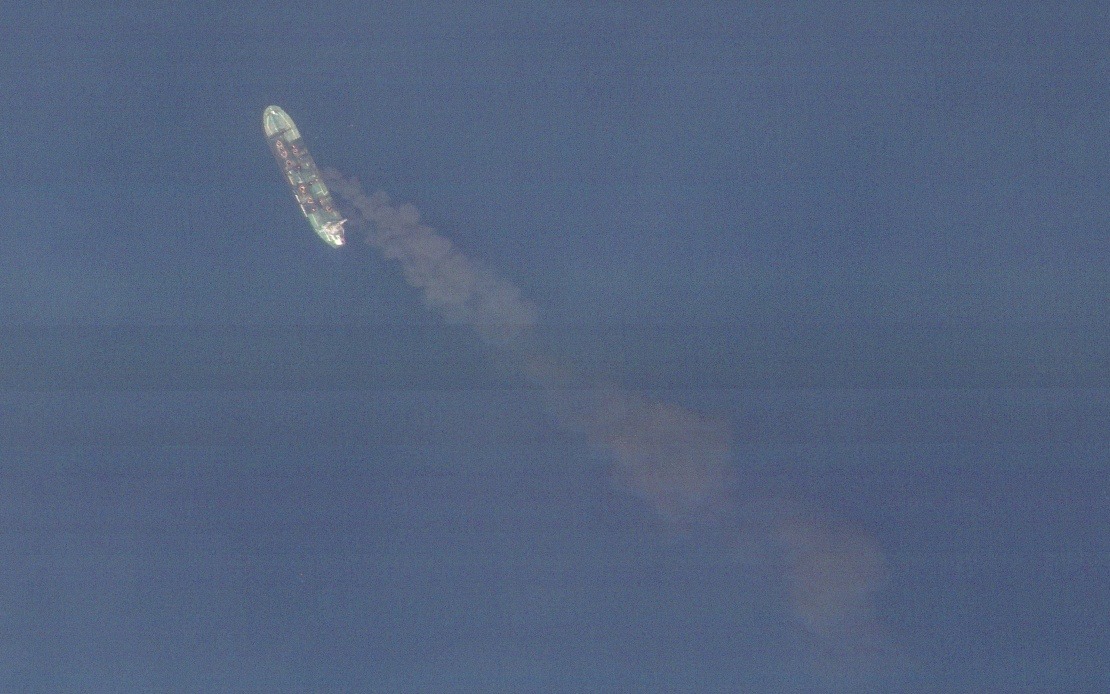
The Saudi-led military coalition operating in Yemen has vowed to enforce robust security measures protecting its commercial shipping interests in one of the world's most vital maritime corridors, following the Houthi group's declaration of a shipping embargo targeting Saudi vessels. The escalation reflects deepening tensions in a conflict that has repeatedly disrupted regional stability and threatens global trade flows through the strategically critical Bab al-Mandab Strait, through which millions of barrels of oil and countless commercial shipments pass daily bound for European and Asian markets.
Coalition spokesperson Turki Al-Malki declared on the social media platform X that the Joint Forces Command would implement all requisite operational measures in accordance with international maritime law to safeguard coalition-affiliated vessels transiting the disputed waters. This statement underscores the coalition's determination to maintain freedom of navigation through a waterway that has become increasingly contested following repeated maritime incidents involving the Iran-aligned Houthis. The declaration signals readiness to confront any hostile actions, though it stops short of detailing specific military operations or response protocols.
The Houthis justified their maritime prohibition by invoking what they characterized as a reciprocal blockade doctrine, framing their action as a proportionate counter to what they describe as a Saudi Arabian siege lasting nearly twelve years. This narrative reflects the militant group's consistent messaging that their actions represent defensive responses to external pressures rather than unprovoked provocations. The timing coincides with broader regional frustrations over humanitarian conditions in Yemen, where coalition airstrikes and ground operations have contributed to what international organizations describe as one of the world's worst humanitarian crises.
In an attempt to counter Houthi accusations of enforcing a blockade, the Saudi Foreign Ministry released a statement asserting that Riyadh has actively worked to alleviate Yemeni civilians' hardship through development initiatives and financial support programs. The ministry pointed to the fact that over three hundred commercial vessels transported essential supplies including food and petroleum products into ports controlled by the Houthis during the first half of the year alone. This data suggests that despite military hostilities, commercial activity and humanitarian goods continue flowing into Houthi-administered territories, contradicting the rebel group's portrayal of complete encirclement.
The immediate trigger for the Houthi maritime ban originated from a controversial incident at Sanaa International Airport, where the Saudi-aligned Yemeni government conducted military strikes intended to prevent an Iranian commercial aircraft carrying a senior Houthi delegation from landing. The airstrike attempt prompted swift retaliation, with the Houthis launching both missile and drone attacks directed toward Saudi Arabian territory. This tit-for-tat dynamic exemplifies how fragile the security situation remains in Yemen despite international diplomatic efforts.
Yemen's internal conflict, which has persisted since late 2014 when the Houthis forcibly captured the capital Sanaa and consolidated control over much of northern Yemen, fundamentally shifted following Saudi Arabia's military intervention in 2015. That intervention, which expanded into a broad regional coalition including several Gulf states, sought to restore the internationally recognized government but instead became mired in a protracted civil war. The prolonged conflict has fractured Yemen into competing zones of control, each backed by different external actors, creating a complex geopolitical landscape that occasionally shows signs of stabilization before deteriorating again.
A significant diplomatic achievement occurred in 2022 when the United Nations successfully brokered a truce that substantially reduced direct military clashes and created a fragile framework for potential negotiations. That truce represented a rare moment of diplomatic progress in a conflict notorious for its intractability and regional dimensions. However, recent escalations centered on control of Sanaa airport and maritime commerce raise concerns that this carefully constructed de-escalation architecture may be coming under dangerous pressure, potentially unraveling the tenuous peace framework that has held for approximately two years.
The Bab al-Mandab Strait represents more than simply a point of military contestation; it constitutes a critical economic artery through which approximately twelve percent of global maritime trade annually transits. For Malaysia and other Southeast Asian economies heavily dependent on maritime commerce and energy imports, disruptions in this waterway create upstream effects that ripple across supply chains, elevate insurance costs for shipments, and introduce unpredictability into precisely calculated logistics networks. Any sustained escalation could force shipping companies to reroute around the African continent, dramatically increasing transit times and transportation expenses.
The Saudi coalition's reaffirmation of its commitment to maintaining protected shipping corridors reflects broader recognition that allowing the Houthis to effectively control maritime traffic would fundamentally alter regional power dynamics and establish a precedent for smaller non-state actors wielding disproportionate influence over global commerce. The coalition's posture also serves to reassure international shipping companies and foreign governments that Saudi Arabia and its allies maintain sufficient military capability to preserve access to these waters. However, the Houthis have demonstrated considerable capacity to threaten commercial vessels through unmanned systems and missile technology, suggesting that any coalition security guarantee remains conditional and imperfect.
The humanitarian dimensions of Yemen's conflict remain inseparable from the current maritime tensions. The nation's civilian population has endured years of disrupted services, economic collapse, and limited access to essential supplies due to the cumulative effects of warfare and blockade-related restrictions. The Houthi maritime ban, ostensibly a political gesture against Saudi Arabia, carries potential consequences for ordinary Yemenis who depend on imports for survival. Conversely, the coalition's security operations, while justified as protecting commerce, have historically resulted in civilian casualties and infrastructure damage that compound Yemen's humanitarian catastrophe.
Regional observers note that the latest confrontation illustrates how local actors in Yemen possess sufficient military capability to create international incidents with broader geopolitical consequences. The Houthis' access to drone and missile technology, widely attributed to Iranian provision and support, has transformed them from a primarily terrestrial insurgent force into a maritime threat capable of targeting shipping and energy infrastructure across the broader region. This evolution has elevated Yemen from an internal conflict to a matter of significant concern for maritime powers and energy-dependent economies worldwide.
Looking forward, the trajectory of Saudi-Houthi tensions will likely determine whether the fragile 2022 truce framework survives or gives way to renewed full-scale hostilities. Diplomatic initiatives involving the United Nations, neighboring Gulf states, and international stakeholders will need to address the underlying grievances that both sides invoke to justify their positions. For Malaysia and regional trading partners, developments in Yemen carry implications extending far beyond Middle Eastern politics, directly affecting maritime security, shipping costs, and energy market stability throughout Asia and beyond.

