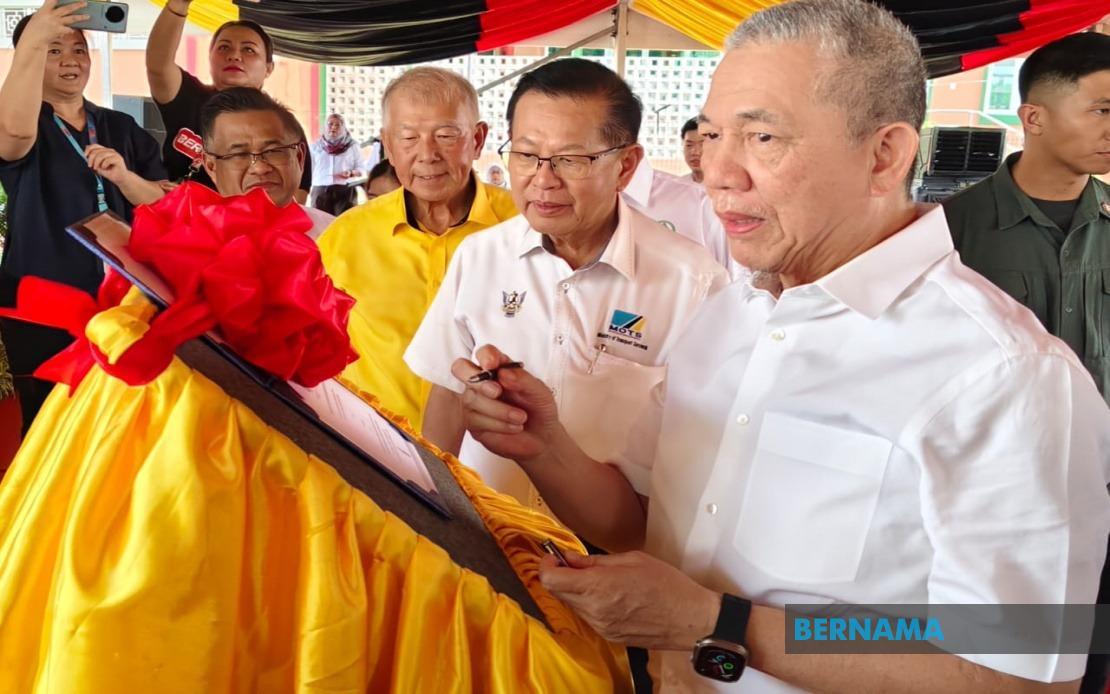
Sarawak is moving forward with an ambitious environmental protection agenda as the federal government commits RM9.46 million to 52 separate initiatives designed to combat the twin crises of riverbank erosion and flooding that have plagued the state's communities. Deputy Prime Minister Datuk Seri Fadillah Yusof announced the scale of the intervention during a site visit to Miri, underscoring the administration's growing focus on climate resilience and natural disaster prevention across the eastern Malaysian state.
The deployment of resources reflects an escalating recognition among policymakers that coastal and riverine erosion poses an existential threat to settlements, infrastructure, and livelihoods throughout Sarawak. The geographic and environmental challenges facing the state—characterised by seasonal flooding, unpredictable weather patterns, and the slow degradation of protective riverbanks—demand sustained, coordinated action rather than ad hoc repairs. The current initiative, branded under the Cakna MADANI Programme, represents a structured attempt to consolidate these efforts under a unified framework with measurable timelines and budgetary oversight.
Progress across the current tranche of projects reflects varying stages of implementation. Of the 52 schemes, 12 have already reached completion, signalling that some interventions are delivering tangible outcomes to affected residents. A further 13 projects are actively under construction, demonstrating momentum in execution across multiple sites. The remaining 27 schemes remain in pre-implementation phases, suggesting that the full impact of this funding round will unfold progressively over the coming months and years. This staggered approach allows for phased capacity deployment and enables authorities to learn from early projects before scaling successful models.
Miri district itself is benefiting from three dedicated Cakna MADANI projects, with particular emphasis on the Tab Cinaq Cemetery Riverbank Stabilisation initiative that Fadillah inspected. The RM134,682 undertaking, launched in May and targeted for completion by November, exemplifies the granular nature of these interventions. Construction of a 50-metre retaining wall will function as both a structural barrier against further erosion and a protective shield for the cemetery and adjacent facilities. Such projects, though modest in individual budget terms, address immediate vulnerabilities in communities where erosion threatens both cultural sites and essential infrastructure simultaneously.
Beyond the immediate Cakna MADANI portfolio, the Malaysian government has cast a significantly broader net for long-term flood management. A complementary suite of 29 flood mitigation projects, commanding a combined outlay of RM3.834 billion, has received formal approval for implementation across Sarawak. This substantially larger budget signals a transition from temporary fixes to permanent, engineering-based solutions designed to protect against worst-case scenarios. The figure underscores the severity with which federal authorities now regard Sarawak's flood vulnerability and the scale of investment deemed necessary to achieve meaningful, lasting protection.
Within this larger programme, the composition of approved schemes reveals strategic prioritisation. Eighteen of the 29 projects represent continuations of existing work, collectively budgeted at RM3.567 billion, indicating that many interventions represent multi-year undertakings requiring sustained commitment. The remaining 11 are newly greenlit initiatives absorbing RM267 million, demonstrating that the government remains alert to emerging risks and evolving needs. This blend of continuation and new-start projects suggests both the persistence of long-standing vulnerabilities and the identification of freshly urgent priorities through ongoing risk assessment.
The Sungai Miri Flood Mitigation Plan, commonly known as RTB Sungai Miri, exemplifies the scale and duration of flagship initiatives. Already eighteen months into construction following its October 2023 commencement, the RM31 million project has achieved physical progress of 58.11 per cent as of the time of Fadillah's announcement. The projected completion date of November 2026 positions this single scheme as a multi-year undertaking, reflecting the engineering complexity and logistical challenges inherent in riverine management across challenging terrain. Such timelines are not unusual for hydraulic infrastructure but underscore the long-term planning horizon that protecting Sarawak's communities demands.
For Malaysian policymakers more broadly, the Sarawak initiative carries implications extending beyond the state's borders. Climate change is intensifying precipitation patterns and raising sea levels across Southeast Asia, rendering erosion and flooding increasingly acute challenges for the entire region. Sarawak's experience in designing and implementing integrated response frameworks—combining localised stabilisation work with major hydrological infrastructure—may offer instructive lessons for other Malaysian states and neighbouring countries confronting similar hazards. The articulation of a phased, budgeted approach under a branded programme also signals a shift toward more transparent, accountable project management in environmental protection.
Fadillah's dual role as Deputy Prime Minister and Energy Transition and Water Transformation Minister positions water management at the intersection of climate adaptation and broader energy policy. This integrated view reflects growing international consensus that water security, energy security, and climate resilience are fundamentally interconnected. The channelling of RM3.834 billion into flood mitigation across Sarawak, therefore, sits within a broader national strategy to build adaptive capacity across multiple domains simultaneously. Communities benefiting from these projects gain not merely physical protection but also tangible evidence of state investment in their futures.
The distribution of 52 Cakna MADANI projects across completion, construction, and pre-implementation phases also highlights the importance of project pipeline management in translating policy into on-the-ground impact. Maintaining momentum across dozens of concurrent initiatives, each with distinct geographic circumstances and technical requirements, demands sophisticated coordination capabilities. Early-stage completions provide both psychological reassurance to affected communities and operational data for refinement of subsequent phases. Ongoing construction projects demonstrate sustained activity and commitment, while pre-implementation schemes signal that the pipeline remains robust and that communities can anticipate continued intervention.
For residents of Sarawak confronting chronic erosion and recurring floods, the announced initiatives represent a material shift in the state's relationship with these environmental hazards. Rather than treating erosion and flooding as inevitable seasonal occurrences requiring only reactive response, the structured investment implies a commitment to preventive infrastructure and systematic risk reduction. The RM9.46 million immediate allocation, coupled with the RM3.834 billion longer-term programme, translates abstract policy commitments into concrete retaining walls, flood barriers, and river conservation works that will reshape the physical landscape and daily security of vulnerable communities across the state.

