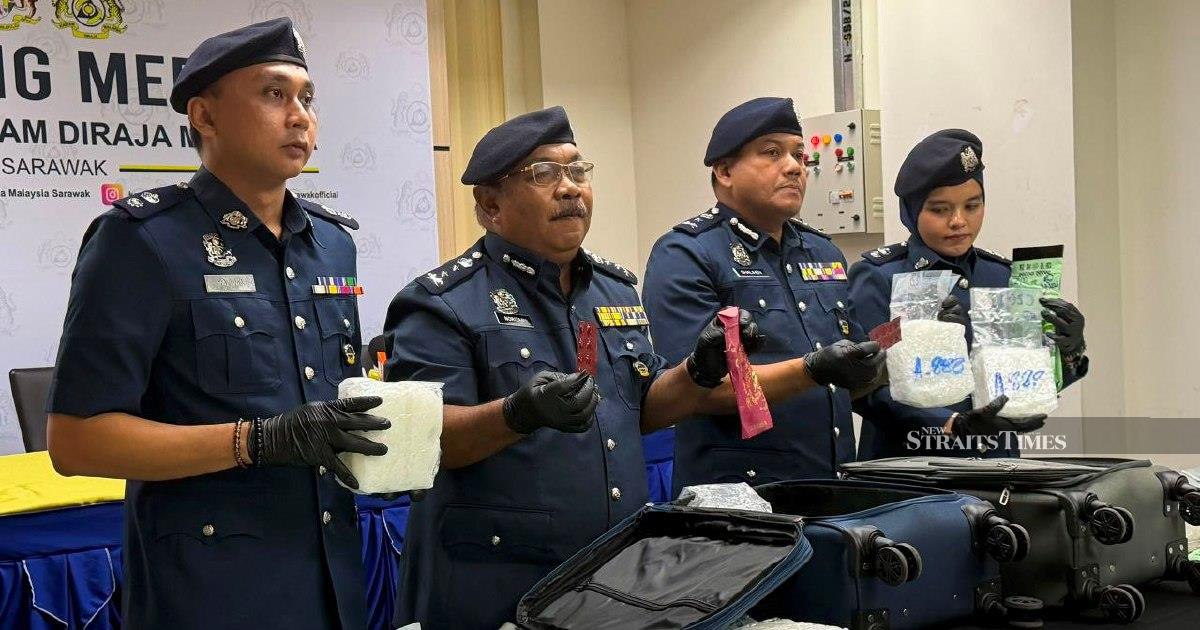
Officers from the Sarawak Customs Department executed a successful interdiction operation at Kuching International Airport on July 9, preventing what would have been a significant drug trafficking incident. Two men were taken into custody following the discovery of narcotics with an estimated street value of RM1.32 million during routine screening procedures at the airport's departure terminal. The seizure represents a notable achievement for regional enforcement efforts and underscores the critical role played by border security agencies in maintaining the integrity of Malaysia's international gateways.
The interception occurred as part of standard customs operations at one of Sarawak's primary aviation hubs. Intelligence gathering and vigilant inspection protocols enabled customs officials to identify suspicious luggage and personal effects belonging to the two detained individuals. The specifics of the narcotics—including their type, quantity, and packaging—form part of an ongoing investigation that will determine the scope of potential criminal charges against the suspects.
Major drug smuggling attempts through Kuching International Airport have historically been relatively less frequent compared to incidents at larger peninsular hubs, making this seizure particularly significant for Sarawak's law enforcement community. The airport's strategic location as a gateway to both domestic and international travel networks makes it an attractive target for transnational trafficking organisations seeking alternative routes around established enforcement checkpoints. This operation demonstrates that customs authorities remain alert to emerging smuggling patterns and are adequately resourced to counter such threats at air borders.
The arrest of the two men marks the beginning of formal legal proceedings that will unfold within Malaysia's criminal justice framework. Charges under the Dangerous Drugs Act 1952 carry severe penalties, including lengthy imprisonment and substantial fines, reflecting the nation's stringent approach toward drug trafficking. The Crown's burden of proof will require establishing the mens rea, or criminal intent, of the accused individuals—a consideration that investigative teams will pursue through forensic examination of the seized materials and interrogation of the suspects.
From a broader Southeast Asian perspective, this intercept highlights the persistent challenge posed by illicit narcotics flowing through regional air corridors. Drug trafficking networks exploit aviation infrastructure precisely because airports process high volumes of passengers and cargo daily, creating opportunities for concealment within legitimate travel patterns. The Sarawak operation illustrates how coordinated customs enforcement, coupled with modern detection technologies and trained personnel, can disrupt even well-organized smuggling operations.
The Sarawak Customs Department's capacity to identify and apprehend traffickers reflects investments in both human capital and technological infrastructure within Malaysia's border security apparatus. Officers underwent specialized training in recognizing behavioural indicators of drug couriers and interpreting imagery from advanced screening equipment. Such capabilities extend beyond Kuching International Airport to encompass maritime ports and land border crossings throughout Sarawak, collectively forming a layered defensive posture against drug importation.
International cooperation frameworks have proven instrumental in building Malaysia's counter-narcotics infrastructure. Partnerships with customs agencies in neighbouring countries, intelligence sharing through regional forums, and technical assistance from advanced economies have strengthened detection and prosecution capabilities. This particular seizure may have involved preliminary intelligence from partner nations, though such collaborative details typically remain confidential for operational security reasons.
The timing of the July 9 operation coincides with a period of elevated vigilance throughout Malaysia's customs and law enforcement sectors. Recent years have witnessed expanding investigations into synthetic drug production and distribution networks, with authorities identifying domestic connections to transnational trafficking syndicates. The Kuching seizure, while potentially isolated, may form part of a larger enforcement picture that intelligence agencies are assembling regarding narcotics flows through the region.
For Malaysian travellers and legitimate commerce, such enforcement successes reinforce confidence in border security while maintaining a reassuring image of professional customs operations. Airlines and ground handling companies also benefit from the knowledge that authorities are actively screening for contraband, thereby reducing their own liability exposure. The incident illustrates that despite inevitable gaps in any security system, Malaysia's enforcement apparatus possesses the will and capability to identify major trafficking attempts.
The investigation into the two arrested individuals will likely extend beyond the immediate seizure, with authorities seeking to establish the identities of upstream suppliers and downstream distributors. Intelligence analysts will examine communications records, financial transactions, and travel histories to determine whether the suspects form part of a larger organised smuggling network or represent independent operators. Such investigative threads often lead to subsequent enforcement actions at other locations and against additional individuals complicit in the trafficking scheme.
As the legal process unfolds for the two detained men, the seized narcotics will remain subject to forensic analysis and evidentiary preservation protocols mandated by Malaysian law. Defence counsel will have opportunity to challenge the admissibility of evidence and the legality of the search procedures undertaken. Regardless of the eventual outcome at trial, the Sarawak Customs Department has demonstrated its commitment to preventing drug trafficking at a critical chokepoint in Malaysia's border security network.

