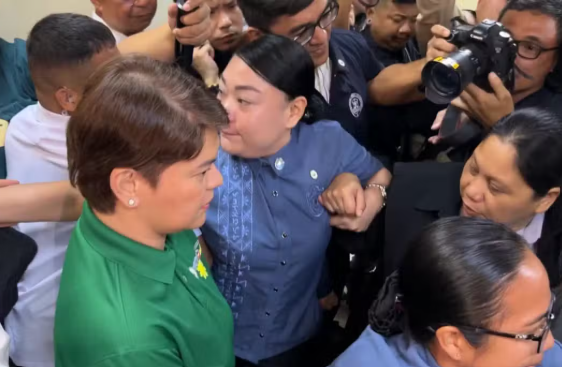
Vice President Sara Duterte arrived at the Philippine Senate on Tuesday to meet with her legal team, using the occasion to reinforce her defiant stance toward the impeachment proceedings against her. In remarks to waiting reporters, she employed evocative language to characterize her constitutional battle, stating that "in this bloodbath and bludgeoning, I will be bloodied but unbowed." The phrase echoes William Ernest Henley's celebrated poem "Invictus," a work that has long symbolized unwavering resolve in the face of overwhelming adversity and the refusal to succumb to defeat.
This latest characterization marks a continuation of Duterte's framing of the impeachment process, which she first described as a "bloodbath" in May 2025. At that time, her comments sparked considerable controversy, as she appeared to welcome the confrontation rather than shy away from it. However, critics and political opponents have seized upon this rhetoric to highlight what they view as an inconsistency in her conduct—Duterte notably absented herself from much of the House impeachment proceedings across both 2025 and 2026, raising questions about her commitment to the process she claims to embrace.
The impeachment trial represents one of the most significant constitutional developments in recent Philippine political history. Four separate articles of impeachment have been formally brought against the Vice President, each carrying grave implications for her political future and ability to serve in public office. The charges encompass a wide spectrum of alleged misconduct, ranging from financial impropriety to threats against the nation's highest officials, suggesting a comprehensive effort by prosecutors to establish a pattern of wrongdoing rather than isolated incidents.
The first article concerns allegations of misappropriation of government funds. Duterte stands accused of misusing a combined P612.5 million in confidential funds—P500 million from her Office of the Vice President and P112.5 million from the Department of Education. The distinction between confidential and operational spending has become a central point of contention, with investigators questioning the transparency and accounting mechanisms surrounding such funds and whether they were deployed for legitimate government purposes or diverted for other uses.
The second article centers on alleged unexplained wealth and deficient asset declarations. Prosecutors contend that Duterte failed to accurately disclose her financial holdings and business interests across the Statements of Assets, Liabilities and Net Worth filings required from 2022 to 2024. This charge also includes allegations that she maintained business interests she should have divested upon assuming the Vice Presidency, suggesting a conflict between her public duties and private financial commitments.
Article III addresses allegations of bribery and procurement irregularities involving Department of Education officials. This charge suggests coordination or illicit arrangements between Duterte and DepEd personnel regarding procurement processes, potentially indicating that education contracts or disbursements were influenced by corrupt considerations rather than merit or public interest.
The fourth and perhaps most inflammatory article involves allegations of assassination threats against President Ferdinand Marcos Jr., First Lady Liza Araneta-Marcos, and former House Speaker Martin Romualdez. These charges carry constitutional weight far beyond financial matters, touching upon national security and the protection of the highest officials of the state. Prosecutors argue that Duterte made statements threatening the lives of these individuals, though the precise context and interpretation of such statements have been contested.
The procedural timeline underscores the gravity of the proceedings. The trial is projected to span 92 days of proceedings, which would extend the constitutional process well into early 2027. This extended duration reflects both the complexity of the charges and the Senate's responsibility to conduct a thorough examination of the allegations. Unlike conventional criminal trials, impeachment requires a supermajority threshold for conviction—specifically, the affirmative vote of at least two-thirds of all senator-judges under the 1987 Philippine Constitution. This stringent requirement was intentionally designed to make conviction difficult, ensuring that impeachment serves as a remedy only for truly egregious breaches of public trust rather than as a tool for partisan advantage.
For Malaysian and broader Southeast Asian observers, the Duterte impeachment trial represents a critical test of institutional resilience in the region. The Philippines, despite its constitutional vulnerabilities and democratic challenges, is employing its impeachment mechanism to hold an elected Vice President accountable—a process that reflects both the system's checks and balances and the intense political contestation that characterizes Philippine governance. The extended timeline and supermajority requirement mean that conviction is far from assured, regardless of the prosecution's evidence or the strength of public sentiment against Duterte.
Duterte's defiant posture and literary invocation of resilience suggest she views this trial as an existential political struggle rather than a neutral constitutional process. Her reference to being "bloodied but unbowed" frames the proceedings as combat in which survival itself constitutes victory, regardless of the underlying facts or constitutional merit of the charges. This rhetorical strategy may resonate with her political base while simultaneously alienating those who view impeachment as a solemn constitutional responsibility demanding serious engagement and transparent participation.
The trial's outcome will depend heavily on the Senate's composition, the quality of evidence presented, and the degree to which senator-judges view the charges as meeting the constitutional threshold for removing a sitting Vice President. Duterte's absence from earlier House proceedings, contrasted with her current engagement and combative rhetoric, has created an image of selective participation that opponents may exploit to suggest evasion or disrespect for the constitutional process. Whether her invocation of "Invictus" will translate into legal survival through the 92-day ordeal remains an open constitutional question that will occupy Philippine political discourse until early 2027.

