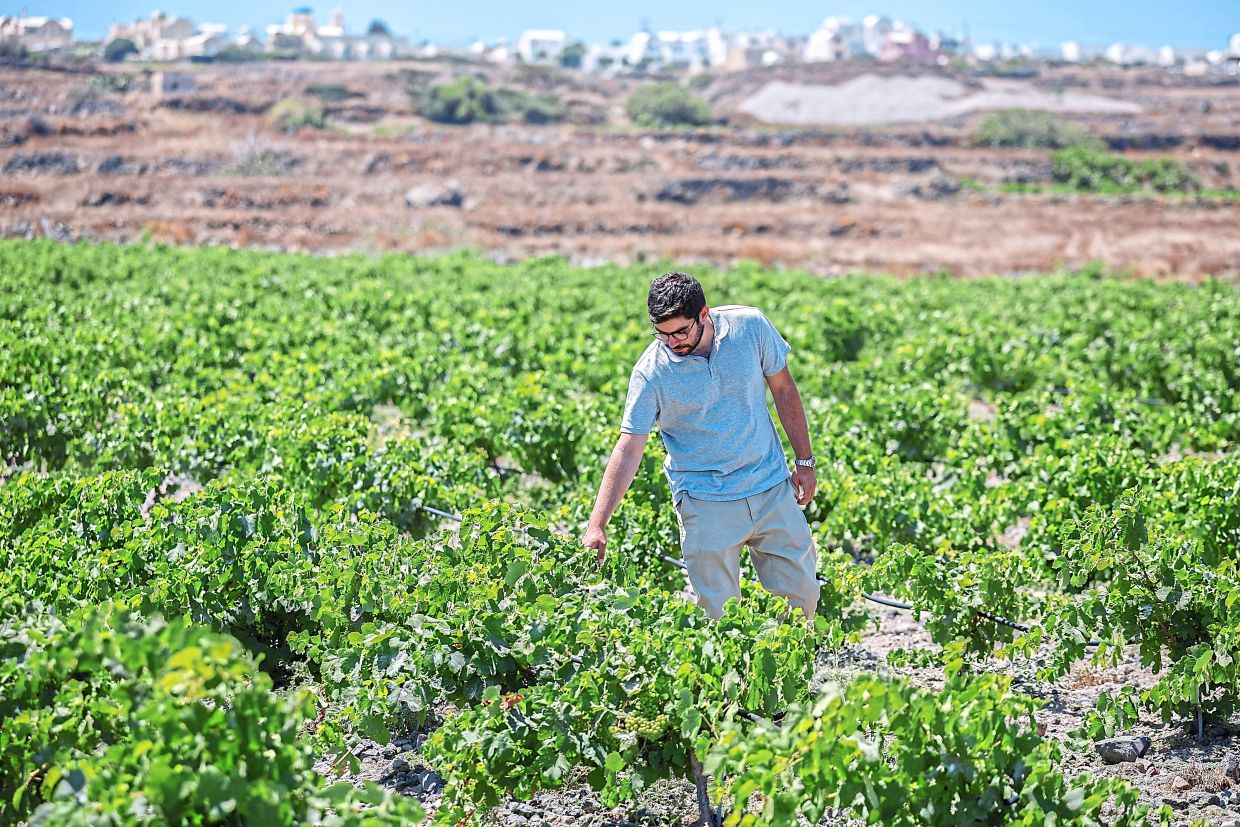
The renowned vineyards of Greece's Santorini island face an unprecedented challenge as climate change intensifies heat and drought conditions, forcing winemakers to abandon centuries-old practices in favour of radical adaptation strategies. During a tour of his vineyard, sixth-generation winemaker Yiannis Boutaris points to a gnarled vine trained into the traditional basket shape—a technique designed to shield grapes from the island's intense summer heat. After nine decades of survival, this particular vine succumbed to the relentless conditions, its demise emblematic of a broader crisis gripping the Mediterranean wine region. The losses extend beyond individual plants: between 2023 and 2025, Santorini experienced severe rainfall shortages and record-breaking temperatures that have ravaged production levels, driven grape prices sharply higher, and sparked urgent concerns about the island's finite freshwater resources.
The predicament afflicting Santorini represents a microcosm of climate impacts sweeping across Greece and the wider Mediterranean basin, where warming temperatures and increasingly unpredictable precipitation patterns threaten the viability of agricultural systems that have sustained communities for generations. What makes Santorini's situation particularly acute is the collision of agricultural demand with tourism pressures—during peak seasons, when hundreds of thousands of visitors flood the island, competition for water intensifies dramatically among farmers, hotel proprietors, and operators of swimming facilities. This three-way tussle for dwindling supplies illustrates how climate vulnerability intersects with economic interests, creating complex trade-offs between preserving heritage industries and maintaining the infrastructure that underpins the island's tourism-dependent economy.
Boutaris and other progressive growers are now collaborating with local authorities and academic researchers on experimental solutions that blend contemporary technology with sustainable principles. One pilot initiative involves capturing wastewater from residential buildings and hospitality establishments, treating it, and redirecting the reclaimed water to irrigate vineyards—an approach already proven effective in water-stressed regions like California. Beyond wastewater recycling, Boutaris is trialling atmospheric water harvesting, a technique that absorbs moisture directly from the air using specially designed hydrogels and subsequently releases it as usable water through heat generated by solar panels. These innovations demonstrate how resource scarcity can catalyse technological creativity, transforming what appears as an insurmountable environmental challenge into an opportunity for sustainable reinvention.
The structural transformation of vineyard management itself forms another critical dimension of the adaptation strategy. Rather than maintaining the scattered, traditional planting pattern that has characterised Santorini's viticulture for centuries, Boutaris and peers are experimenting with row-based configurations that streamline irrigation delivery and reduce water waste through evaporation. Neighbouring winemaker Yiannis Papaeconomou, whose vines are only six years old, has implemented subsurface irrigation systems that deliver water directly to root zones rather than spraying from above, further minimising evaporative losses. Concurrently, both producers are employing strategic trellising arrangements that enhance water distribution efficiency. These methodological shifts represent not merely technical adjustments but a philosophical recalibration—acknowledgment that preservation of the wine tradition requires fundamental departures from the production methods that sustained it for centuries.
The severity of recent climatic oscillations on Santorini cannot be overstated. According to Stefanos Koundouras, a viticulture specialist at Aristotle University in Thessaloniki, the island experienced its hottest temperatures in six decades during 2023 and 2024, conditions that pushed environmental stress beyond historical norms. Koundouras emphasises that the challenges confronting Santorini foreshadow broader vulnerabilities affecting European wine regions, particularly throughout the Mediterranean basin where climate models predict continued warming and desiccation. Beyond the immediate production challenges, he notes a qualitative dimension to the crisis: the distinctive character and reputation of Mediterranean wines—attributes shaped by specific terroir conditions and climatic patterns—face degradation as these environmental parameters shift. For a region whose identity and export value depend heavily on the authenticity and consistency of product quality, this represents a threat to commercial viability that transcends simple yield reduction.
The economic implications reverberate through Santorini's entire agricultural sector and beyond. In northern Greece, where climatic conditions remain comparatively moderate, grape prices languish at approximately €0.80 per kilogram, translating to roughly RM3.70. By contrast, Santorini's constrained supply and elevated production costs have driven local grape prices to dramatically higher levels, squeezing winemakers' profit margins even as they invest substantially in adaptive infrastructure. This price disparity highlights how climate impacts generate uneven regional consequences, potentially concentrating economic hardship on already-vulnerable agricultural communities whilst redistributing advantages toward less-affected areas—a pattern with significant implications for rural development and social stability across Greece.
The wastewater recycling initiative embodies a pragmatic reconciliation of environmental, economic, and technological considerations. Rather than relying on expensive desalination plants—which impose both substantial financial burdens and significant energy demands on island operations—treated wastewater recycling offers comparable reliability with superior sustainability credentials. This approach also carries important symbolic weight: it positions Santorini's wine industry not as a victim passively succumbing to environmental change, but as an adaptive sector actively developing solutions that might prove transferable to other Mediterranean regions facing comparable pressures. The pilot programme's collaborative framework, involving government bodies, academic institutions, and private producers, demonstrates how innovation emerges through partnerships transcending traditional sectoral boundaries.
For Malaysian and Southeast Asian observers, Santorini's climate adaptation story carries several instructive dimensions. The region's experience illustrates how established industries built around specific environmental conditions face existential jeopardy when those conditions shift beyond historical parameters—a lesson increasingly relevant as Southeast Asian agriculture confronts intensifying heat, erratic monsoon patterns, and water stress. The adaptive strategies emerging from Santorini—wastewater recycling, atmospheric water harvesting, precision irrigation, and crop configuration modifications—represent technologies and methodologies with potential applicability across tropical and subtropical agricultural systems. Furthermore, the Santorini case demonstrates how heritage industries can innovate without abandoning their essential character, a balance particularly important for regions where agricultural identity, cultural continuity, and economic security intertwine inseparably.
The broader significance of Santorini's vineyard crisis extends beyond wine production into fundamental questions about climate resilience and agricultural transformation. The convergence of environmental stress, tourism pressure, and production demands creates a crucible in which traditional systems face redesign imperatives. Boutaris and Papaeconomou's willingness to experiment—retaining core elements of winemaking tradition whilst fundamentally reimagining cultivation methods—suggests a model for how heritage agricultural sectors might navigate climate disruption. Yet this adaptation carries implicit acknowledgment: the Santorini wine industry as it has existed for centuries cannot persist unchanged. Instead, a new model is emerging, one that harnesses contemporary technology, embraces sustainability principles, and accepts that preservation requires transformation. Whether these experimental approaches prove sufficient remains uncertain, but the commitment to innovation rather than resignation offers at least a pathway through an otherwise seemingly intractable crisis.

