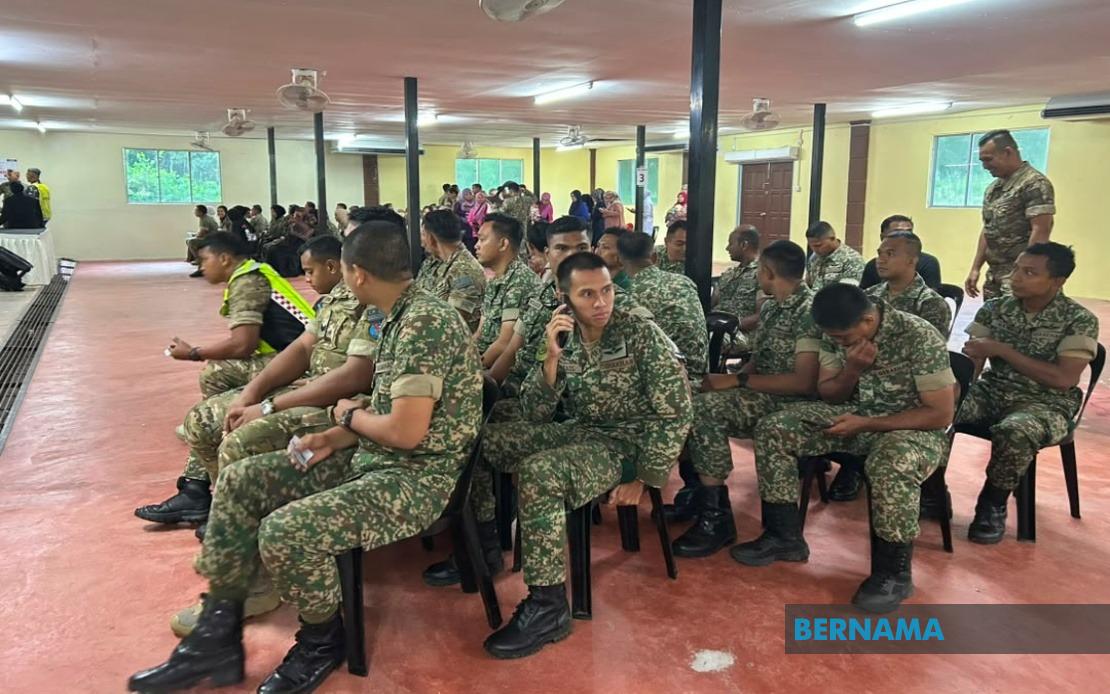
Security personnel began casting votes on July 7 in the early voting phase of the 16th Johor State Election, with two cabinet ministers using social media to encourage the 24,751 eligible early voters to approach the process with democratic responsibility and civic integrity. The appeal underscores the significance both the government and opposition place on maintaining public confidence in the electoral process, particularly among uniformed services who form a substantial bloc of the electorate in this closely watched state contest.
Home Minister Datuk Seri Saifuddin Nasution Ismail and Defence Minister Datuk Seri Mohamed Khaled Nordin each issued separate calls through Facebook, framing early voting not merely as a procedural exercise but as a constitutional privilege that carries moral weight. Saifuddin Nasution, who doubles as Pakatan Harapan secretary-general, emphasised that early voters should "exercise your right with full responsibility and in the spirit of democracy," signalling the opposition coalition's commitment to a competitive yet measured campaign. His intervention highlights how PH, despite being the ruling federal coalition, recognises that maintaining electoral credibility requires visible support from senior leaders during voting phases.
The early voter contingent comprises 12,041 members of the Malaysian Armed Forces and their spouses, alongside 12,710 police personnel and their spouses—a combined 24,751 voters whose ballots are cast before the general polling day on Saturday. This subset of the electorate holds particular significance in Malaysian politics. Security forces traditionally vote early due to operational requirements, yet their participation patterns have become scrutinised in recent electoral cycles as political strategists assess how these cohorts lean. Both coalitions are clearly attentive to this demographic, with ministerial-level messaging aimed at legitimising the process rather than overtly campaigning.
Menteri Besar Datuk Onn Hafiz Ghazi, representing the ruling Barisan Nasional government in Johor, made a competing appeal to early voters, asking them to "place their trust in every Barisan Nasional candidate to continue the agenda of stability, development and public welfare." His framing emphasises continuity and incumbency advantage—a strategy where the ruling coalition highlights existing programmes and developmental achievements to justify re-election. This multi-level appeal from BN leadership demonstrates the state government's concern that early voting could set a tone for the broader campaign narrative.
Sixty-four early voting centres opened at 8 am across Johor on July 7, with staggered closing times between noon and 6 pm depending on location and voter registration density. The logistical coordination reflects the Election Commission's effort to facilitate voting for security personnel while maintaining election day procedures for the general population. For Malaysian voters, this procedural detail matters: transparent, orderly early voting builds confidence that the subsequent main polling day will also proceed fairly and efficiently.
The 16th Johor State Election involves 56 seats contested by both Pakatan Harapan and Barisan Nasional, with 172 candidates in total seeking office. Notably, both major coalitions are fielding candidates in every seat, indicating neither side is ceding ground—a competitive posture that suggests close electoral calculations in this economically significant state. Johor's political outcome carries implications beyond state governance, as it often signals broader electoral trends affecting national politics in Malaysia.
All three leaders explicitly prayed for the voting process to proceed smoothly, peacefully and in orderly fashion—a rhetorical nod to Malaysia's post-2018 democratic renewal, during which electoral integrity became a rallying point for reform-minded voters. That such appeals now come from both government and opposition voices suggests a maturing consensus that credible elections serve all political actors' long-term interests. The call for peace and order also reflects awareness that electoral disputes, whether genuine or manufactured, can destabilise state governments and damage public institutions.
For Malaysian observers, particularly those tracking electoral dynamics in peninsular states, the Johor contest matters because the state represents a significant economic and political pivot point. The state government controls land, development approvals, and fiscal resources that influence both business confidence and voter sentiment. An early voting phase where security personnel participate visibly and apparently without friction could bolster government confidence heading into Saturday's main polling day. Conversely, should irregularities emerge in early voting, they would immediately invite scrutiny and claims of procedural bias.
The emphasis by cabinet ministers on early voting responsibility also carries subtle educational weight for the broader electorate. By treating security personnel's votes with formal ministerial attention, both coalitions implicitly signal that all votes matter equally and that electoral processes deserve respect regardless of political affiliation. This messaging becomes especially important in a state where historical BN dominance faced challenges in recent election cycles, making voter mobilisation and turnout critical for both sides.
As Johor moves toward Saturday's main polling day, the early voting phase has completed without reported incident, allowing both Pakatan Harapan and Barisan Nasional to shift focus to final campaign messaging and ground-level voter engagement. The appeals from Saifuddin Nasution, Mohamed Khaled, and Onn Hafiz Ghazi have set a tone emphasising process integrity and democratic participation, framing the election as a legitimate constitutional exercise rather than a partisan battle. Whether this tone persists through Saturday's main voting and the subsequent result will significantly influence how Malaysians view electoral credibility in the months ahead.

