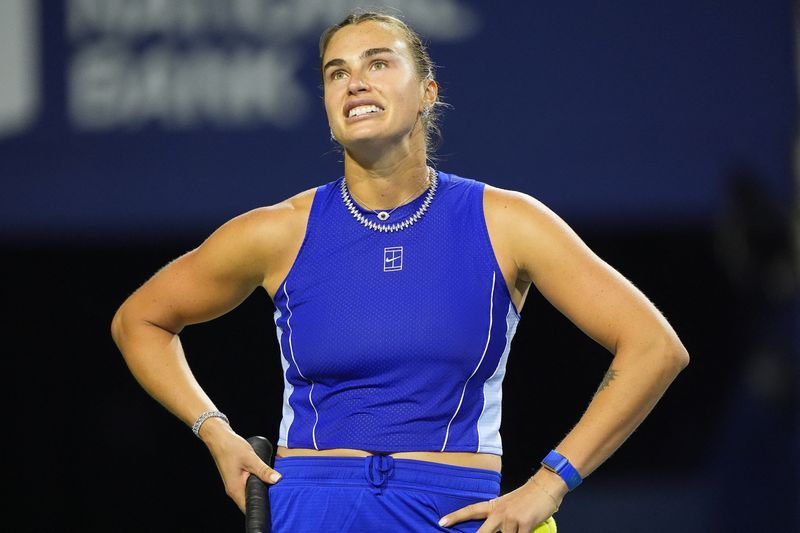
The tennis calendar's final major tuneup before the U.S. Open has delivered an unexpected outcome, with world number one Aryna Sabalenka falling at the Canadian Open in Toronto on Saturday. In a gruelling fourth-round encounter that extended past two and a half hours, the Belarusian top seed succumbed to Russia's 16th-seeded Ekaterina Alexandrova in a 7-6(3) 4-6 6-4 defeat, marking a significant stumble just weeks before the year's final Grand Slam tournament in New York.
The loss carries particular weight given Sabalenka's status as the defending U.S. Open champion and a four-time Grand Slam winner. As the tournament favourite heading into Flushing Meadows, the setback in Canada signals vulnerability on the hard courts where she has dominated in recent seasons. The match offered a masterclass in composure from Alexandrova, who maintained her aggressive approach throughout and capitalised when it mattered most, converting her third match point when Sabalenka double-faulted while serving to remain in contention at 4-5 in the deciding set.
Alexandrova's path to the quarter-finals demonstrates the tactical acumen required to overcome elite opponents. The Russian broke serve early in the opening set to seize momentum, but Sabalenka's counter-attack forced a tiebreak that Alexandrova captured through superior execution. The momentum shifted again in the second set, where Sabalenka demonstrated the resilience that has defined her career, establishing a commanding 4-3 lead before holding serve to force a decisive third frame.
The final set proved pivotal, with Alexandrova's relentless shot-making gradually eroding Sabalenka's composure. The world number one's unforced error count mounted as the match progressed, a concerning pattern for someone preparing for a Grand Slam tournament where consistency over best-of-three sets is paramount. Despite engineering two match-point saves during her final service game, Sabalenka's double fault on the third attempt concluded the contest and sent Alexandrova through to face Ukraine's Elina Svitolina in the semi-finals.
Svitolina advanced to that stage by dismantling American eighth seed Amanda Anisimova 6-2 6-4, showcasing clean, aggressive tennis throughout. The Ukrainian's comprehensive victory suggests she has found ideal form on hard courts, positioning her as a formidable opponent for Alexandrova. For Malaysian and Southeast Asian tennis followers, this development highlights how rapidly momentum can shift in professional tennis, with unseeded or lower-ranked players capable of toppling the sport's hierarchy through disciplined execution and tactical awareness.
Alexandrova's post-match commentary revealed the mental discipline required to upset a champion. Speaking at courtside, she articulated her strategy of treating each point as individual and critical, avoiding the psychological trap of tracking the overall score. This approach allowed her to maintain aggressive intent without becoming overwhelmed by the magnitude of facing the world's best player. Her acknowledgment that she had assumed her opportunity had passed after the second set loss speaks to the psychological resilience required to stage comebacks against elite opposition.
For Sabalenka, the result presents both a challenge and an opportunity in the fortnight remaining before the U.S. Open. Historically, players have used early setbacks to identify weaknesses and refine approaches ahead of major tournaments. The Belarusian's error-prone performance in the final set, particularly the deciding double fault, suggests mechanical or mental issues that require attention. Her position as the top seed and defending champion means expectations remain sky-high, but this loss at Toronto may force tactical recalibration ahead of New York.
The Canadian Open serves as a traditional final Grand Slam preparation event, making it a bellwether for players' readiness. Sabalenka's elimination suggests the field at Flushing Meadows will be more wide-open than anticipated, with multiple contenders capable of mounting serious title campaigns. Alexandrova's victory demonstrates that the women's game continues to develop depth, with players outside the traditional elite capable of producing breakthrough performances on tennis's biggest stages.
For regional sports audiences, Sabalenka's loss underscores the unpredictability that makes tennis compelling viewing. Even champions at their peak can encounter opponents who execute flawlessly, and this match exemplified that dynamic. The Canadian Open result will reverberate through the U.S. Open predictions and betting markets, potentially opening opportunities for other contenders to claim what was widely perceived as Sabalenka's tournament to lose. Alexandrova's quarter-final berth represents career advancement and validates her persistent work within professional tennis's competitive hierarchy.

