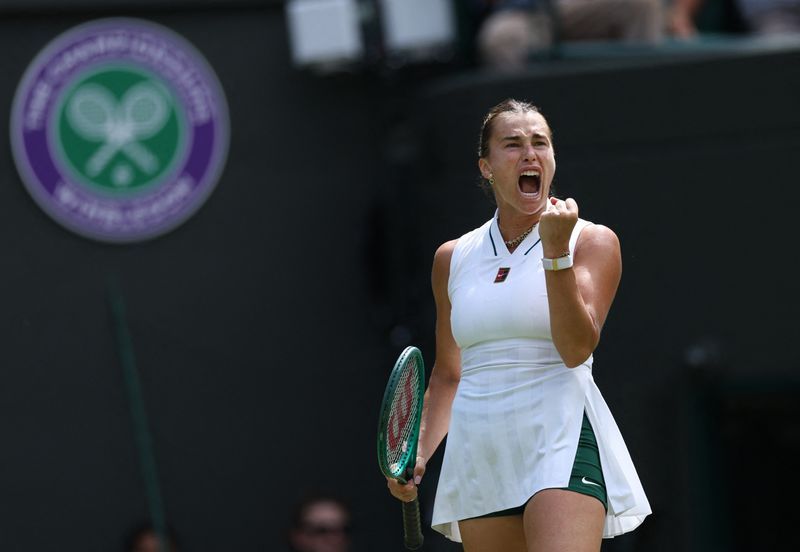
Aryna Sabalenka's complicated history with Wimbledon's grass courts was laid bare once again on Wednesday as the Belarusian top seed narrowly escaped a major upset against American McCartney Kessler, emerging victorious 6-1 7-6(9) in a match that showcased both her dominance and vulnerability on the turf. The encounter at the All England Club revealed the sharp contrasts that define Sabalenka's game on this surface—explosive power when conditions suit her, but uncertainty and frustration when they do not. Her path through the opening set appeared straightforward, with the world number one dictating play with her characteristic aggression and demonstrating the shot-making that has made her a force on hard courts. Yet as the second set unfolded, the script shifted dramatically.
Kessler, the sole player to have reached the second round without surrendering a single game in her first-round match, mounted an unexpectedly fierce challenge that pushed Sabalenka to the brink of capitulation. The American stormed to a commanding 5-2 advantage in the second set, leaving observers wondering whether an upset might be in the offing. The physical and mental toll became evident as Sabalenka repeatedly slapped her thigh in visible frustration following missed opportunities, her composure fraying with each point that slipped away. This was Sabalenka at her most vulnerable, struggling to impose her will and apparently susceptible to a player possessing the confidence of an impressive opening week.
What separated Sabalenka from slipping into a third set was not necessarily superior tennis at that moment, but rather a combination of experience and the deeper reserves of a player ranked first in the world. When Kessler secured two set points at 5-3, the momentum appeared irreversible. The American then secured two further opportunities in the subsequent tiebreak, each one representing a genuine chance to force a decisive final set. Yet Sabalenka's superior depth of stroke—the weight and precision that has defined her career—ultimately prevailed where finesse and positional excellence might have faltered. She powered through the critical moments with the kind of shot selection that speaks to years of competing at the sport's highest level, eventually converting her third match point after one hour and 39 minutes of absorbing tennis.
For Sabalenka, the significance of this victory extends beyond the immediate advancement to the next round. The Belarusian remains on track in her pursuit of a first Grand Slam title on grass courts, a goal that has eluded her despite her dominance across other surfaces. Hard courts have long represented her domain, yet winning a major on a surface so different from those where she has previously triumphed would represent a significant step forward in her career ambitions. The mental hurdle of competing on grass has proven persistent, making each victory here more valuable than the mere ranking points awarded.
Kessler's performance, while ultimately unsuccessful, demonstrated that Sabalenka is not invincible at Wimbledon and that her grass-court game remains a work in progress. The American's aggressive approach and willingness to take calculated risks nearly rewarded her with a stunning scalp. Her ability to reach the second round without dropping a set—a distinction she held before this match—speaks to her quality and potential future at this level. For a young American player, taking the world number one to a tiebreak before ultimately falling short represents valuable experience that will inform her development.
In her post-match reflection, Sabalenka acknowledged the severity of the examination she had faced. She openly stated that Kessler had tested her comprehensively and that she felt relief rather than mere satisfaction at progressing. This honesty about the difficulty of the encounter underscores the growing competitive depth within women's professional tennis, where even a player of Sabalenka's calibre must navigate genuine threats from rising talents. Her observation that her opponent had played with incredible aggression and produced superb tennis speaks to the quality on display, making her ultimate victory that much more credible.
Looking ahead, Sabalenka will confront Latvia's Jelena Ostapenko in the third round. Ostapenko, a former champion of the French Open and a player with considerable grass-court experience, presents another stern assignment. The trajectory of Sabalenka's tournament will depend significantly on whether she can build upon her resilience against Kessler and translate the lessons learned into increasingly fluid performances. Should she continue advancing, her grass-court credentials will strengthen considerably, potentially opening new chapters in her quest for grand slam diversity. For now, however, she advances with the knowledge that Wimbledon remains a challenge requiring her full arsenal of skills and mental fortitude.
The broader implications for the women's tournament are also worth noting. The emergence of players like Kessler, capable of pushing the established elite, enriches competitive tennis and ensures that major tournaments remain unpredictable. Yet Sabalenka's ability to find a way through when circumstances do not favour her is precisely the quality that distinguishes champions from promising competitors. Wednesday's victory, though harder-fought than the scoreline's opening set might suggest, reinforced why Sabalenka enters Wimbledon as the tournament favourite and why her ambitions for a first title on this surface remain rooted in genuine possibility rather than mere speculation.

