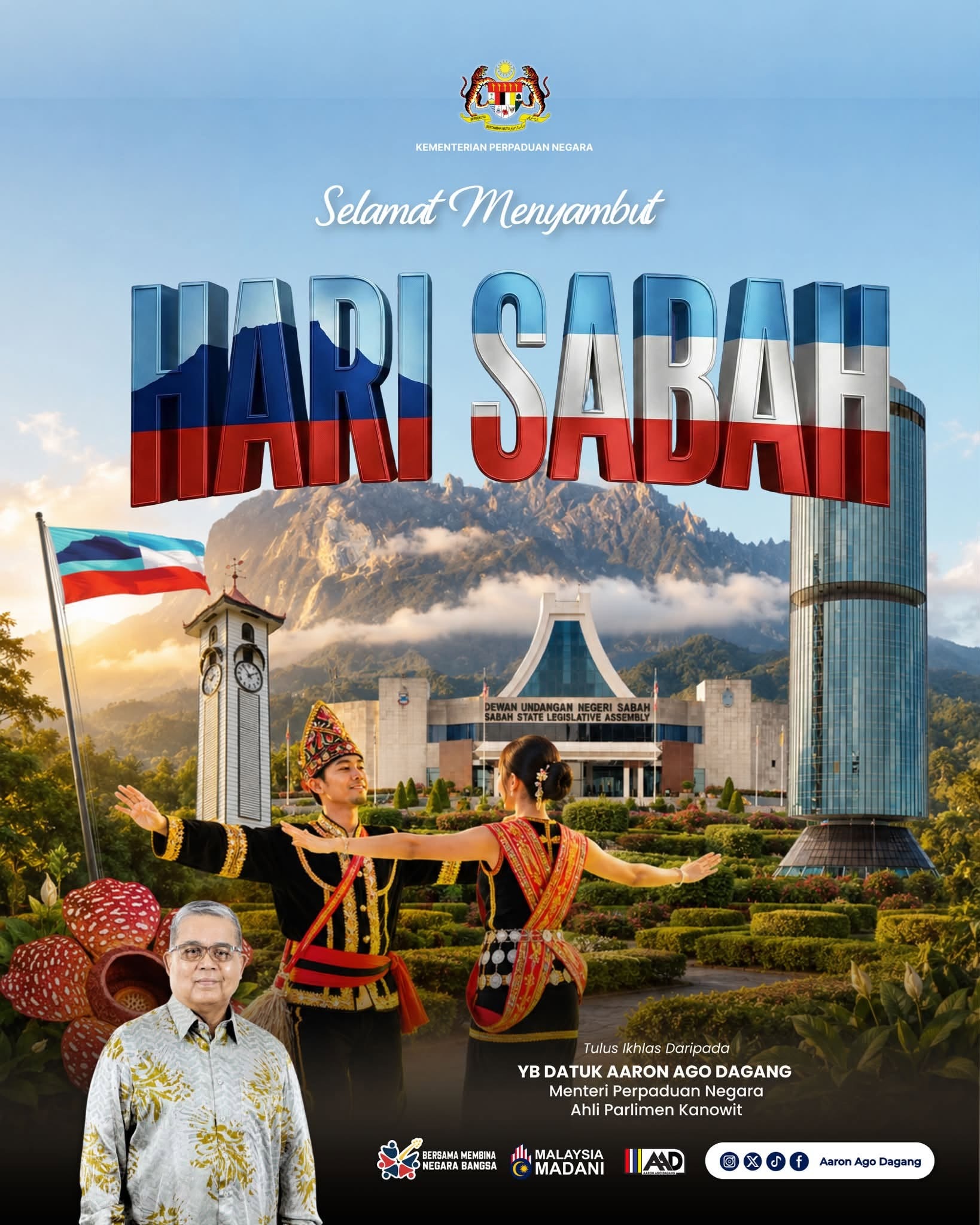
Sabah's extraordinary tapestry of ethnic communities represents far more than a statistical curiosity; it embodies the very essence of Malaysia's multiracial character and stands as a practical model for national cohesion, according to National Unity Minister Datuk Aaron Ago Dagang. Speaking on Sabah Day on August 31, the minister emphasised that the state's cultural heterogeneity, rather than fracturing society, has historically served as a binding force when communities commit to understanding and valuing one another's heritage.
The scale of Sabah's demographic complexity is striking. Within its borders reside 35 distinct ethnic groups and 217 sub-groups, each maintaining their own linguistic traditions, customary practices, distinctive clothing, musical expressions, and accumulated cultural knowledge. This constellation of communities—including the Kadazan, Dusun, Bajau, Murut, Rungus, Bisaya, Lotud, and Lundayeh peoples, alongside numerous others—has incrementally constructed the social and cultural foundation upon which contemporary Sabah stands. The depth of this diversity often goes unrecognised in national discourse, yet it constitutes an invaluable asset in an era when many societies struggle with intercommunal tensions.
The minister's framing of diversity as a strength rather than a challenge carries particular significance for Southeast Asia, a region grappling with questions of national identity and social cohesion. Sabah's historical experience demonstrates that multiethnic societies need not be inherently unstable or fractious. Instead, when institutional frameworks and civic values actively promote respect for difference, cultural pluralism can generate resilience and mutual enrichment. Aaron's message implicitly rebuts narratives that portray ethnic and cultural variation as inevitably destabilising, offering an alternative vision grounded in the state's lived reality.
August 31 occupies a pivotal position in Sabah's historical narrative, marking the transition from colonial administration to self-determination. The date commemorates the culmination of Sabah's journey through successive periods of governance—from the era of North Borneo through the administration of the British North Borneo Company, the traumatic interval of Japanese occupation, and the restoration of British oversight. By 1963, the state had achieved meaningful self-governance, a milestone immediately followed by the state's accession to the Federation of Malaysia on September 16 of that year. This historical trajectory underscores how Sabah's diverse communities navigated profound institutional and political transformations whilst maintaining social cohesion.
The minister's emphasis on historical consciousness serves a deliberate pedagogical purpose. By invoking the sacrifices and contributions of preceding generations, Aaron framed civic responsibility as a continuum extending from past to present. Those who built Sabah through struggle and dedication established institutional and cultural foundations that the contemporary population inherits. This intergenerational perspective resonates particularly with younger Sabahans, many of whom lack direct familiarity with the state's pre-independence circumstances and the genuine challenges that earlier generations confronted in building multiethnic harmony.
The responsibility for stewarding Sabah's future, Aaron stressed, now rests primarily with the current generation of the state's inhabitants. This articulation of agency and obligation carries implications beyond ceremonial rhetoric. If contemporary Sabahans embrace this responsibility, the trajectory involves ambitious expansion across multiple domains—advancing educational standards, stimulating economic dynamism, accelerating technological adoption, and driving comprehensive development initiatives. None of these objectives can be achieved through parochial or fragmented approaches; each requires mobilising the talents and resources of Sabah's entire population across all ethnic communities.
Parallel to these developmental imperatives exists an equally pressing custodial duty. As Sabah pursues modernisation and economic transformation, the minister underlined the necessity of preserving the state's distinctive historical record, its accumulated cultural wisdom, and the particular identity that distinguishes Sabah within the Malaysian federation. This balance between forward momentum and historical preservation represents a genuine tension in many societies, yet one that Sabah's experience suggests remains resolvable through intentional effort. Economic progress and cultural conservation need not be mutually antagonistic; indeed, cultural heritage increasingly represents an economic asset through tourism, creative industries, and cultural enterprises.
The 2024 designation of August 31 as an official Sabah Day formalises recognition of the state's distinct historical trajectory and contemporary identity within Malaysia. This institutional acknowledgment provides a regularised platform for public reflection on the values and principles that structure Sabah's internal life. Unlike national public holidays that attempt to encompass Malaysia's entire federation, state-specific commemorations permit focused attention to regional particularities and regional aspirations. For Sabahans, the establishment of this dedicated observance offers recurring opportunity to reaffirm commitment to the principles of multiethnic coexistence that the minister articulated.
For Malaysian policymakers and citizens beyond Sabah, the minister's message carries instructive value. In an era when some segments across Southeast Asia propagate narratives suggesting that religious, ethnic, or cultural difference necessarily generates social fragmentation, Sabah's experience offers a compelling counterexample. The state's 35 ethnic groups have not resolved all tensions nor achieved perfect equanimity; yet their sustained coexistence within a framework emphasising mutual respect constitutes a genuine achievement worthy of emulation and systematic study. As Malaysia navigates evolving national demographics and intercommunal dynamics, Sabah's model of pluralism rooted in practical acceptance rather than abstract principle merits serious consideration in broader policy discourse.

