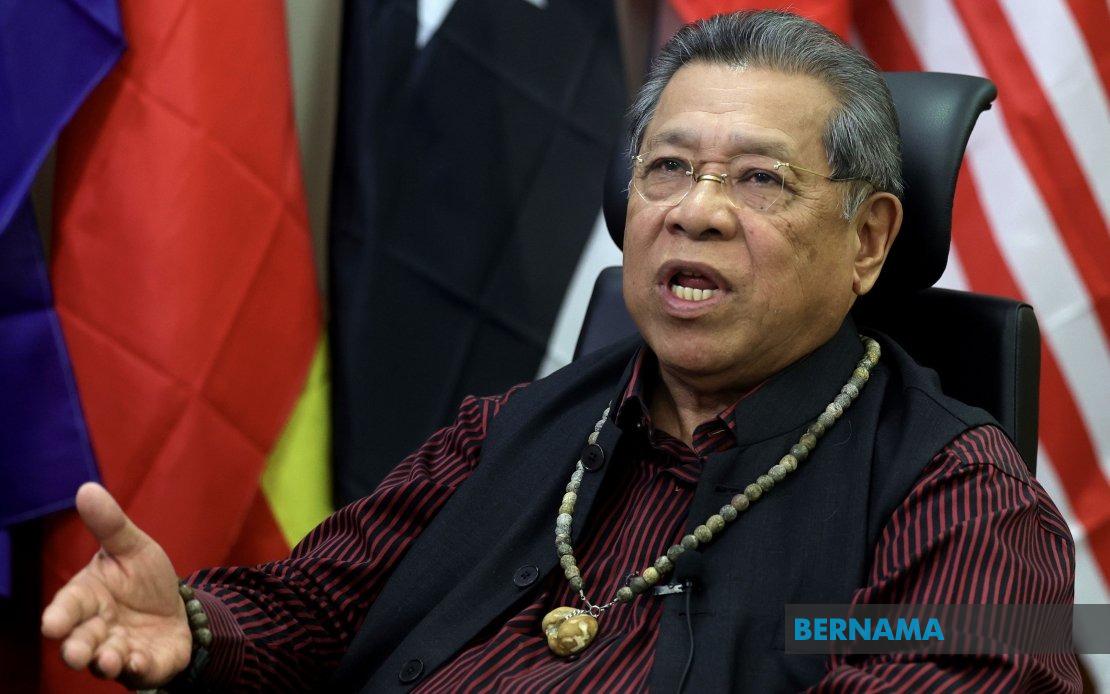
The promised surge in federal funding to Sabah represents a pivotal moment for the state's economic development trajectory, according to United Sabah National Organisation (USNO) president Tan Sri Pandikar Amin Mulia. Speaking alongside the 2026 PKR National Congress in Melaka, Pandikar Amin highlighted how the enhanced allocation would unlock capacity for infrastructure and development initiatives across the state, ultimately translating into tangible improvements for ordinary Sabahans.
The figures underpinning this optimism are substantial. Prime Minister Datuk Seri Anwar Ibrahim unveiled that federal allocations to Sabah have climbed dramatically to RM17.6 billion in 2026, a jump from RM13 billion in 2022—representing a 35 per cent increase over the four-year span. For a state historically positioned on Malaysia's economic periphery, such a boost holds considerable promise for addressing long-standing infrastructure deficits and accelerating regional competitiveness.
Pandikar Amin's public backing of the federal government carries symbolic weight within Sabah's political ecosystem. His endorsement extends beyond mere fiscal acknowledgment; he framed the funding trajectory as essential to Malaysia's broader national ambitions. By linking state-level development to national progress, the USNO leader positioned Sabah's advancement not as a regional concern but as integral to the country's overall trajectory on the world stage.
The timing of this announcement coincided with Anwar's presidential address at the PKR gathering in Ayer Keroh, where he systematically rebutted longstanding allegations that the MADANI Government has shortchanged certain states. These criticisms have simmered within opposition circles and among segments of Sabah's electorate, particularly following the state's integration into the federal coalition framework in recent years. Anwar's defence rested on the principle that allocation differentials reflect divergent state priorities and capacity absorption rather than political discrimination.
For Malaysian observers tracking regional equity and federal distribution patterns, the Sabah funding narrative raises important questions about resource allocation philosophy. The government's position suggests that allocations respond to identified needs and development readiness rather than uniform per-capita formulas. This approach carries implications for other states monitoring their own federal support levels, potentially prompting scrutiny of whether their allocations truly reflect developmental requirements or political positioning.
Sabah's development challenges remain formidable despite improved funding prospects. The state faces acute infrastructure gaps, particularly in transportation networks, digital connectivity, and education facilities outside major urban centres. A 35 per cent increase, while substantial, must still stretch across these competing demands. Effective project selection and implementation efficiency will ultimately determine whether the funding translates into measurable quality-of-life improvements or becomes absorbed by bureaucratic processes and incomplete initiatives.
The political context surrounding this announcement deserves careful attention. Pandikar Amin's assertion that Anwar Ibrahim remains essential to Malaysia's political and international standing reflects the delicate coalition dynamics that have characterised Malaysian governance since 2022. USNO's positioning within federal power structures depends partly on demonstrating tangible benefits flowing to Sabah's constituents. The funding increase thus serves multiple audiences: it reassures Sabah voters of their state's relevance within national councils, while signalling to federal partners that the coalition arrangement produces measurable returns.
For Southeast Asian observers, Sabah's development trajectory carries broader regional significance. As Malaysia's largest state by land area and a crucial territorial anchor for national maritime claims in contested waters, the state's stability and prosperity touch upon regional geopolitics. Enhanced federal investment potentially strengthens governance capacity and economic resilience in a strategically important jurisdiction, with ripple effects across the region's maritime security and economic integration frameworks.
The funding announcement also reflects Anwar's administration's broader development vision post-pandemic. Having assumed office amid economic headwinds and competing fiscal pressures, the government's willingness to significantly increase allocations to Sabah suggests confidence in fiscal trajectory recovery. This stance contrasts with austerity narratives that dominated earlier recovery phases, potentially signalling a shift toward growth-focused federal spending strategies across multiple regions.
Looking forward, the critical variable will be implementation. Malaysian development history contains numerous examples of announced allocations failing to translate into completed projects within projected timelines. Sabah requires not merely the budgetary commitment but also streamlined administrative machinery, skilled project management, and coordination between state and federal authorities to convert funding into functioning infrastructure and services.
Pandikar Amin's commentary, ultimately, reflects political consensus around enhanced federal support for Sabah at this juncture. Whether this allocation represents a sustainable commitment to state development or a cyclical political manoeuvre will become evident through project execution over coming years. For Sabah's 3.9 million residents and Malaysia's broader development agenda, the real test lies not in announcement rhetoric but in tangible outcomes on the ground.

