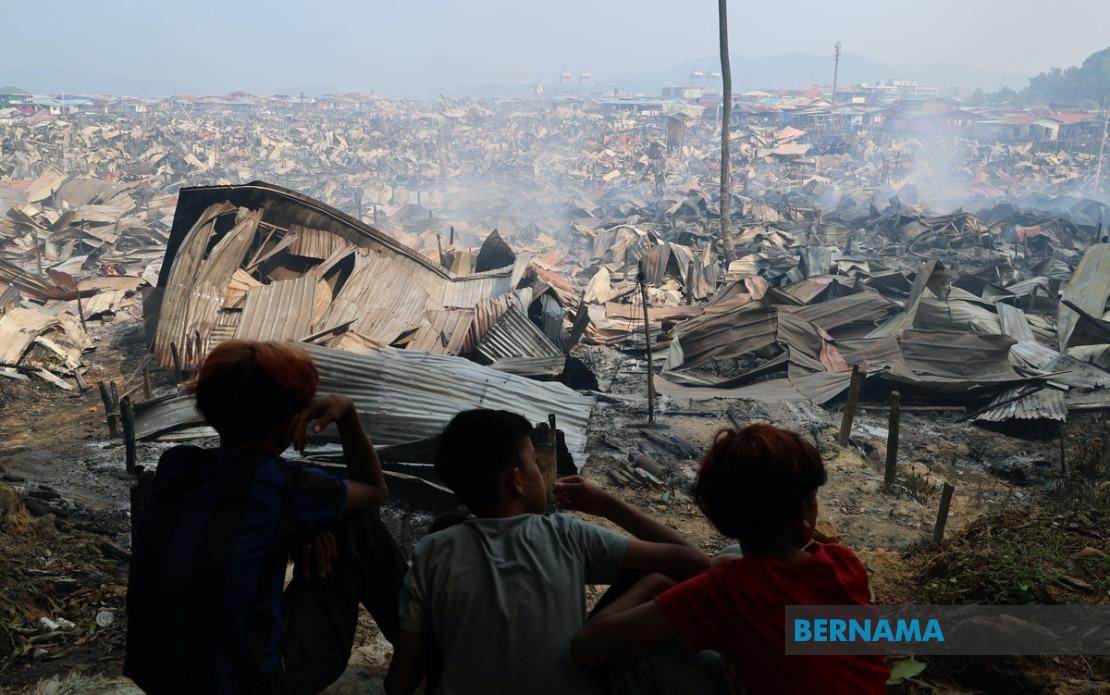
The Sabah government has mobilised rapid financial support for families devastated by a major fire in Kampung Lok Buta, Numbak, which gutted more than 200 residential structures in the early morning hours and left three young children dead. Chief Minister Datuk Seri Hajiji Noor announced that each affected Malaysian household head would receive RM3,000 in combined assistance, drawn equally from three sources: the state government, the federal government, and the Yayasan Kebajikan Sabah, which each contribute RM1,000 per household.
The announcement came after Hajiji visited survivors sheltering at the Likas Multipurpose Hall temporary relief centre in Kota Kinabalu, where he pledged to ease the immediate financial hardship facing displaced families. The decision underscores the scale of the humanitarian crisis triggered by the blaze, which erupted around 1.40 am and spread rapidly through the densely populated informal settlement. The triple-source funding mechanism demonstrates coordination between state and federal authorities in crisis response, ensuring that relief mobilisation extends beyond state capacity alone and reflects shared responsibility for citizen welfare across governance levels.
The three-tier funding structure carries symbolic weight in Malaysian federalism, particularly in Sabah where tensions between state and federal interests frequently surface in policy debates. By securing federal government participation in this relief effort, the state administration has ensured that victims benefit from the full machinery of national social support systems. The involvement of Yayasan Kebajikan Sabah, a state-based welfare foundation, further demonstrates how public-private partnerships and civil society institutions complement government responses during emergencies.
Beyond immediate cash assistance, the government has committed to comprehensive rebuilding support coordinated through the State Secretary's Office and Majlis Amanah Rakyat (MARA). This institutional involvement signals that reconstruction will follow structured pathways rather than ad hoc measures, potentially enabling access to technical expertise, materials support, and long-term housing solutions. However, the determination of whether homes will be rebuilt at their original Kampung Lok Buta location or elsewhere remains pending, pending environmental and urban planning assessments. This deliberation reflects broader questions about informal settlement management in Malaysian cities, where rapid urbanisation and limited affordable housing frequently drive residents into unplanned areas vulnerable to fire hazards.
The humanitarian gesture extends to non-Malaysian residents affected by the fire, with each foreign household head receiving RM1,000 from the state government. This inclusion addresses the documented reality that informal settlements in Malaysian urban areas frequently house migrant workers and their families who lack citizenship status. The decision to provide assistance regardless of nationality demonstrates a disaster response approach prioritising human vulnerability over legal status, though the reduced amount for non-citizens compared to Malaysian households reflects a graduated support philosophy.
Supplementary aid packages including food supplies and household essentials are being distributed to affected families, addressing immediate survival needs while the RM3,000 cash transfers tackle longer-term housing and livelihood recovery. This dual-track assistance model recognises that post-disaster recovery spans multiple timescales: immediate provision of basic necessities occurs in parallel with financial transfers enabling families to make deliberate decisions about shelter reconstruction and household reestablishment.
The fire's death toll—three children comprising a pair of young siblings plus a cousin—adds tragic weight to the disaster narrative. The victims, Nana Abdullah (four years old), Mohd Asrul (six years old), and Nurfarahdilah Mohd Tajihah (eight years old), represent the particular vulnerability of child populations in informal settlements where fire safety infrastructure, building codes, and emergency response protocols often fall short of standards in formally planned residential areas. These deaths will likely intensify debate regarding kampung upgrade programmes, fire safety certification, and whether informal settlement residents receive adequate access to emergency prevention and response services.
For Malaysian and Southeast Asian observers, the Kampung Lok Buta incident illustrates recurring tensions within rapid urbanisation patterns across the region. Informal settlements proliferate in cities where formal housing supply fails to match demand from rural-urban migrants and lower-income households, creating concentrated pockets of fire risk, inadequate infrastructure, and limited emergency service access. The fire's scale—destroying over 200 structures—demonstrates how concentrated informal housing creates cascading disaster scenarios where small ignition sources propagate into massive conflagrations affecting thousands of inhabitants simultaneously.
The government's response also reflects evolving Malaysian disaster management practices, where immediate financial transfers are increasingly prioritised alongside traditional relief delivery models. The RM3,000 per household allocation, while modest, grants families agency in determining their own recovery priorities rather than imposing top-down solutions. This approach aligns with international disaster recovery literature emphasising beneficiary-centred assistance over paternalistic aid delivery, though questions remain about whether such sums sufficiently address the full scope of housing reconstruction costs in urban contexts.
The involvement of MARA in rebuilding coordination carries particular implications, given the institution's historical focus on Bumiputera economic advancement. How MARA engages with this relief operation will signal whether disaster recovery in Sabah prioritises needs-based assistance across all ethnic communities or maintains traditional targeted approaches. The intersections between disaster relief, ethnic policy, and resource allocation will likely shape both immediate recovery trajectories and longer-term settlement patterns in Kota Kinabalu's expanding urban periphery.
Moving forward, this incident may catalyse broader policy discussions about informal settlement regulation, fire safety standards, and integrated urban development strategies across Malaysian cities. The temporary relief centre at Likas Multipurpose Hall represents the first phase of a longer recovery process that will test government implementation capacity and sustained commitment to displaced families beyond the initial crisis period. Whether the RM3,000 assistance proves adequate, and how effectively MARA-coordinated reconstruction proceeds, will determine whether this relief operation becomes a model for future disaster responses or reveals systemic gaps in Malaysia's emergency management infrastructure.

