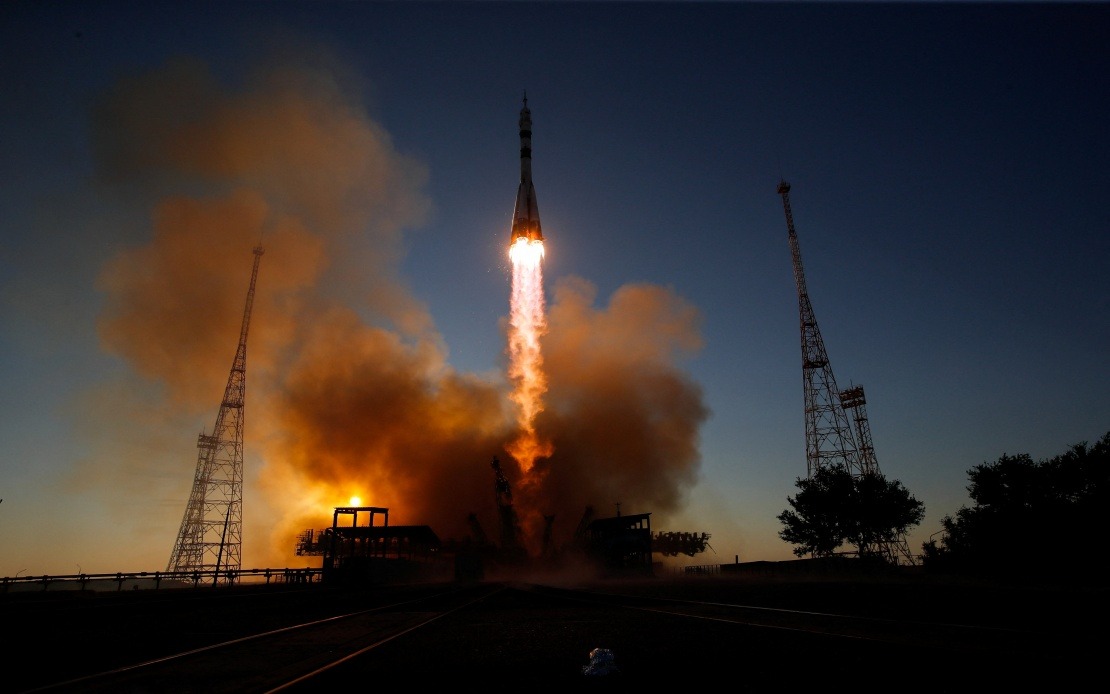
A Soyuz MS-28 spacecraft carrying two Russian cosmonauts and one American astronaut has successfully separated from the International Space Station, according to live coverage from Russia's Roscosmos space agency. The departure on July 26 marks the conclusion of an extended expedition for cosmonauts Sergey Kud-Sverchkov and Sergey Mikayev alongside United States astronaut Christopher Williams, who have collectively spent eight months in orbit conducting scientific research and maintaining station systems.
The undocking sequence proceeded according to plan, with the three-person crew beginning their descent procedures following separation from the orbiting laboratory. Roscosmos confirmed that the spacecraft would maintain a safe distance from the ISS before executing critical maneuvers to leave orbit. This cautious approach reflects standard safety protocols developed over decades of spaceflight operations, ensuring that the departing vehicle does not pose any risk to the station or its remaining inhabitants.
Once cleared of immediate proximity to the station, the Soyuz MS-28 initiated its deorbit burn, a controlled engine firing designed to slow the spacecraft and reduce its orbital altitude. This maneuver, essential for any spacecraft returning from space, gradually transitions the vehicle from orbital velocity toward a trajectory that intersects with Earth's atmosphere at a safe angle. The precision required for this operation underscores the complexity of modern space operations and the coordination necessary between international space agencies.
The spacecraft's design incorporates a modular separation system that allows it to jettison its orbital and service modules before the final descent. The functional components that sustained life support, power generation, and propulsion during the orbital phase separate from the descent capsule, which contains the three crew members and their equipment. This three-module configuration has proven reliable across hundreds of Soyuz missions dating back to the Soviet era.
The descent capsule's landing site near Zhezkazgan in the Kazakh steppe represents a traditional recovery location for Soyuz missions. Kazakhstan, a former Soviet republic, maintains a crucial role in global spaceflight operations, hosting the Baikonur Cosmodrome from which Soyuz vehicles launch and providing vast steppes suitable for landing operations. The scheduled touchdown time of approximately 12:50 pm Moscow time, or 09:50 GMT, follows carefully calculated trajectory predictions that account for atmospheric conditions and recovery team positioning.
Kud-Sverchkov, Mikayev, and Williams have occupied the ISS since November 27, completing a standard increment duration that typifies modern expedition rotations. During their tenure, the trio contributed to numerous investigations spanning biology, physics, materials science, and Earth observation. Their work represents the collaborative spirit that characterizes the ISS program, with Russian and American personnel working alongside specialists from other nations in pursuit of scientific advancement and technological innovation.
The return of this crew signals the continuation of the ISS's operational cadence, with fresh personnel arriving to maintain the station's research capabilities. The International Space Station operates on a rotation system where crews typically spend six months to eight months aboard, allowing for knowledge transfer and ensuring continuous staffing for critical maintenance and experimental work. This cycling of personnel demands reliable transportation systems, making the Soyuz's track record of dependability essential for the program's sustainability.
For Southeast Asian nations with growing interests in space technology and astronomy, Soyuz operations exemplify the practical applications of international cooperation in space exploration. While Malaysia and neighboring countries do not currently operate human spaceflight programs, partnerships with established space agencies like Roscosmos and NASA through the ISS framework provide opportunities for technological advancement and scientific participation. Malaysian researchers have engaged with the ISS through collaborative studies, contributing to the station's mission objectives.
The successful completion of Kud-Sverchkov, Mikayev, and Williams's expedition underscores the resilience of human spaceflight despite geopolitical tensions. Russia and the United States maintain robust collaboration in orbital operations, demonstrating that scientific endeavor and mutual interest in space exploration can transcend diplomatic complexities. This enduring partnership has preserved the ISS as a functioning laboratory and symbol of peaceful international cooperation.
As space agencies worldwide pursue expanded human spaceflight capabilities, including missions to the Moon and eventual Mars exploration, the reliability of established systems like Soyuz remains foundational. The successful operation of each mission reinforces confidence in current technologies while informing development of next-generation vehicles. For observers in Malaysia and across Southeast Asia, these routine yet remarkable achievements illustrate humanity's expanding presence beyond Earth and the ongoing technological advancement that makes such missions routine.

