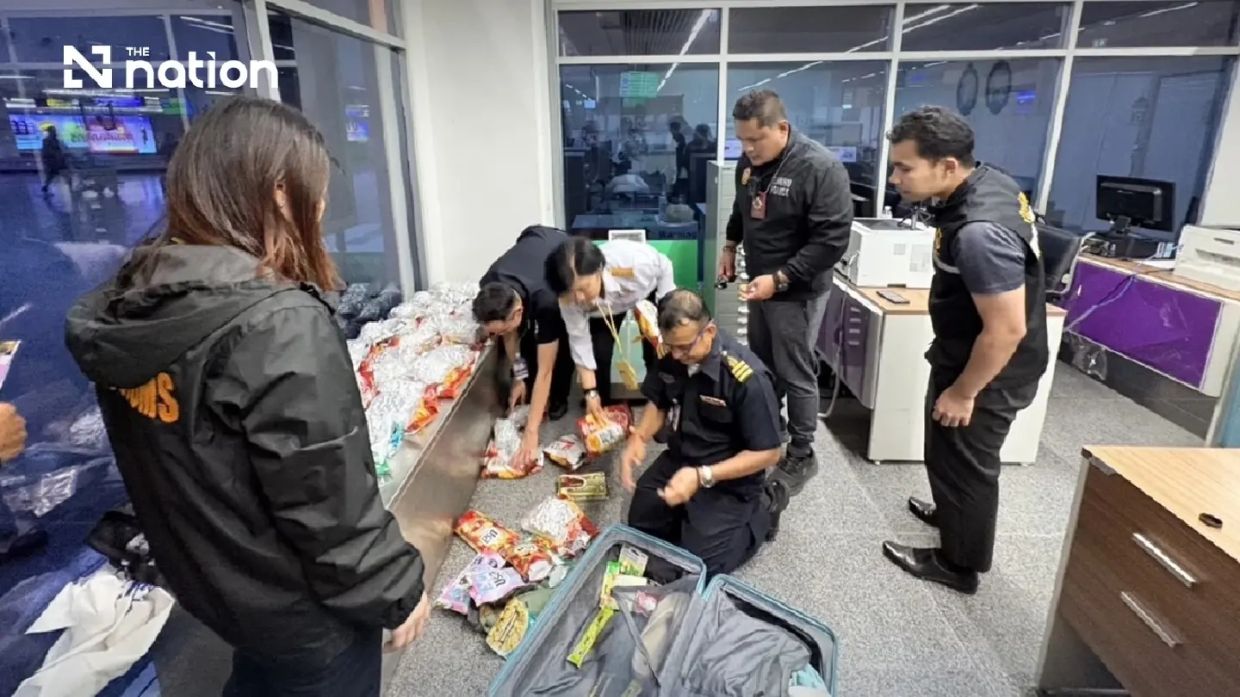
Thai customs authorities have arrested a Russian national at Phuket International Airport following the discovery of a substantial quantity of cannabis concealed in his luggage. The incident, which occurred on Wednesday, July 8, represents another significant drug interception at one of Thailand's busiest international travel hubs, underscoring persistent challenges in combating narcotics trafficking through the country's air routes.
Sergei Chalabari, 30, was detained inside the international departure terminal of Phuket International Airport in Mai Khao subdistrict, Thalang district, as he prepared to leave Thailand. Customs officer Rawin Kanokakorn and his team conducted a routine inspection of two blue BP WORLD wheeled suitcases that together weighed approximately eight kilograms. What emerged during their examination proved to be a carefully organised attempt to move prohibited substances across Thailand's borders.
The contraband comprised two distinct forms of cannabis product totalling 17.6 kilograms in gross weight. Officers discovered 35 vacuum-sealed packages of cannabis flowers, weighing 11.4 kilograms combined, systematically distributed throughout the luggage. Additionally, 12 packages of cannabis resin, totalling 6.2 kilograms, were located during the search. The meticulous packaging and organisation of the drugs suggested a level of planning that goes beyond personal consumption, pointing instead toward commercial-scale smuggling operations that increasingly target Southeast Asian ports of exit.
During questioning, Chalabari acknowledged ownership of both the suitcases and all seized contents. Officials promptly charged him with attempting to smuggle goods out of the kingdom without passing through authorised customs procedures, a serious offence under Thai law that carries substantial penalties. His admission simplified the investigative process, though it raises questions about how such a substantial quantity of narcotics managed to be packaged and transported to the airport without detection by earlier security screenings.
The operation's successful conclusion reflects the coordinated efforts of multiple Thai enforcement agencies working within Phuket's aviation security framework. Sakhu Police Station superintendent Pol Col Salan Sankhisasanakun and deputy superintendent for investigation Pol Lt Col Rattanawut Nukaew oversaw the police response, whilst customs personnel led by Nucha Jeeradit, chief of the Phuket Airport Customs House, conducted the actual seizure. The involvement of Thanomjit Burirak from the customs control division and Charoenporn Jaengwansuk from the investigation and suppression section demonstrates the layered approach Thailand employs at its international airports.
For Malaysian observers, this seizure carries significant implications regarding regional drug trafficking patterns. Russian nationals and Eastern European criminals have become increasingly visible in Southeast Asian narcotics operations, often serving as intermediaries between production centres in the Golden Triangle and Western markets. The sophistication of this attempted smuggling suggests established networks rather than isolated criminal ventures, potentially indicating expanded distribution channels that could extend into Malaysia's ports and airports.
Thailand's Phuket International Airport handles approximately eight million passengers annually, making it a critical chokepoint for transnational smuggling operations. The sheer volume of travellers creates inherent challenges for customs screening, yet this particular seizure demonstrates that focused inspections and vigilant officers can still identify major trafficking attempts. The cannabis resin component of the haul is particularly noteworthy, as this concentrated form commands higher street values and suggests the cargo was destined for premium markets, likely in Europe or North America where pricing structures make such high-risk smuggling economically viable.
The arrest underscores Thailand's evolving drug threat profile. Whilst methamphetamine trafficking from Myanmar remains the dominant concern for Thai law enforcement, cannabis production and distribution has expanded significantly throughout the region. Thailand's own decriminalisation of cannabis for medical purposes has created ambiguity in enforcement priorities, though commercial-scale smuggling across borders remains unambiguously illegal. This case demonstrates that officials continue to treat any attempt to export narcotics as a serious breach warranting full criminal prosecution.
Chalabari's detention and transfer to Sakhu Police Station for legal proceedings initiates a process that typically involves additional questioning, formal charges, and court proceedings that may extend over months. Given Thailand's stringent drug laws and the quantity involved, conviction could result in substantial imprisonment. The case also serves as a stark reminder to travellers of Thailand's zero-tolerance approach to drug smuggling, regardless of the smuggler's nationality or the chemical composition of the substances involved.
For Malaysia, this incident reinforces the necessity of maintaining vigilant airport security protocols across our own aviation hubs. The international nature of the smuggling attempt—a Russian attempting to export drugs through Thai territory—demonstrates how criminal networks operate across multiple jurisdictions simultaneously. Enhanced cooperation between Malaysian and Thai customs authorities, alongside intelligence sharing regarding known smuggling routes and methods, remains essential for protecting our region from increasingly organised transnational drug operations.

