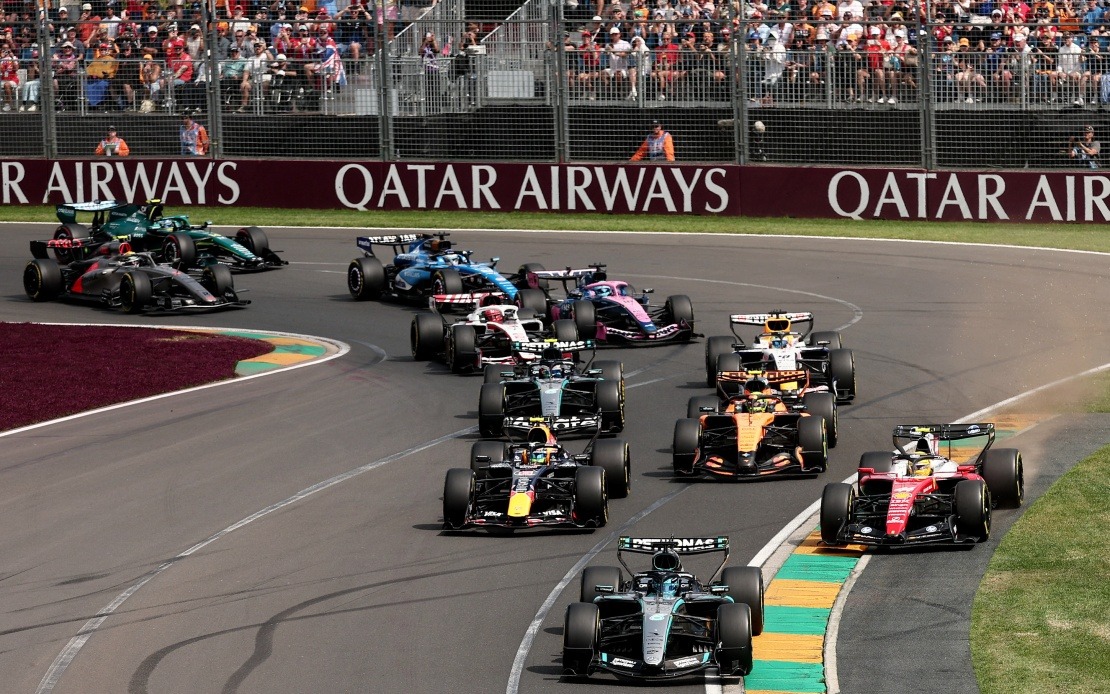
George Russell's mounting frustration with Mercedes spilled over into an expletive-laden radio rant following his retirement from the Belgian Grand Prix at Spa-Francorchamps, exposing the deepening cracks in what remains a critical battle for the driver's championship hopes. The British driver, already trailing his Italian teenager teammate Kimi Antonelli by a substantial 50-point margin after ten rounds, saw his afternoon unravel following a collision with Lewis Hamilton that came after his machine suffered an early engine glitch. Russell's candid radio transmission, which remained unbroadcast during Sunday's race coverage, revealed the raw emotion simmering beneath the paddock's usual veneer of professionalism, with the driver repeatedly questioning the state of battery charge deployment in his car across a crucial straight section.
The weekend at the Belgian circuit had been beset with troubles from the outset, with a deployment anomaly within Russell's Mercedes proving consequential enough to cost him approximately half a second in qualifying trim relative to Antonelli. Initially, the technical team attributed the problem to Russell's driving technique, a hypothesis that was hastily shelved once engineers conducted deeper diagnostics and found no validation for that theory. The cumulative effect of these setbacks appears to have worn upon Russell psychologically, with the driver expressing that he now feels emotionally numb to the succession of mechanical failures that have plagued his season. His appeal to Mercedes engineering ahead of next weekend's Hungarian Grand Prix, the final race before the summer hiatus, conveyed a combination of hope and resignation—a man clinging to the possibility of redemption while bracing for further disappointment.
Mercedes team principal Toto Wolff provided context for the technical failures afflicting his senior driver, acknowledging that Russell's emotional response was understandable given the circumstances whilst simultaneously invoking the prestige associated with representing the Brackley-based outfit. Wolff's response balanced empathy with institutional messaging, recognising that elite drivers experience periods of difficulty just as any world-class athlete might, and pledging the team's unwavering commitment to finding solutions. The team principal characterised Russell's current mood as a temporary condition requiring therapeutic support from team management, suggesting that rebuilding optimism and motivation remained feasible objectives despite the accumulated frustration.
The technical investigation into Russell's power unit failures revealed a complex picture reflective of modern Formula One's sophisticated engineering landscape. According to Wolff, the Mercedes power unit system involves intricate management of energy harvesting and deployment mechanisms that interact unpredictably with driver inputs, creating a matrix of potential failure points. The specific problem identified in Russell's vehicle manifested as insufficient energy availability for deployment into turn 18, the final corner of the Spa circuit, which represents an energy-intensive section where battery reserves prove critical. Wolff noted a silver lining to this development—that the technical failure became apparent at a high-speed circuit like Spa, where energy deficiencies are immediately obvious, rather than at Budapest, where the circuit topology would have masked the underlying problem and complicated future diagnosis.
The championship arithmetic presents a stark reality for Russell as the season approaches its halfway point. Antonelli's sixth victory from ten races demonstrates a consistency and performance level that Russell has struggled to match this season, and the 50-point deficit represents roughly two race victories of lost ground. For Malaysian and Southeast Asian Formula One enthusiasts, Russell's struggles offer a cautionary tale about the unforgiving nature of modern motorsport, where reliability issues can rapidly transform championship races into exercises in damage control. The situation also underscores the competitive intensity within top teams, where even a driver of Russell's pedigree and experience can find himself outpaced and struggling against internal rivals.
Mercedes' acknowledgment of reliability problems stemming from new regulations suggests that the technical foundation of the current season's cars remains somewhat experimental and unstable. Wolff's comment that "with new regulations sometimes that happens" indicates a broader industry-wide challenge in adapting to fresh technical frameworks, though this provides little solace to Russell as he attempts to salvage his championship campaign. The complexity involved in managing hybrid power unit systems, particularly the sophisticated recuperation and deployment algorithms that modern regulations demand, has created a vulnerability that even a manufacturer of Mercedes' resources struggles to fully mitigate.
Russell's emotional trajectory throughout the weekend reflects the psychological toll that mechanical failure inflicts on top-level competitors. The progression from initial frustration with specific technical malfunctions to the broader statement that he now feels numb to disappointment suggests a dangerous erosion of mental resilience. For drivers operating at the pinnacle of competitive motorsport, where tenths of seconds often separate victory from mediocrity, such psychological fatigue can become self-perpetuating, reducing the confidence and aggression necessary to extract maximum performance from an imperfect machine. Russell's situation serves as a reminder that Formula One success requires not merely technical excellence and driving skill, but also the psychological fortitude to maintain motivation through sequences of setbacks.
The implications of Mercedes' technical struggles extend beyond Russell's individual championship prospects. Should the team fail to resolve these reliability issues before the summer break, the deficit could prove insurmountable, leaving Wolff's organisation to contemplate a fundamentally revised season narrative. The Hungarian Grand Prix represents a critical test case, offering the team one final opportunity to validate fixes before the extended break. Budapest's circuit characteristics, less dependent on straightline speed and energy management than Spa, might paradoxically prove more forgiving for Russell if the underlying technical issues remain unresolved.
For regional Formula One audiences, Russell's predicament represents a cautionary examination of how swiftly championship contenders can find themselves in genuine trouble when reliability proves inconsistent. The contrast between Antonelli's ascendant form and Russell's accumulating misfortunes highlights the brutal efficiency with which modern Formula One can partition competitors into winners and those struggling with mechanical gremlins. As the season progresses toward Budapest, Russell faces not only the technical challenge of extracting additional performance from his Mercedes, but also the psychological test of maintaining focus and determination despite mounting evidence that external factors may conspire against his championship aspirations.

