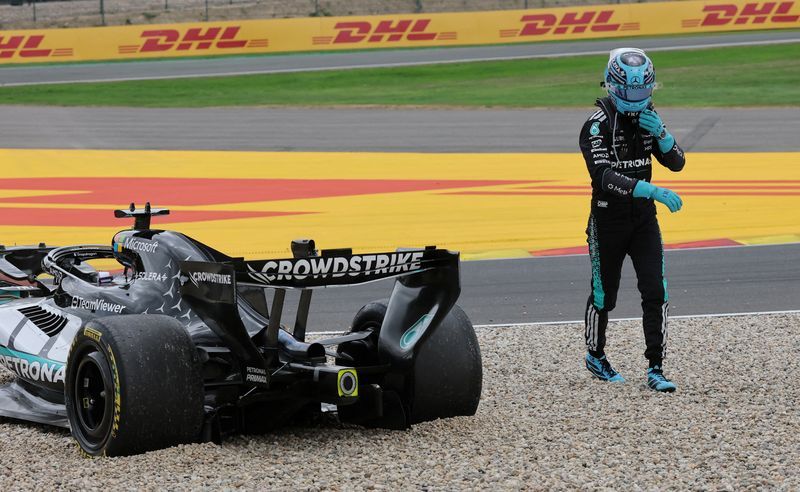
George Russell confronted one of the most frustrating moments of his Formula One season when a first-lap collision with Lewis Hamilton at the Belgian Grand Prix ended his hopes of scoring points at Spa-Francorchamps on Sunday. The Mercedes driver, who had qualified third, found himself unable to recover from a series of mechanical issues that left him vulnerable to rivals, ultimately spinning into the gravel after contact with his former teammate. The incident deepened Russell's struggles in what has become an inconsistent campaign, as he reflected on the mounting disappointment with an exhausted resignation that spoke volumes about the pressure mounting on his shoulders.
Russell's race unravelled almost immediately after the start. Despite executing a strong opening corner, he rapidly lost significant ground on the opening lap when his car's electrical system malfunctioned, leaving him unable to deploy the hybrid power unit effectively. With battery charge plummeting to zero percent as he approached the demanding Eau Rouge corner, Russell found himself defensively exposed and unable to maintain his grid position. This mechanical failure forced him to drop from third place to sixth in the opening stages, setting up a desperate attempt to recover that would prove disastrous.
The collision itself arose from Russell's effort to reclaim lost positions. In attempting to pass Hamilton, the pair made contact as they ran side by side through the circuit. The impact sent Russell's car spinning off the track into the gravel, immediately ending his afternoon. Hamilton, despite also receiving a five-second penalty from stewards for causing the collision, managed to continue his race and salvage what points he could from the encounter. Russell stepped from his car and walked away, his frustration evident as the safety car was deployed to clear his stricken vehicle from the circuit.
For Russell, the blame lay less with Hamilton's driving than with the underlying mechanical issues that had compromised his position in the first place. He acknowledged that while the collision with his former colleague constituted a racing incident, Hamilton bore greater responsibility for the contact. However, Russell expressed far deeper frustration with the car's performance, particularly the battery and turbo systems that had failed to deliver power when he most needed it. This distinction between technical failure and on-track incident highlighted the layers of disappointment accumulating through his season.
The ongoing reliability problems Russell faces carry significant championship implications. This latest failure to finish represents his third race without scoring points this season, a concerning trend that stands in sharp contrast to the championship leader's consistency. Meanwhile, Kimi Antonelli, who started from pole position at Spa, continues to extend his commanding lead at the top of the standings. With nine rounds completed out of the season's 22 scheduled races, Antonelli has opened a 25-point advantage over Russell and holds six victories already, establishing himself as the clear favourite for the title.
Russell's struggles contrast sharply with his teammate's performance, amplifying questions about whether mechanical misfortune or driver performance represents the primary obstacle to his championship challenge. The disparity in points accumulation between the two Mercedes drivers cannot be attributed solely to fortune, yet Russell's catalogue of technical failures suggests systematic issues within his car setup or allocation of hybrid system resources. This pattern emerging across multiple races indicates deeper problems requiring urgent attention from the engineering team if Russell is to remain competitive for the remainder of the season.
The Mercedes driver's statement that he felt "numb to the disappointment" carried a weight beyond mere sportsman's understatement. When asked about his emotional response, Russell suggested that repeated setbacks across the campaign had dulled his initial frustration into weary acceptance. This psychological toll of mounting failures represents a danger to any driver's championship prospects, as hope and determination gradually erode under the weight of circumstance. The frequency with which Russell finds himself confronting adversity threatens to undermine the mental resilience required to mount a serious title challenge.
Russell had flagged concerns about his vehicle's performance on the straights during Saturday's qualifying session, providing early warning that mechanical problems were brewing. These pre-race observations gained relevance when identical issues manifested during Sunday's race, suggesting the engineering team had struggled to identify and rectify the underlying problems overnight. The continuity of technical difficulties from qualifying through to race day indicates either inadequate diagnosis of the original problem or insufficient time to implement meaningful repairs between sessions.
The incident at Spa-Francorchamps crystallises the challenges confronting Russell's championship ambitions at the halfway point of the season. With Antonelli establishing such a commanding lead and demonstrating superior consistency, Russell faces a rapidly narrowing window to recover ground. The mathematical task of overturning a 25-point deficit remains theoretically possible given the races remaining, but the current trajectory suggests the championship is Antonelli's to lose rather than Russell's to win. The Mercedes driver must demonstrate that he possesses the resilience and skill to overcome both mechanical misfortune and mental fatigue if he is to reignite his title challenge before the season reaches its conclusion.

