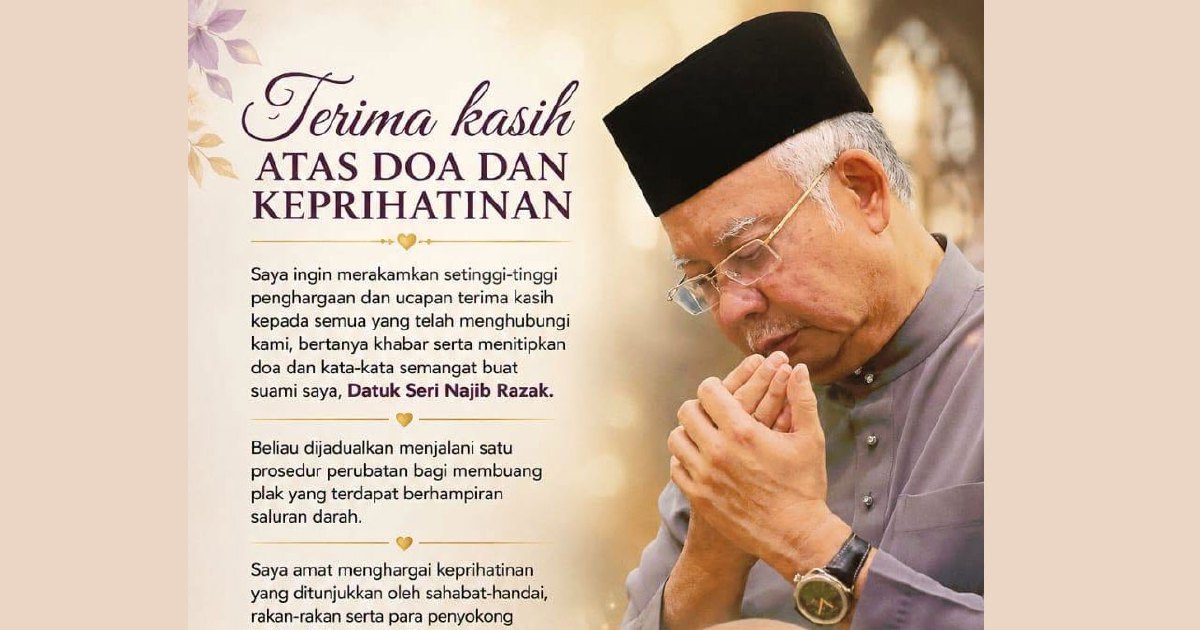
Datin Seri Rosmah Mansor has made a public appeal for prayers and well-wishes as her husband, former prime minister Datuk Seri Najib Razak, prepares to undergo a medical procedure aimed at removing plaque accumulation near a major blood vessel. The request, shared with supporters through a public statement, reflects the couple's appreciation for the continued backing they have received from various quarters despite their turbulent political and legal circumstances in recent years.
The scheduled treatment represents an important health intervention for Najib, whose health has become a matter of public interest given his prominent position in Malaysia's political landscape. Vascular procedures of this nature are relatively common among individuals experiencing arterial plaque buildup, a condition that develops gradually as fatty deposits accumulate within blood vessel walls. The removal of such deposits, known medically as plaque or atherosclerotic material, is intended to restore proper blood flow and mitigate the risk of serious cardiovascular events such as stroke or heart attack.
Rosmah's direct appeal to the public demonstrates the couple's reliance on community support during periods of personal challenge. Throughout their years in the spotlight, the family has cultivated a strong base of supporters who have stood by them through various political transitions and legal proceedings. The request for prayers is culturally significant in Malaysia's multi-faith society, where such appeals typically resonate across religious and ethnic communities who share common values of compassion and goodwill during health crises.
The timing of the procedure announcement comes as Najib continues to navigate the legal system following his previous convictions and ongoing court battles. His health status has implications beyond the personal realm, as it touches on questions about the stability and continuity of those within his political circle. For supporters and associates, any development affecting his wellbeing carries broader significance in terms of their collective political future and the broader narrative of accountability and redemption that has characterised recent Malaysian political discourse.
Vascular procedures requiring plaque removal typically involve minimally invasive techniques that have become standard in modern cardiology and interventional radiology. These treatments aim to restore blood flow through arteries that have become partially or significantly restricted by accumulated deposits over time. The procedure Najib is scheduled to undergo is designed to prevent complications and extend overall health and quality of life, making it a routine but medically important intervention.
Rosmah's public statement also serves to humanise the former first family during a period when their image has been subject to intense scrutiny and significant criticism from various segments of society. By framing the medical situation as a family matter requiring community prayers, she has recontextualised her husband's predicament as a universal human experience—illness and recovery—rather than purely through the lens of political consequences and legal accountability.
The appeal reflects broader patterns observable in Malaysian political culture, where figures facing adversity often mobilise their support networks through public statements emphasising shared faith, family values, and community bonds. Such appeals can be particularly effective in Malaysia's context, where religious observance and collective prayer hold cultural and social significance across different communities, even amid deep political divisions.
For observers of Malaysian politics, Najib's health situation adds another dimension to the ongoing narrative of his political career and current legal circumstances. The former prime minister has maintained a relatively lower public profile in recent years compared to his predecessors, with health considerations likely factoring into decisions about his level of public engagement and activity. The family's openness about his upcoming medical procedure suggests they are viewing it as manageable and routine rather than as a matter of grave concern.
Rosmah's gratitude toward supporters who have stood by the family is notably explicit in her statement. The couple has experienced considerable isolation in certain political and social circles following shifts in political power and ensuing investigations into past governance. Consequently, maintaining and reinforcing relationships with loyal supporters has become increasingly important to preserving their social standing and influence within Malaysia's complex political ecosystem.
The medical procedure scheduled for Najib represents a moment that transcends political divisions, as healthcare matters typically prompt expressions of human solidarity regardless of one's political affiliation. Rosmah's request for prayers thus serves a dual purpose: it genuinely seeks spiritual and emotional support for her husband's wellbeing while simultaneously reinforcing the family's connection to their base of supporters during what could be perceived as a vulnerable period.
As Malaysia continues to grapple with questions of political accountability and institutional reform, the personal dimension of high-profile figures' lives remains a subject of public interest and concern. Najib's upcoming medical procedure, while fundamentally a private health matter, intersects with broader public discourse about former leaders, political consequences, and the human dimension of political change in the country.

