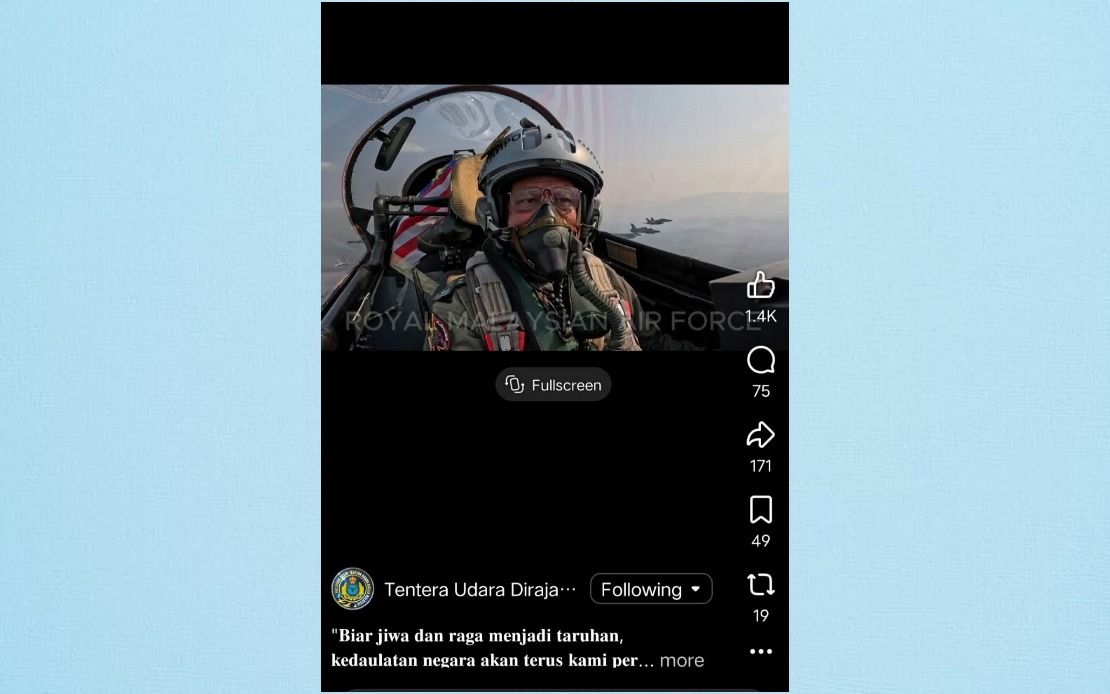
The skies above Putrajaya erupted with the roar of fighter jets on National Day as the Royal Malaysian Air Force orchestrated one of the most anticipated highlights of Malaysia's 69th independence celebration. The display, held at the federal administrative centre, saw a carefully choreographed aerial exhibition that combined entertainment with a clear demonstration of the nation's military air capabilities and operational readiness.
General Tan Sri Muhamad Norazlan Aris, the RMAF chief, took personal command of the spectacle by piloting a Sukhoi Su-30MKM at the head of the formation. This marked the second consecutive year he has directly led the National Day air show, underscoring the significance the military leadership places on this public display of air defence prowess. The decision to have the top military air commander in the cockpit sends a symbolic message about institutional pride and the chain of command's commitment to excellence in operational performance.
The core formation consisted of eleven combat aircraft flying in precise synchronisation. Four Su-30MKM jets, the RMAF's primary air superiority fighters, formed the backbone of the display alongside four F/A-18D Hornet fighters and three BAE Hawk 208 trainers. These aircraft represent different generations of the Malaysian air force's inventory, from advanced multi-role fighters to training platforms that have been adapted for light attack roles, providing a visual representation of the service's operational depth.
Beginning at 9.30 am, the display ran for exactly ten minutes, a timeframe carefully calculated to maintain spectator engagement while managing airspace usage and fuel consumption. The pilots executed a series of specially choreographed formation patterns including the Kite, Diamond, Delta and Victory Combine configurations. These geometric formations require exceptional precision flying at high speed, with minimal margin for error. Each manoeuvre was designed to showcase the responsiveness and manoeuvrability of modern fighter aircraft while creating visually striking patterns for the thousands gathered below.
The professionalism of the display extended to its commentary component. Three RMAF officers—Major Patrick Dinnesh, Major Neny Suhaida Ab Suki and Captain Muhammad Iqbal Nasrudin—provided real-time narration to spectators, explaining the technical aspects of aircraft movements and formation changes. This educational dimension transformed the show from mere spectacle into an informative exhibition, helping civilians understand the complexity of military aviation operations and the skills required to execute such displays safely.
Following the fighter jet segment, the display transitioned to demonstrate the RMAF's broader operational capabilities beyond air combat. Transport aircraft including the C-130H Hercules, A400M Atlas and CN235 appeared in sequence, emphasising the service's capacity for airlift operations and logistical support missions. These aircraft, often invisible to the general public, form the essential backbone of any modern air force, enabling everything from humanitarian disaster relief to military troop and cargo movements across the region and beyond.
The aerial exhibition further expanded its scope by incorporating rotary-wing assets, with EC725 and AW139 helicopters operated by the RMAF flying in formation. Notably, these RMAF aircraft participated in combined formations with assets from the Malaysian Army, Royal Malaysian Navy, Fire and Rescue Department of Malaysia and Royal Malaysia Police. This inter-service coordination demonstrated the integrated approach to national defence and disaster response, reflecting the reality that modern security challenges typically require seamless cooperation across multiple agencies and military branches.
The reaction from the estimated thousands of spectators gathered at Dataran Putrajaya throughout the display underscored the enduring public appeal of such air shows. Many attendees remained fixed on the skies, their attention never wavering as aircraft thundered overhead. The visceral impact of high-performance military jets operating at close proximity—a controlled environment but nonetheless impressive—continues to resonate with Malaysian audiences across generations. The combination of visual spectacle, physical sensation from engine noise, and the implicit message of national capability creates an emotional connection that traditional parades cannot replicate.
From a strategic communication perspective, the National Day air display serves multiple purposes beyond entertainment value. For the civilian population, it reinforces national pride and provides tangible evidence of the country's defence investment and technological capabilities. For international observers and neighbouring nations, such displays communicate Malaysia's operational readiness and the sophistication of its air assets. The participation of inter-agency assets sends a message about whole-of-government integration in national security affairs, important in a region where civilian-military coordination is sometimes questioned.
The transformation of Putrajaya's airspace into a dramatic theatre of military capability added a distinctive character to this year's National Day celebrations. While traditional ceremonies and parades mark the calendar moment of independence, aerial displays inject dynamism and technological modernity into the commemoration. For Malaysian audiences increasingly exposed to global media standards and international defence showcases, maintaining world-class presentation of military capabilities remains important for national morale and institutional legitimacy.
The successful execution of such a complex operation also reflects the training standards and safety protocols within the RMAF. Coordinating eleven fast jets, transport aircraft, helicopters and multiple agencies in a display over an urban area represents significant logistical and technical achievement. The absence of incidents allows the focus to remain entirely on the impressiveness of the flying itself rather than safety concerns, validating the service's operational standards to both domestic and international audiences.

