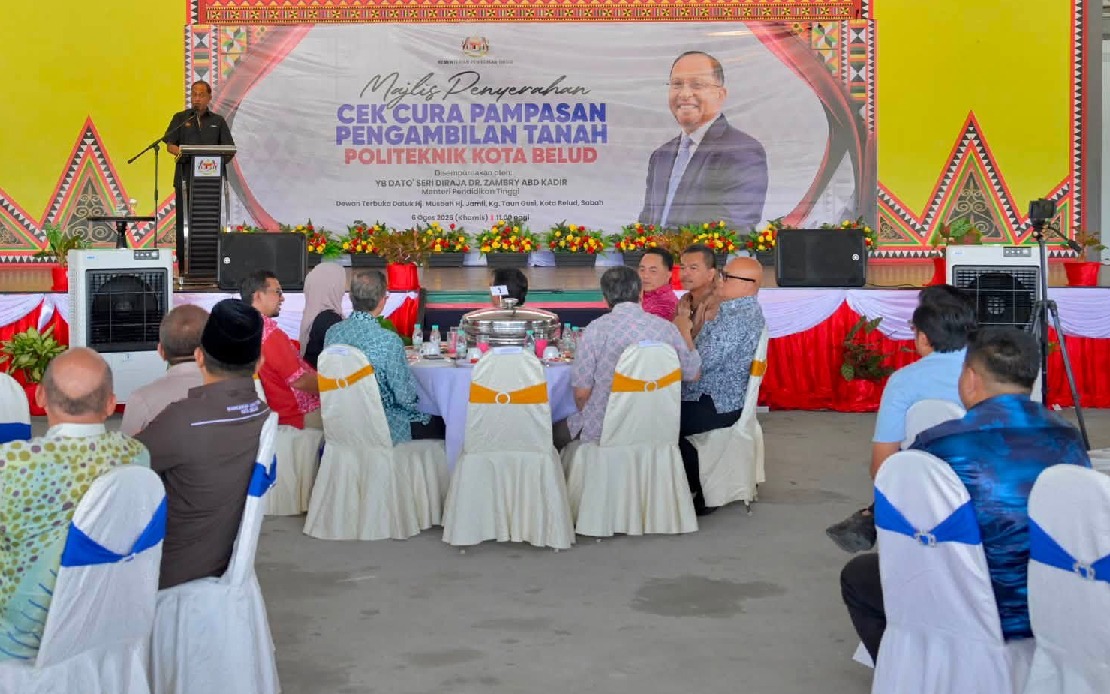
Malaysia's ambitious RM250 million polytechnic development in Kota Belud has officially moved into its construction phase, with Higher Education Minister Datuk Seri Zambry Abd Kadir confirming the facility is expected to be operational by 2030. The ministerial announcement came during a ceremony in Kota Belud on August 6, where compensation was formally presented to landowners whose property was acquired for the project, marking the symbolic beginning of physical construction work.
The journey toward establishing this institution has been lengthy, with the initial proposal dating back to 2017 when Kota Belud MP Datuk Seri Abdul Rahman Dahlan first advocated for the facility. The intervening years involved comprehensive planning, feasibility studies, and the complex process of acquiring the necessary land through proper compensation arrangements. By completing the land acquisition phase, the project has cleared a significant administrative hurdle that often delays infrastructure development in Malaysia.
According to Zambry, the next critical phase involves detailed design planning and architectural development work, which will prepare the groundwork for full implementation. The minister indicated that substantive construction activity is anticipated to commence under the Third Rolling Plan of the 13th Malaysia Plan, which begins next year. This timeline suggests that while ceremonial groundwork has commenced, major construction contracts and workforce deployment may take several additional months to fully mobilise.
The polytechnic's curriculum has been specifically designed to address Sabah's evolving economic landscape and anticipated skills shortages. Rather than offering generic vocational training, the institution will concentrate on programmes aligned with emerging industries and future workforce demands. Planned specialisations include green energy technologies, artificial intelligence applications, computer science fundamentals, and technology-driven agricultural innovation—areas where Malaysia and Southeast Asia are experiencing acute skills gaps.
The focus on green energy and sustainable technology reflects Malaysia's broader commitment to achieving net-zero carbon emissions and transitioning toward renewable power generation. As Sabah possesses significant potential for solar, wind, and hydroelectric development, training a local workforce in these domains addresses both immediate industry requirements and long-term regional energy security objectives. The artificial intelligence and computer science offerings position graduates to participate in Malaysia's digital economy expansion and support the country's aspiration to become a regional technology hub.
Smart agriculture represents another strategic curriculum area, responding to Sabah's agricultural heritage and the imperative to modernise farming practices through precision technology, data analytics, and automation. As traditional agriculture faces labour shortages and climate pressures, technology-enabled farming methods offer productivity improvements and sustainability gains that will be crucial for Southeast Asian food security in coming decades.
The intake capacity has been conservatively planned, with the polytechnic initially enrolling approximately 500 students during its inaugural year of operation. However, Zambry outlined expansion plans that would increase capacity to between 1,000 and 1,500 students once the facility reaches full operational maturity. This phased approach allows for gradual curriculum refinement, faculty recruitment and training, and infrastructure scaling while maintaining educational quality standards.
For Malaysian policymakers and regional observers, the project demonstrates a deliberate strategy to distribute technical education infrastructure beyond established urban centres. Kota Belud's location in Sabah positions the polytechnic to serve rural and semi-rural communities across the state and potentially neighbouring Brunei, reducing educational inequality and creating pathways for talent from underserved regions. This geographic distribution also supports workforce development strategies that align technical training with local industry ecosystems rather than concentrating educational capacity in conventional urban hubs.
The RM250 million investment reflects the significant financial commitment required to establish a modern polytechnic institution equipped with contemporary facilities, laboratories, and technology infrastructure necessary for delivering competitive technical education. This scale of investment suggests the government regards skills development in emerging technologies as sufficiently important to justify substantial capital expenditure in regional locations.
From a Southeast Asian perspective, Malaysia's expansion of polytechnic capacity in high-technology domains mirrors similar initiatives across the region as governments compete to develop workforces capable of participating in advanced manufacturing, renewable energy, and digital economy sectors. The Kota Belud project positions Malaysia alongside regional peers in prioritising technical skills development as a competitive advantage.
Successful implementation of this project will require coordination between federal education authorities, state-level stakeholders, and private industry partners to ensure curriculum relevance and graduate employment outcomes. The 2030 completion timeline provides approximately six years for construction, equipment procurement, staff recruitment, and programme development—a reasonable but compressed schedule for establishing a fully functional polytechnic.
For prospective students across Sabah and potentially neighbouring regions, the Politeknik Kota Belud will eventually offer accessible pathways into high-demand fields without requiring relocation to peninsular Malaysia. This accessibility factor may prove particularly significant for students from rural backgrounds who might otherwise face barriers to technical education. The institution's emergence will also contribute to regional economic development by building local human capital and potentially attracting technology-focused enterprises to Sabah seeking graduates with contemporary skills.

