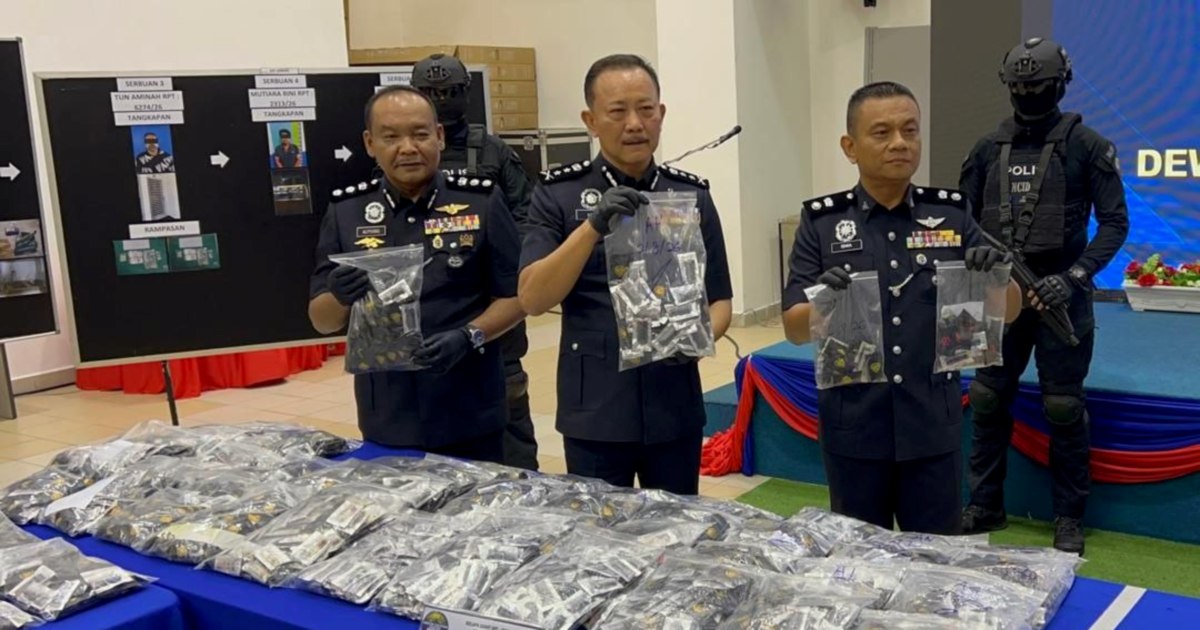
Law enforcement agencies in Johor have successfully disrupted a major operation manufacturing and peddling vape cartridges laced with controlled narcotics, marking a significant blow to the state's drug trafficking networks. The operation, which yielded an estimated street value of RM10.68 million in contraband products, came to an end following coordinated police action on Sunday that resulted in the apprehension of seven individuals suspected of operating the illicit enterprise across multiple locations throughout Johor.
The enforcement action represented a culmination of investigative work targeting what authorities determined to be an organised distribution chain specialising in the conversion of vaping devices into delivery mechanisms for illicit substances. The simultaneous nature of the raids—conducted across five separate sites in the state—underscores the sophistication of police intelligence gathering and the coordination required to prevent suspects from fleeing or destroying evidence during the operation. Such coordinated multi-location enforcement actions have become increasingly common in Johor and across Malaysia as law enforcement adapts tactics to confront evolving drug distribution methods.
The discovery of this particular syndicate highlights a troubling trend in Southeast Asia's narcotics landscape: the repurposing of commercially available vaping devices, which are marketed as legitimate nicotine delivery systems, into instruments for distributing prohibited substances. This adaptation reflects traffickers' efforts to exploit regulatory gaps and the discreet nature of vaping technology to circumvent traditional detection methods. Vaping devices remain relatively inconspicuous in public settings, and their normalisation among younger demographics makes them an attractive vehicle for drug distribution networks seeking to expand their customer base.
From a public health perspective, the emergence of drug-infused vaping products presents particular challenges for Malaysian authorities and communities. The products combine the addiction potential of controlled substances with the accessibility and social acceptability increasingly associated with vaping among adolescents and young adults. Health officials and drug prevention specialists have expressed mounting concern about the psychological impact of such products, particularly given their capacity to introduce users to dependency-forming drugs in formats that may seem less obviously illicit than traditional methods of narcotics administration.
The magnitude of the haul—RM10.68 million in street value—provides quantifiable evidence of the commercial scale at which these operations function. This figure reflects not merely the street-level retail value of the seized cartridges but the profit margins that incentivise criminal syndicates to sustain such enterprises despite enforcement risks. The economics of drug trafficking in the region continue to shift, with organised networks demonstrating willingness to invest in product innovation and distribution infrastructure to maintain market share and maximise returns, even as authorities intensify their countermeasures.
Johor's position as a major transit hub and commercial centre, coupled with its proximity to Singapore and other regional markets, has historically made the state vulnerable to drug trafficking activities. The port facilities, road networks, and cross-border commerce provide natural corridors for narcotics movement, and criminal networks have long exploited these geographic advantages. Recent enforcement successes in the state suggest that police capacity to identify and disrupt distribution networks continues to improve, though the persistent emergence of new operations indicates the challenge remains formidable.
The investigation and enforcement action also reflect broader regional cooperation frameworks, as trafficking operations increasingly operate across state and national boundaries. Intelligence sharing between federal and state authorities, combined with technological advances in surveillance and forensic analysis, has enhanced law enforcement's ability to penetrate criminal networks and identify key players. However, the seven arrests, while significant, typically represent only mid-level operatives and distribution specialists rather than the higher-level organisers who coordinate supply chains and manage finances.
For Malaysian policymakers and regulatory bodies, this operation underscores the need for comprehensive approaches to vaping regulation that balance legitimate harm-reduction applications against potential criminal misuse. Several countries in the region have explored stricter licensing frameworks for vape retailers and manufacturers, combined with enhanced penalties for the distribution of drug-infused alternatives. Malaysia's regulatory environment continues to evolve as the government weighs public health considerations against commercial interests and enforcement capabilities.
The arrests and seizure also carry implications for communities across Johor, particularly in areas where vaping has achieved market penetration among younger populations. Parents, educators, and youth-serving organisations have increasingly expressed concerns about the difficulty of distinguishing between legitimate and illicit vaping products, particularly when products may be acquired through informal distribution networks. The visibility of this enforcement action may serve an important deterrent function, though research on the effectiveness of such operations in reducing overall drug use remains mixed.
Police indicated that investigations into the syndicate's operations would continue, suggesting the likelihood of additional arrests as authorities pursue upstream and downstream connections within the distribution network. Understanding the full scope of the organisation—including financial flows, supplier relationships, and customer networks—requires sustained investigative effort extending well beyond the initial coordinated raids. Such follow-up investigations frequently yield intelligence valuable to law enforcement's broader strategy against narcotics trafficking throughout the region.

