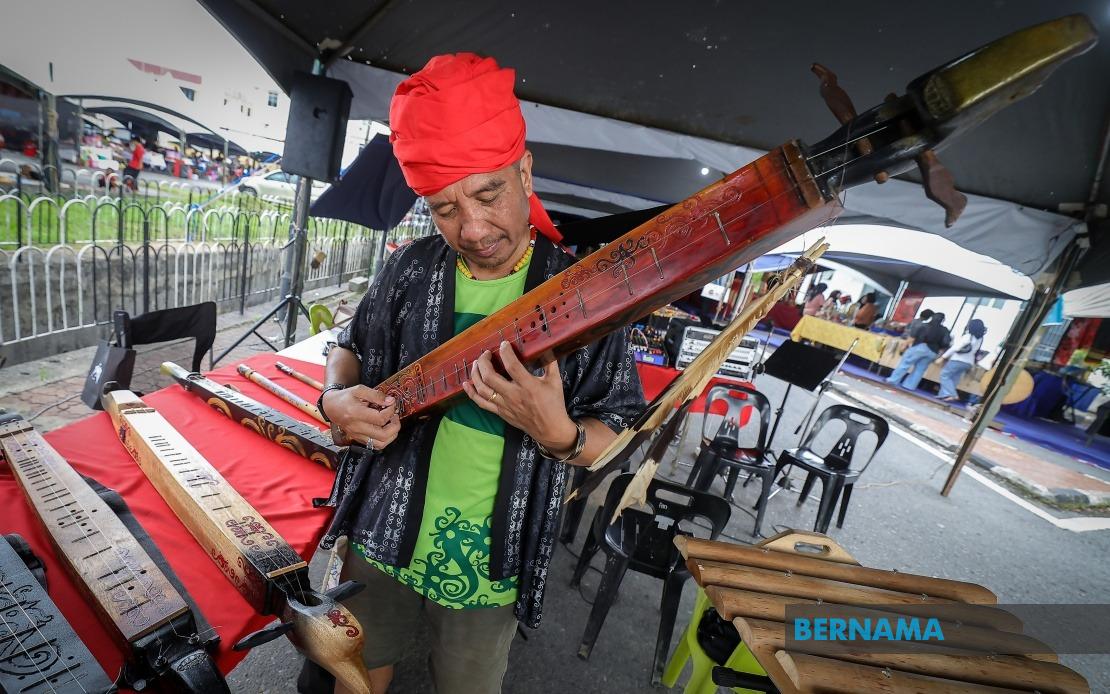
Sarawakian musician and instrument maker Rining Peter Paris has stepped into fresh creative territory with 'Sigar Suba', his latest release performed alongside his band Bata' Uduh. Unveiled on July 1, the world music fusion track represents a deliberate shift in artistic focus, zeroing in on the cultural identity of the Lun Bawang community rather than treading familiar thematic ground. The single draws its power from an array of traditional instruments, with the Tapi' — a two-stringed plucked instrument venerated in Lun Bawang culture — standing at the forefront alongside the Pek Bu, Ruding and xylophone, creating a sonic landscape that bridges ancestral traditions with contemporary world music sensibilities.
At 53, Rining has long grappled with the imbalance in artistic representation within his community's music canon. His earlier compositions, including 'Busak Baku' and 'Busak Elai', primarily explored themes celebrating feminine aesthetics and the natural world — commonplace subject matter in community music traditions. Yet Rining recognised a conspicuous absence: songs that meaningfully centred the cultural identity and distinctive heritage markers of Lun Bawang men. This observation catalysed the creation of 'Sigar Suba', a deliberate corrective that places male identity and traditional masculine elements at the narrative heart of the composition.
The song's title carries specific cultural resonance rooted in Lun Bawang ceremonial life. 'Sigar' references the traditional red headpiece that men don during important celebrations, whilst 'suba' translates simply as red. Together, these words evoke the striking crimson headgear worn at the Irau Aco festival and other significant community gatherings — a visual emblem of cultural pride and ceremonial participation. By anchoring the song's title to this tangible cultural artifact, Rining grounds his composition in concrete heritage rather than abstract concepts, making the work immediately recognisable and meaningful to community members.
The lyrical content, rendered entirely in the Lun Bawang language, functions as a meticulous inventory of traditional male attire and regalia. The composition details the kuyu talun, a bark shirt representing pre-contact material culture; the pelepet, a traditional machete integral to daily life; and ornamental tusks that adorned ceremonial dress. Rather than merely listing these items, the song positions them as markers of identity and continuity, inviting listeners to contemplate their significance within the broader tapestry of Lun Bawang heritage. This approach acknowledges that material culture — clothing, tools, ornaments — encodes and transmits cultural knowledge across generations.
Rining's primary audience for this work extends beyond casual listeners to encompass younger members of the Lun Bawang community, particularly young men navigating questions of cultural identity in an increasingly globalised world. He articulates a clear pedagogical intention: the song functions as a cultural anchor, reminding younger generations of their heritage and encouraging them to actively maintain and celebrate these markers of belonging. In an era where traditional knowledge faces erosion through migration, education systems oriented toward dominant cultures, and the gravitational pull of global popular culture, Rining's work operates as a counterforce — making heritage engagement aesthetically contemporary rather than merely nostalgic.
The musician's commitment to cultural preservation extends well beyond songwriting into instrumental craft. Over nearly a decade, Rining has devoted himself to reviving and advancing the Tapi' as both a functional instrument and cultural symbol. His dual role as composer and luthier reflects a holistic approach to heritage work — one cannot fully separate the music from the instrument that produces it, nor the instrument from the knowledge systems that sustain its construction and performance. This integration embodies a philosophy where cultural preservation functions through multiple, interlocking channels.
Rining's commercial and artistic success with the Tapi' demonstrates viable pathways for traditional instrument sustainability in contemporary markets. He has handcrafted and sold 66 instruments to buyers scattered across geographic and cultural boundaries — Australia, the United States, Canada, and Malaysia — indicating genuine international interest in Sarawak's indigenous musical heritage. This market demand proves significant: it suggests that world music audiences actively seek instruments embodying specific cultural narratives and craftsmanship traditions. The Tapi' has attracted the attention of Malaysian experimental musician Belle Sisoski, further validating its artistic potential beyond community contexts.
Bata' Uduh's creative methodology offers instructive lessons for heritage musicians navigating the tension between authenticity and contemporary relevance. Rather than preserving traditional sounds in amber-like stasis, the band deliberately infuses reggae and fusion elements into compositions built on traditional instrumental foundations. This approach acknowledges a cultural reality: younger audiences, including younger Lun Bawang people, consume music shaped by global genres and production aesthetics. By translating heritage instruments into sonic contexts these audiences already inhabit, Bata' Uduh makes traditional culture accessible without compromising its integrity or rendering it quaint.
Rining's artistic aspirations reveal an understanding that sustainable heritage preservation requires material stability and creative autonomy. His stated goal of transitioning to full-time Tapi' making and composition by 2028 reflects recognition that cultural work demands dedicated labour and resources. For Southeast Asian indigenous musicians and craftspeople, such ambitions often prove constrained by economic precarity and limited institutional support. Rining's trajectory — building markets for traditional instruments whilst developing a recording presence on major streaming platforms — charts one possible route toward self-determination in cultural production, though success remains far from guaranteed.
The release of 'Sigar Suba' on major music streaming platforms represents an infrastructural shift in how Southeast Asian heritage music reaches audiences. Traditional music historically circulated through community gatherings, ceremonial occasions, and word-of-mouth knowledge transmission. Digital platforms democratise access, enabling curious listeners worldwide to encounter music they might never encounter through geographic proximity alone. Yet this accessibility carries complications: decontextualisation, potential commodification, and the risk that cultural nuance dissolves through unfamiliar listening frameworks. Rining navigates these tensions by maintaining the Lun Bawang language and specific cultural references throughout 'Sigar Suba', anchoring the composition firmly within its community context even as distribution mechanisms scatter it globally.
For Malaysian and broader Southeast Asian contexts, Rining Peter Paris exemplifies a growing cadre of indigenous artists refusing the false binary between tradition and modernity. His work demonstrates that heritage preservation need not mean stasis; that younger generations can maintain cultural identity through contemporary creative forms; and that market viability exists for work grounded in specific, non-dominant cultural narratives. 'Sigar Suba' stands as both artistic statement and cultural intervention — a song designed to be sung by young Lun Bawang people whilst simultaneously existing within global music distribution systems. In this duality lies both the promise and complexity of contemporary indigenous cultural work in Southeast Asia.

