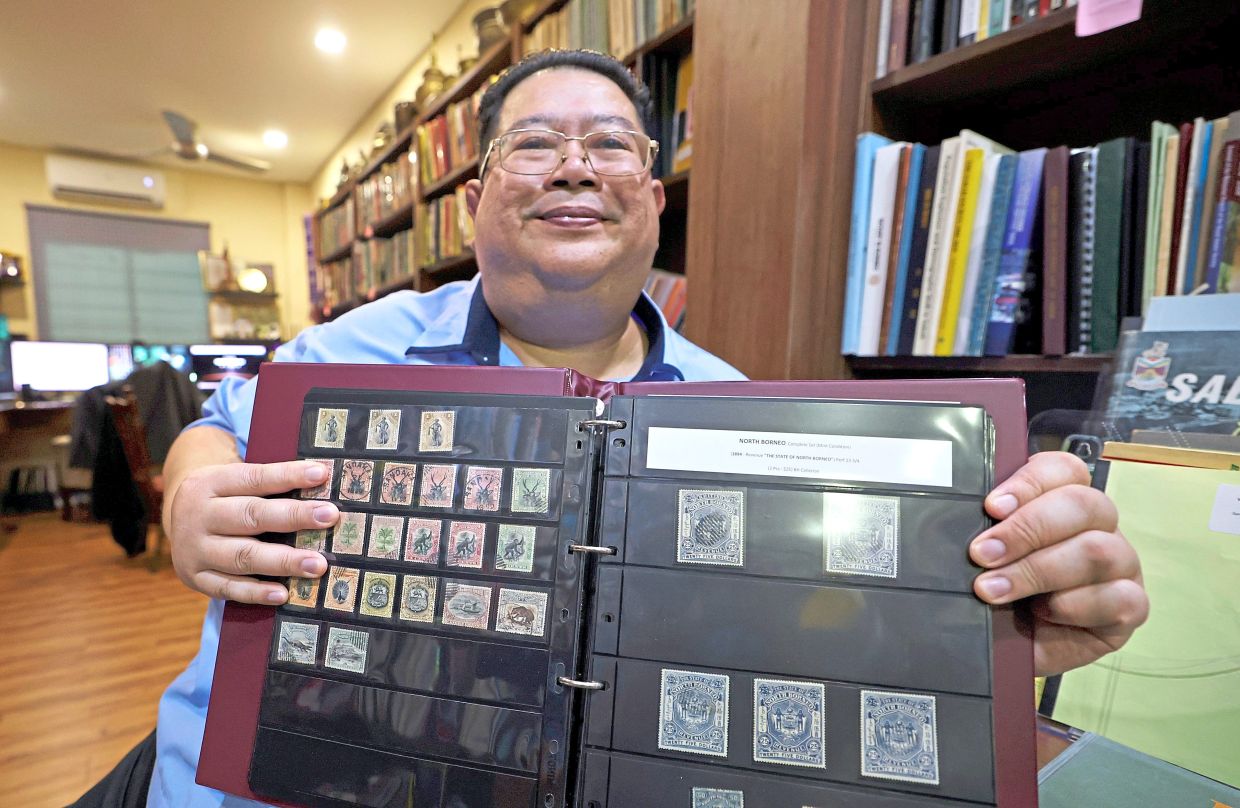
The stamps that once bore letters across North Borneo over a century ago are now vanishing from Malaysian consciousness, yet their preservation has emerged as an unexpectedly urgent cultural mission. These philatelic treasures, issued between 1883 and 1963, represent far more than postage markers—they document a crucial chapter in Sabah's transformation from a chartered trading company's territory to a modern Malaysian state. As digital communication renders traditional letter-writing obsolete, the fragile paper records of North Borneo's past risk fading into obscurity alongside the postal systems they once served.
Dr Shari Jeffri, the 56-year-old founder and president of the Borneo History Association, has emerged as a leading voice in this preservation effort. He describes the stamps as a "living archive" that connects contemporary Sabahans to their heritage and argues passionately that these artefacts must be safeguarded and transmitted to future generations. His conviction stems not from academic detachment but from deeply personal roots—a family collection inherited from his grandfather, who worked at the Recreation Club Jesselton in Kota Kinabalu during the 1920s and caught the collecting bug after observing British officers' enthusiasm for the hobby.
The challenge confronting philately enthusiasts extends beyond mere nostalgia. A Bernama survey of antique dealers in Kota Kinabalu revealed that North Borneo stamps have become progressively scarce in the local market, with valuations fluctuating based on age, condition, and rarity. During this research, collectors discovered specimens of genuine historical significance, including an album holding a six-cent stamp portraying Queen Elizabeth II alongside a Dusun woman, and a ten-cent denomination illustrating logging operations—both from the 1954 to 1961 era. These discoveries underscore both the richness and fragility of Sabah's stamp heritage.
Shari's personal journey into serious philately began when he inherited his grandfather's collection, though he was first introduced to stamp collecting at age seven. He only truly committed to the hobby during secondary school, transforming a childhood curiosity into a decades-long scholarly pursuit. His collection includes two extraordinarily prized specimens from the inaugural 1883 issue—two-cent stamps depicting a brown sailing boat with complete postmarks intact. For dedicated philatelists, ownership of stamps from the 1883 series represents a milestone achievement, as these founding issues provide irreplaceable windows into the territory's early postal infrastructure and imperial aesthetic.
The British North Borneo Chartered Company commenced stamp production in 1883, maintaining this service for approximately five decades until 1963. Examining these chronologically arranged stamps reveals a deliberate evolution in design philosophy and imagery. The earliest issues featured symbolic representations—lions, boats, and tigers—accompanied by the Latin inscription Pergo et Perago, meaning "I undertake and I achieve," as the Company sought to promote the territory internationally. From 1894 onwards, designers increasingly emphasised Borneo's distinctive natural environment, featuring indigenous flora, fauna, and wildlife. The 1935 series marked a particularly important inflection point, with designs that more transparently reflected Sabah's distinct identity across denominations ranging from two cents to one dollar.
The technical preservation of these stamps presents substantial practical obstacles. Shari emphasises that acid-free archival albums are essential for preventing colour fading and paper deterioration. Equally crucial is the recognition that stamps bearing complete postal cancellations—those that retain clear marks indicating mailing date, originating post office, time, and location—command exceptional value among collectors and historians alike. These cancelled stamps function as miniature historical documents, encoding postal activity and administrative practices within their physical surfaces. The paper composition and adhesive formulation of individual stamps provide forensic evidence of authenticity and marketplace value, requiring trained expertise to properly evaluate.
Shari's professional credibility in this field reflects serious study and international consultation. He trained under renowned Singaporean philatelic specialists Voon Kyam Foh and Tan Chun Lim, supplementing this mentorship with meticulous research using authoritative references including the Commonwealth & British Empire Stamps catalogue. This scholarly foundation allows him to situate North Borneo stamps within broader imperial postal histories while developing specific expertise in territorial variants and chronological progression. His approach demonstrates that philately, often dismissed as antiquarian hobby, represents a legitimate historical discipline with methodological rigour comparable to archival research or numismatic studies.
A fundamental paradox confronts stamp preservation efforts across Southeast Asia: the very technological advances that have rendered stamps economically obsolete have also removed them from everyday visibility and popular understanding. Younger Malaysians, who encounter communications primarily through digital networks, lack the intuitive familiarity with stamps that older generations cultivated through routine letter-writing. Shari acknowledges this generational challenge directly, noting that contemporary interest in stamp collecting has contracted significantly compared to previous decades. Only a dedicated minority pursues the hobby actively, and the broader community of enthusiasts continues a steady decline that threatens the knowledge transmission necessary for informed preservation.
The implications of this cultural erosion extend beyond individual collectors' concerns. Regional institutions throughout Malaysia and Borneo increasingly recognise that philatelic collections constitute valuable documentary evidence for understanding colonial administrative practices, territorial economics, indigenous representation, and cultural identity formation. North Borneo stamps, particularly those spanning the British North Borneo Chartered Company era through the transition to Malaysian sovereignty, offer material evidence of how territorial authorities marketed their domains to global audiences and which local subjects they chose to commemorate. The visual presentation of Dusun peoples, logging enterprises, flora, and fauna on these stamps reveals colonial priorities and aesthetic preferences that merit historical examination.
Sabah's position as a relatively young state within Malaysia, with distinct colonial lineage and ongoing negotiations regarding autonomy within the federation, makes historical documentation particularly significant. Stamps issued during the 1950s and early 1960s, as North Borneo approached independence and eventual incorporation into Malaysia, represent pivotal moments of political transition frozen in miniature format. These artefacts speak to how territories understood themselves and presented themselves during periods of constitutional and sovereign transformation. Collectors like Shari function as custodians not merely of pretty objects but of essential historical evidence.
The fragmentation of North Borneo's stamp heritage across private collections and antique markets creates preservation vulnerability. Unlike museum collections maintained under regulated conditions, dispersed private collections risk loss through inheritance disputes, accidental disposal, or environmental damage. Shari's advocacy for systematic preservation, education, and intergenerational transmission addresses these structural weaknesses. His work with the Borneo History Association represents an attempt to transform collecting from isolated hobby into supported cultural practice with institutional recognition and responsibility.
Moving forward, the challenge for Malaysian cultural institutions and collectors involves recalibrating how stamp heritage is valued and transmitted. Digital archiving, scholarly publication about North Borneo philatelic history, and educational programmes introducing younger Malaysians to these artefacts offer pathways toward sustainable preservation. Regional stamp exhibitions, cooperative cataloguing projects, and partnerships between private collectors and public institutions could strengthen protective frameworks. Without deliberate intervention, the visual and material record of North Borneo's transformation—compressed into thousands of small paper rectangles—risks dispersal and deterioration within a generation.
Ultimately, Shari's decades-long commitment to North Borneo stamps reflects a conviction that even obsolete technologies carry historical significance and cultural meaning warranting careful stewardship. His grandfather's decision to collect stamps during the 1920s, motivated by observing British officers' enthusiasm, inadvertently created a family archive that now illuminates Sabah's past. In an era when letter-writing seems quaint and stamps appear purely functional, this perspective—that ordinary objects can become extraordinary historical witnesses—deserves renewed consideration across Malaysia and beyond.

