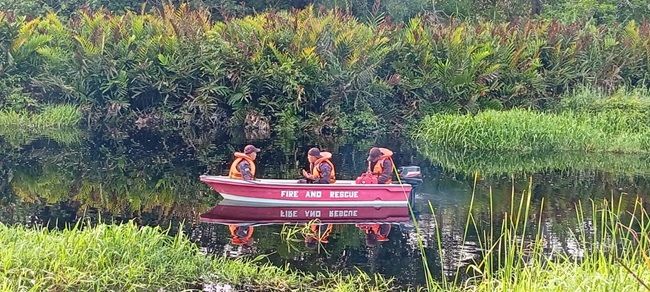
Rescue efforts to locate a missing fisherman feared to have been attacked by a crocodile in Kampong Baru Sungai Bera have now stretched into a third consecutive day, with authorities deploying sophisticated search methods across the waterway and surrounding areas. The operation, which intensified following a distress call received on Wednesday, June 24, has yielded no sightings of the victim despite extensive coordination between multiple government agencies and ongoing surveillance of the river system.
The Brunei Fire and Rescue Department (FRD) has mobilised substantial resources to conduct what has become a complex multi-front search operation. Personnel are conducting systematic patrols using dedicated rescue boats moving along the river's course, whilst simultaneously combing the banks on foot to examine any evidence or signs of the missing person. The department has also deployed aerial surveillance capabilities, utilising unmanned drones to scan areas that would be difficult or dangerous for ground teams to access, particularly given the presence of crocodile hazards that pose risks to rescue personnel themselves.
The incident has prompted cooperation across Brunei's security and conservation apparatus, reflecting the serious nature of wildlife encounters in the sultanate's waterways. The Royal Brunei Police Force has contributed officers from Seria Police Station to the broader search framework, bringing additional manpower and investigative expertise. More notably, the force's specialist Marine Police unit (POLMAR) has joined proceedings, providing expertise in river-based operations and water safety protocols. The Wildlife Division's involvement underscores official recognition that understanding the behaviour and movement patterns of crocodiles in this particular river system is integral to locating the victim.
Command of the operation rests with Senior Superintendent Amirul Hadi Junaidi, the Commanding Officer of the Operations Branch, ensuring unified coordination across the various agencies involved. This centralised leadership structure has proven critical in managing the deployment of boats, personnel, and technological assets in a way that maximises search efficiency without duplicating efforts or creating gaps in coverage.
Initial investigations based on interviews with the victim's family established that the man was engaged in fishing activities along the river when the crocodile attack allegedly occurred. This detail is significant for search strategists, as it indicates the incident took place in an active fishing zone rather than an isolated location, potentially meaning other people were in the vicinity and may provide additional witness accounts as the investigation develops. The circumstances suggest this was not an anomalous event in an unpopulated region, but rather an encounter in an area where human and wildlife activities intersect regularly.
The FRD's immediate response on the day of the distress call demonstrated the structured nature of Brunei's emergency services. Two fire engines carrying nine personnel, led by Acting Station Officer Mohd Zulkifli Md Tahir, were dispatched to the scene. Upon arrival, the team established a Tactical Command Post to coordinate subsequent operations, a critical infrastructure element that allowed search efforts to be sustained and scaled over subsequent days as additional resources arrived. This command post has evidently remained operational throughout the three-day search, serving as the nerve centre for coordinating boat movements, drone flights, and ground searches.
The deployment of drone technology in this operation highlights how modern emergency response in Southeast Asia increasingly incorporates advanced surveillance systems. Drones offer particular advantages in crocodile search scenarios, allowing rescuers to scan river sections without exposing personnel to the reptile threat, and providing overhead perspectives that might reveal disturbed vegetation, unusual water conditions, or other physical indicators of what occurred. The footage captured can also be analysed after the initial search sweep, potentially revealing details missed during real-time observation.
For Malaysian readers, this incident resonates with broader regional concerns about safety in river and wetland environments. While Brunei's crocodile populations are smaller and less notorious than those in Malaysia's more expansive waterway systems, the fundamental dynamics of human-wildlife conflict remain similar. The crocodile species present in both nations occupy similar ecological niches and exhibit comparable predatory behaviour, suggesting that search and rescue protocols developed in Brunei's response to this incident may hold relevance for Malaysian emergency services grappling with comparable situations.
The absence of any trace of the victim after three days of intensive searching raises difficult questions about survivability in crocodile attacks and the challenges faced by rescue teams in recovering victims in river environments. Crocodile attacks are characteristically rapid and overwhelming, often resulting in fatalities before rescue response can be mobilised. The victim's family, having reported the incident promptly, gave authorities their best window for potential recovery, yet that window appears to have closed without positive outcome. This grim reality underscores the inherent danger of fishing in crocodile-inhabited rivers, a risk that persists despite public awareness campaigns and safety advisories in both Brunei and the broader region.
The operation's continuation past the point where victim recovery seems likely suggests authorities may now be focused on recovery of remains for family purposes and conducting a thorough forensic investigation into the circumstances. Such investigations are important for understanding whether this represents an isolated attack or part of a pattern requiring broader public health interventions or wildlife management responses. As the search extends into its fourth day, the emphasis will likely shift from rescue to recovery and from immediate response to longer-term analysis of what led to this tragedy and how similar incidents might be prevented.

