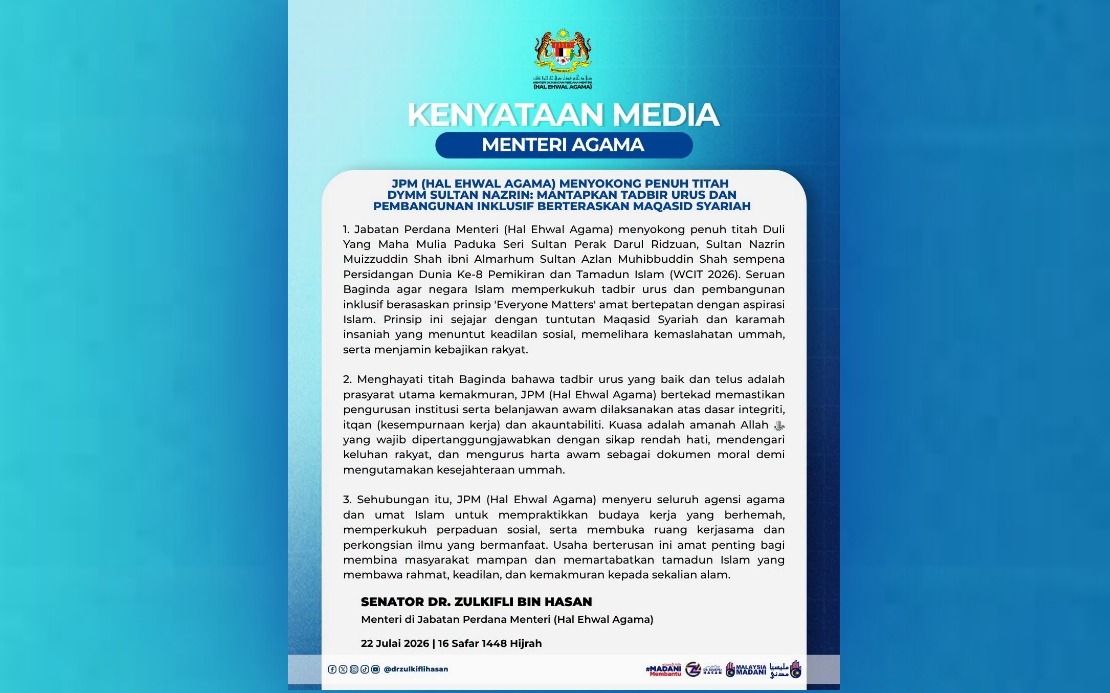
The Prime Minister's Department (Religious Affairs) has pledged to deepen its institutional governance by adopting Sultan Nazrin Shah's vision of inclusive leadership, signalling a deliberate shift toward embedding principles of equity and transparency across Malaysia's religious administration. The commitment follows the Perak Sultan's address at the 8th World Conference on Islamic Thought and Civilisation (WCIT) in which he articulated a compelling case for Muslim-majority nations to prioritise good governance and development that reaches every citizen, transcending divisions of race, religion and political affiliation.
Minister in the Prime Minister's Department (Religious Affairs) Dr Zulkifli Hasan framed this alignment as far more than symbolic compliance, arguing instead that the "Everyone Matters" principle sits at the philosophical heart of Islam itself. He contended that Sultan Nazrin's exhortation mirrors core Islamic values, particularly the Maqasid Syariah—the overarching objectives of Islamic law—and the foundational Islamic concept of karamah insaniah, which emphasises human dignity as inviolable. This theological grounding matters significantly for Malaysian audiences, as it positions good governance not as a Western import but as authentically Islamic, potentially bridging traditional and modernist sensibilities within Muslim communities across Southeast Asia.
Sultan Nazrin's framing of governance carries particular weight in the Malaysian context, where debates over public administration, religious authority and national cohesion frequently intersect. His assertion that truly inclusive public service—one indifferent to a citizen's ethnic or religious identity—embodies national unity and humble leadership strikes at the heart of longstanding tensions in Malaysian governance. The Sultan's emphasis on listening to grievances before legislating suggests a deliberate departure from top-down administrative models, advocating instead for participatory processes that invite public input into policymaking affecting religious and civic life.
Dr Zulkifli elaborated on the practical implications, committing his ministry to an administrative framework built on three pillars: institutional integrity, itqan (Islamic concept of excellence and mastery in work), and accountability. This tripartite approach signals an intention to marry Islamic ethical precepts with contemporary governance standards. By invoking itqan alongside Western accountability mechanisms, the ministry positions Islamic work ethic as compatible with, rather than opposed to, modern institutional standards—a message relevant for Southeast Asian nations grappling with how to harmonise tradition and contemporary administration.
The minister's assertion that authority constitutes a divine trust requiring humble stewardship represents a notable theological emphasis in public discourse. By framing governmental power as an amanah (sacred trust from Allah), Dr Zulkifli invokes one of Islam's most profound ethical concepts, obligating leaders to manage public resources as a moral responsibility rather than a prerogative. This reframing has implications beyond Malaysia; it offers a theological vocabulary through which other Southeast Asian nations—Indonesia, Brunei, and others—might deliberate governance reform in culturally consonant terms.
Sultan Nazrin's broader address tackled the interconnectedness of the contemporary world, rejecting isolationism as economically unviable and strategically foolish. His observation that no nation, regardless of resource endowment, can insulate itself from global trade, investment flows and technological exchange reflects an internationalist perspective sometimes absent from nationalist rhetoric. For Malaysia, a trading nation heavily integrated into regional and global supply chains, this framing validates economic openness while arguing that inclusivity and sound governance are prerequisites for prosperity—not hindrances to it. The Sultan's synthesis of moral governance and economic pragmatism offers a useful counterpoint to populist governance models that sometimes pit nationalism against institutional accountability.
The emphasis on listening to people's grievances before enacting laws contrasts sharply with perception of top-down religious administration in parts of Southeast Asia. Sultan Nazrin's vision envisions religious governance—typically perceived as reserved and hierarchical—becoming participatory and responsive. For Malaysian readers, this carries particular salience given ongoing debates over religious authority, minority rights and the scope of Islamic law in a plural society. His implicit argument that legitimacy flows partly from consultation and responsiveness rather than solely from religious or constitutional authority suggests a reconceptualisation of how religious institutions should relate to their constituents.
Dr Zulkifli's call for religious agencies and the Muslim community to cultivate courtesy in workplace conduct, strengthen social cohesion, and encourage knowledge-sharing points toward an administrative culture emphasising collaboration over hierarchy. This appeal addresses practical governance challenges: institutions characterised by infighting, opacity and knowledge hoarding tend toward corruption and inefficiency. By explicitly promoting collaborative culture, the ministry signals recognition that structural reform and ethical exhortation must proceed hand-in-hand. For Southeast Asian governments struggling with institutional capacity and corruption, this integrated approach offers a model worthy of examination.
The commitment to prioritising the ummah's collective welfare, framed explicitly as a moral responsibility of public stewardship, grounds governance in community well-being rather than narrow institutional interest or elite preference. This resonates across the region, where public institutions sometimes prioritise preservation of bureaucratic privilege over service delivery. The invocation of social justice and ummah welfare—concepts emotionally resonant in Muslim-majority societies—potentially mobilises Islamic sentiment toward institutional reform rather than institutional resistance, a consequential shift in political psychology.
For Malaysia specifically, embedding Sultan Nazrin's principles into religious affairs administration could influence how other government departments approach governance reform. If the religious affairs portfolio successfully implements integrity-focused, participatory governance, it may set a template for broader public sector transformation. Conversely, any failure to translate commitments into institutional practice risks deepening cynicism about reform rhetoric, a particular hazard for governments attempting to rebuild public trust following governance scandals.
The broader significance of this commitment extends to Malaysia's regional standing. As Southeast Asia's most established Islamic democracy navigates tensions between religious authority and plural governance, its approaches to religious administration influence how neighbouring nations—particularly Indonesia, whose religious institutions face comparable pressures—think about similar questions. Should Malaysia's religious affairs ministry succeed in operationalising inclusive, accountable religious governance, it could demonstrate a governance model applicable across Muslim-majority Southeast Asia, potentially shaping how the region's Islamic institutions evolve in coming years.

